
Table of Contents
If you’ve had silver fillings for 15, 20, or even 30 years, you may assume they’re still doing their job.
After all, if a filling isn’t hurting, it must be fine… right?
Not necessarily.
One of the most common things we see during dental exams is a tooth that looks healthy on the surface but is actually beginning to crack around an old silver filling.
In many cases, patients have no idea anything is wrong until they bite into something hard, develop sensitivity, or experience a sudden tooth fracture.
Here’s what we usually tell patients:
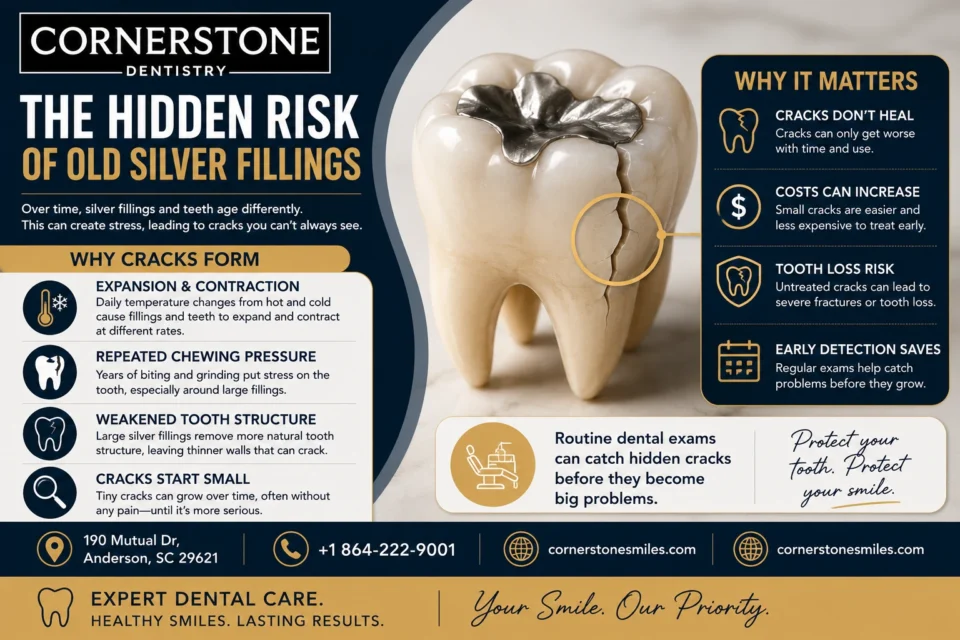
The biggest problem with aging silver fillings isn’t that the filling itself fails. It’s that over time, the tooth around the filling can begin to crack.
And once a crack becomes large enough, the treatment often becomes more expensive, more invasive, and more urgent.
That doesn’t mean every silver filling needs to be replaced.
Many continue functioning well for decades.
But there are some warning signs that may indicate an old filling is placing stress on your tooth and increasing the risk of a fracture.
Let’s look at three of the most common signs dentists watch for and what they may mean for your long-term oral health.
Worried Your Silver Fillings Are Cracking?
Don’t wait for a small crack to become a bigger dental problem. Schedule an evaluation today.
Why Old Silver Fillings Can Create Problems Over Time
Before discussing the warning signs, it helps to understand why silver fillings sometimes contribute to tooth fractures.
Silver fillings, also called amalgam fillings, have been used successfully for more than 150 years.
They’re durable, long-lasting, and have helped save millions of teeth.
The issue isn’t that silver fillings are bad.
The issue is that teeth and fillings age differently.
Unlike modern tooth-colored materials that bond directly to tooth structure, amalgam fillings rely more on mechanical retention.
As years pass, the filling and tooth respond differently to temperature changes from:
- Hot coffee
- Ice water
- Soups
- Cold drinks
- Everyday chewing forces
Over decades, this repeated expansion and contraction can create stress inside the tooth.
Large fillings can act almost like a wedge.
Eventually, tiny cracks may begin forming in the surrounding enamel and dentin.
Many patients don’t realize anything is happening until those small cracks become much larger.
Sign #1: Pain When You Bite Down or Release Pressure
One of the earliest warning signs of a cracked tooth is discomfort during chewing.
Patients often describe it differently:
- “It hurts when I chew nuts.”
- “Sometimes I feel a sharp zing.”
- “I only notice it on certain foods.”
- “The pain comes and goes.”
Interestingly, cracked teeth often hurt more when pressure is released than when it’s applied.
Why?
When a crack exists, chewing can cause the tooth to flex slightly.
As the pressure comes off, the crack can shift microscopically, irritating the nerve inside the tooth.
This creates a brief but noticeable pain.
Why This Matters
Many people ignore occasional biting discomfort because it seems minor.
The problem is that cracks rarely heal on their own.
Unlike a broken bone, a cracked tooth cannot regenerate.
Small cracks can become larger every time the tooth is used.
The earlier the problem is identified, the more treatment options may be available.
Not Every Bite Sensitivity Means a Crack
It’s important to be fair here.
Biting discomfort doesn’t automatically mean an old silver filling is cracking your tooth.
Other possibilities include:
- A high filling
- Tooth grinding
- Gum inflammation
- A cavity
- A damaged crown
That’s why diagnosis matters.
However, when we see bite sensitivity around a large, aging amalgam filling, a crack becomes one of the first things we investigate.
Sign #2: Visible Lines or Fractures Around the Filling
Sometimes the warning signs are visible.
Sometimes they’re not.
During routine exams, dentists frequently discover small fracture lines extending from the edges of old silver fillings.
Patients are often surprised because they never noticed them.
These cracks may appear as:
- Fine dark lines
- Hairline fractures
- Small pieces of missing enamel
- Cracks radiating outward from the filling
In some cases, the filling itself remains completely intact while the surrounding tooth begins to fail.
This distinction is important.
Many patients assume:
“The filling looks fine, so the tooth must be fine.”
Unfortunately, that’s not always true.
The tooth is what we’re trying to protect.
The filling is simply the restoration.
Why Large Silver Fillings Create Greater Risk
The larger the filling, the less natural tooth structure remains.
Imagine a tree trunk.
A small hole drilled into the center may not significantly weaken it.
A much larger hollowed-out section creates a different situation entirely.
The same concept applies to teeth.
Large silver fillings can leave thinner walls of remaining enamel.
Over years of chewing, those walls may become vulnerable to fracture.
This doesn’t mean every large filling is dangerous.
It simply means the risk increases as more natural tooth structure has been replaced.
Sign #3: Sudden Sensitivity to Cold or Sweet Foods
Another common warning sign is new sensitivity.
Patients frequently report:
- Cold drinks suddenly hurt
- Ice cream causes discomfort
- Sweet foods trigger sharp sensations
- Temperature sensitivity seems to be increasing
This can happen for several reasons.
When tiny cracks form, they may allow fluid movement within the tooth.
That movement can stimulate the nerve and create sensitivity.
In other situations, a filling may begin separating slightly from the tooth structure, creating microscopic gaps.
These gaps can allow external stimuli to reach areas of the tooth that were previously protected.
The Key Word: New
Many people have experienced mild sensitivity at some point.
What concerns us more is sensitivity that:
- Recently developed
- Continues worsening
- Appears around older restorations
- Persists after the trigger is removed
These changes often justify a closer evaluation.
What Happens If You Ignore a Cracked Tooth?
This is where treatment decisions become important.
Some cracks remain stable for years.
Others progress rapidly.
The challenge is that predicting which crack will worsen is not always possible.
Potential outcomes include:
Best-Case Scenario
The crack remains small and is treated with a crown before significant damage occurs.
Moderate Scenario
The crack extends deeper and requires root canal treatment plus a crown.
Worst-Case Scenario
The crack travels below the gumline or splits the tooth entirely.
At that point, the tooth may become non-restorable and require extraction.
This is why dentists often recommend treatment before a crack becomes catastrophic.
The goal is preservation, not reaction.
Should Every Silver Filling Be Replaced?
No.
This is one of the biggest misconceptions online.
Some articles make it sound like every silver filling is a ticking time bomb.
That’s simply not true.
Many silver fillings remain functional for decades.
Replacement is usually considered when there are signs of:
- Cracking
- Leakage
- Recurrent decay
- Structural weakness
- Significant wear
A healthy tooth with a stable amalgam filling may not require any intervention.
Replacing fillings unnecessarily removes healthy tooth structure and may create new risks.
For families following changes in preventive dental care, the fluoride ban debate and what SC Bill S. 743 means for kids may also be relevant when considering how fluoride helps protect teeth from decay.
Good dentistry isn’t about replacing everything.
It’s about identifying what actually needs attention.
What Are the Treatment Options?
If an old silver filling is contributing to cracks, treatment depends on the severity of the damage.
For patients dealing with decay around another type of restoration, cavity under a crown: what happens and how it’s treated can help explain how hidden decay is detected and what treatment may involve.
Option 1: Replace the Filling
If the crack is small and the tooth remains structurally sound, replacing the filling may be appropriate.
Modern composite materials bond directly to tooth structure and can help reinforce weakened areas.
Option 2: Dental Crown
For larger cracks or heavily restored teeth, a crown may provide better protection.
Crowns surround the tooth and help reduce stress on weakened areas.
Option 3: Root Canal and Crown
If the crack has irritated or damaged the nerve, root canal treatment may be necessary before placing a crown.
Option 4: Extraction
If the crack extends too deeply, saving the tooth may no longer be possible.
This is typically the outcome dentists hope to avoid through earlier intervention.
How Dentists Detect Cracks Before They Become Emergencies
Cracked teeth aren’t always obvious.
Dentists use several tools to identify them, including:
- Visual examination
- Digital X-rays
- Magnification
- Bite testing
- Intraoral photography
- Symptom evaluation
Often, the diagnosis comes from combining multiple clues rather than finding one obvious fracture.
This is why regular exams remain valuable even when nothing hurts.
Many serious cracks are discovered before symptoms become severe.
The Most Expensive Mistake Patients Make With Old Fillings
The biggest mistake isn’t having silver fillings.
The biggest mistake is assuming an old restoration is fine simply because it isn’t causing pain.
Cracks often develop quietly.
By the time severe pain appears, the treatment options may be more limited and more expensive.
That doesn’t mean you should panic every time you see a silver filling.
It simply means older restorations deserve periodic evaluation, especially if they’re large or several decades old.
The goal isn’t to replace fillings unnecessarily.
The goal is to identify structural problems before a tooth breaks in a way that can’t be repaired.
Don’t Wait Until a Small Crack Becomes a Broken Tooth
One of the advantages of routine dental exams is that they often reveal problems long before patients notice symptoms. A tiny crack today may be manageable with a conservative restoration. The same crack a year or two later could require a crown, root canal, or even extraction.
If you have older silver fillings and you’ve noticed sensitivity, biting discomfort, or visible changes around a restoration, an evaluation can usually determine whether the tooth is stable or beginning to weaken.
At Cornerstone Dentistry in Anderson, Dr. Andrew Wilson and Dr. Dale Hardy help patients assess aging fillings based on the condition of the tooth—not simply the age of the restoration. That allows patients to make informed decisions before a small structural issue becomes a much larger dental problem.
Don’t Ignore Signs of a Cracked Tooth
Aging silver fillings may put extra stress on your teeth. Get them evaluated before the damage worsens.