
Table of Contents
Here’s the honest answer most patients want:
Most dental hygienists tend to prefer electric toothbrushes for themselves and their families — not because manual toothbrushes are bad, but because electric brushes make it easier to brush well every day.
That said, a manual toothbrush can absolutely work if you use it correctly.
At Cornerstone Dentistry in Anderson, SC, this is usually how we explain it:
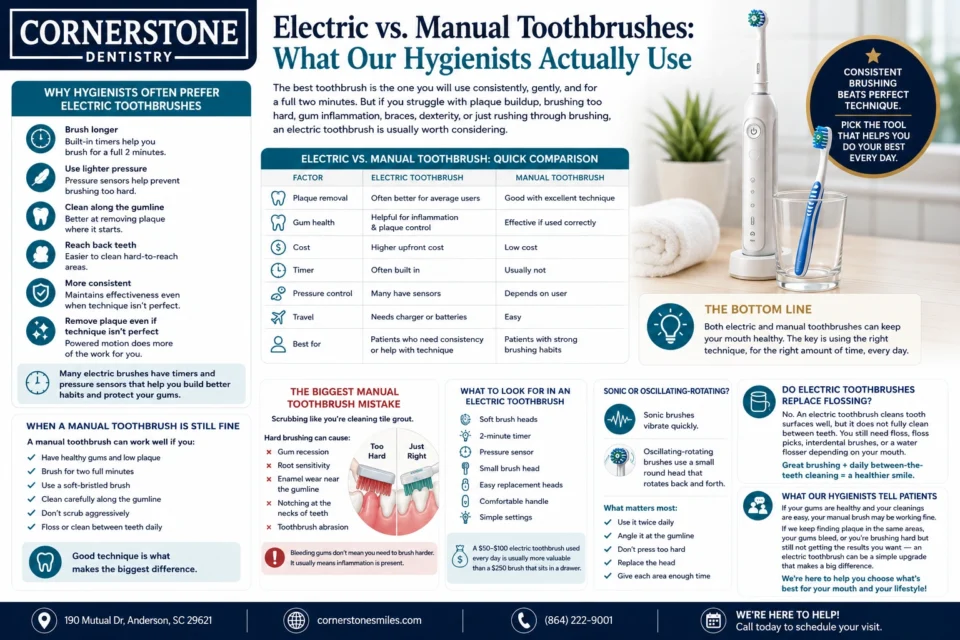
The best toothbrush is the one you will use consistently, gently, and for a full two minutes. But if you struggle with plaque buildup, brushing too hard, gum inflammation, braces, dexterity, or just rushing through brushing, an electric toothbrush is usually worth considering.
Upgrade Your Brushing Routine Today
Book an appointment and get personalized toothbrush guidance from our dental team.
Are Electric Toothbrushes Really Better?
For many people, yes.
Research has found that powered toothbrushes can reduce plaque and gingivitis more than manual toothbrushes, especially brushes with oscillating-rotating movement. Cochrane’s review found powered brushes provided a modest reduction in plaque and gingivitis compared with manual brushing.
But this does not mean every patient needs an expensive toothbrush.
The American Dental Association says either manual or powered toothbrushes can be used effectively, and recommends brushing twice a day for two minutes with a soft-bristled brush. The ADA also recommends replacing the brush or brush head every three to four months, or sooner if the bristles are frayed.
So the real question is not, “Can a manual toothbrush work?”
It can.
The better question is:
Which brush helps you do a better job without damaging your gums?
Why Hygienists Often Like Electric Toothbrushes
Hygienists spend all day seeing the difference between what patients think they are cleaning and what is actually being cleaned.
Electric toothbrushes help because they reduce common brushing mistakes.
They can help with:
- brushing long enough
- using lighter pressure
- cleaning along the gumline
- reaching back teeth
- staying more consistent
- removing plaque when technique is not perfect
Many electric brushes also have built-in timers and pressure sensors. Those two features alone can make a big difference for patients who brush too quickly or scrub too hard.
When a Manual Toothbrush Is Still Fine
A manual toothbrush is not “wrong.”
It may be perfectly fine if you:
- have healthy gums
- do not build up much plaque
- brush for two full minutes
- use a soft-bristled brush
- clean carefully along the gumline
- do not scrub aggressively
- floss or clean between your teeth daily
Some patients with excellent home care use manual brushes and do beautifully.
The problem is that many people brush too fast, too hard, or miss the same areas every day.
The Biggest Manual Toothbrush Mistake
The biggest mistake is not using a manual brush.
It is scrubbing like you are cleaning tile grout.
Hard brushing can contribute to:
- gum recession
- root sensitivity
- enamel wear near the gumline
- notching at the necks of teeth
- toothbrush abrasion
Patients sometimes think bleeding gums mean they need to brush harder. Usually, the opposite is true. Bleeding often means inflammation is present, and the goal is careful, consistent plaque removal — not more force.

Who Benefits Most From an Electric Toothbrush?
An electric toothbrush is especially helpful for patients with:
- gum inflammation
- frequent plaque buildup
- periodontal disease history
- braces or clear aligner attachments
- dental implants
- crowns or bridges
- arthritis or limited hand movement
- sensitivity from brushing too hard
- a habit of rushing
- kids or teens who need help brushing better
For patients with limited dexterity, an electric brush can make good home care much easier. The ADA notes that both manual and powered toothbrushes can be effective, but in real life, powered brushes often help when technique is the issue.
Electric vs. Manual Toothbrush: Quick Comparison
| Factor | Electric toothbrush | Manual toothbrush |
| Plaque removal | Often better for average users | Good with excellent technique |
| Gum health | Helpful for inflammation and plaque control | Effective if used correctly |
| Cost | Higher upfront cost | Low cost |
| Timer | Often built in | Usually not |
| Pressure control | Many have sensors | Depends on user |
| Travel | Needs charger or batteries | Easy |
| Best for | Patients who need consistency or help with technique | Patients with strong brushing habits |
What Should You Look For in an Electric Toothbrush?
You do not need the most expensive model.
For most patients, the useful features are:
- soft brush heads
- two-minute timer
- pressure sensor
- small brush head
- easy replacement heads
- comfortable handle
- simple settings
The extra app, Bluetooth tracking, and fancy modes may be nice, but they are not necessary for most people.
A $50 to $100 electric toothbrush used every day is usually more valuable than a $250 brush that sits in a drawer.
Sonic or Oscillating-Rotating?
Both can work.
Sonic brushes vibrate quickly. Oscillating-rotating brushes use a small round head that rotates back and forth.
Some research has shown strong results for oscillating-rotating powered toothbrushes, especially for plaque and gingivitis reduction.
But for most patients, the brand or motion type matters less than:
- using it twice daily
- angling it at the gumline
- not pressing too hard
- replacing the head
- giving each area enough time
Do Electric Toothbrushes Replace Flossing?
No.
This is one of the most common misunderstandings.
An electric toothbrush cleans tooth surfaces well, but it does not fully clean between teeth where the teeth touch. You still need floss, floss picks, interdental brushes, or a water flosser depending on your mouth.
A great toothbrush with no between-the-teeth cleaning still leaves plaque behind.
What Our Hygienists Usually Tell Patients
If your gums are healthy and your cleanings are easy, your manual brush may be working fine.
If your hygienist keeps finding plaque in the same areas, your gums bleed, or you are brushing hard but still not getting clean, an electric toothbrush is usually a smart upgrade.
Not because it is trendy.
Because it helps remove more of the daily guesswork.
The Bottom Line
Electric toothbrushes are usually easier for most people to use well. Manual toothbrushes can work if your technique is excellent.
If you are choosing between the two, here is the simplest advice:
- Use a soft-bristled brush
- Brush twice a day for two minutes
- Do not scrub hard
- Replace the brush or head every three to four months
- Clean between your teeth daily
- Ask your hygienist where you are missing plaque
At Cornerstone Dentistry in Anderson, our hygienists can usually tell pretty quickly whether your current toothbrush is doing the job. Sometimes the answer is, “Keep doing what you’re doing.” Other times, switching to electric makes home care easier, cleaner, and gentler.
Electric or Manual? Ask the Pros
Call now to learn what our hygienists recommend for a cleaner, healthier smile.