
Table of Contents
If you’ve been told you need a dental crown, one of the first questions you probably have is:
“Why does the price vary so much?”
And honestly, it’s a fair question.
Patients in Anderson often see crown estimates anywhere from about $900 to $1,800 per tooth, sometimes even more depending on the situation. That can feel confusing — especially when online searches make crowns sound like a simple, standardized procedure.
They’re not.
A dental crown is more like a custom restoration than an off-the-shelf product. Two people can both “need a crown” and have completely different treatment complexity, materials, lab work, insurance coverage, and long-term goals.
Here’s what we usually tell patients at Cornerstone Dentistry:
The cheapest crown is not always the best value — but the most expensive option is not automatically necessary either.
The right crown depends on the tooth, your bite, the condition of the tooth underneath, your cosmetic goals, and how long you want the restoration to last.
Let’s break down what actually changes the cost of a dental crown in Anderson, South Carolina — and when paying more may (or may not) make sense.
Need a Dental Crown in Anderson?
Understand your options, costs, and best treatment path. Book your appointment now.
The Short Answer: Why Crown Prices Vary
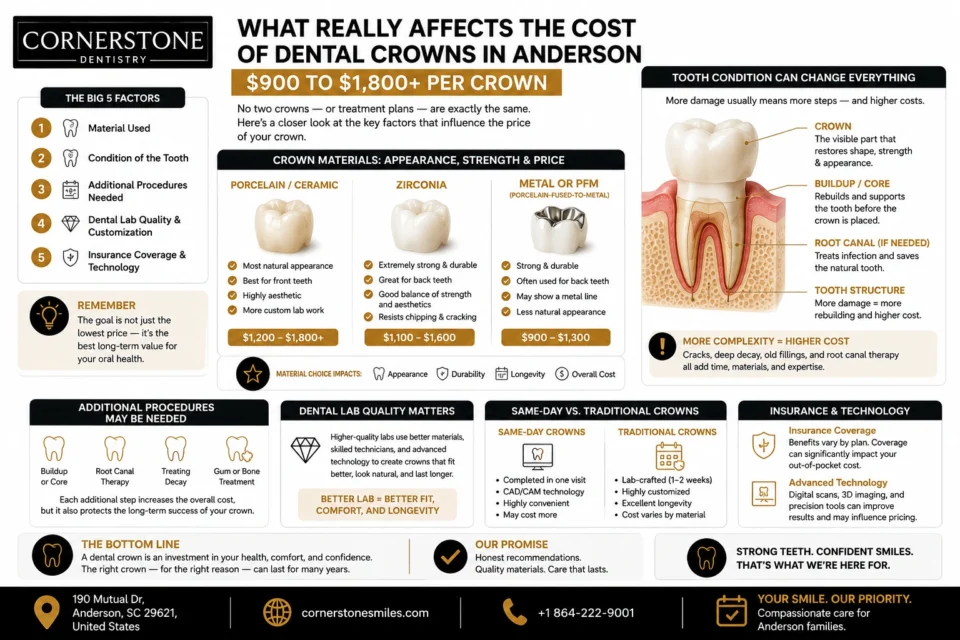
Most dental crown pricing comes down to five things:
- The material used
- How damaged the tooth is
- Whether additional procedures are needed
- The quality of the dental lab and customization
- Insurance coverage and office technology
A simple crown on a back tooth with minimal damage may cost closer to the lower end of the range.
A highly cosmetic front-tooth crown with extensive rebuilding, digital scanning, and premium ceramic materials may land toward the higher end.
The important thing is understanding what you’re actually paying for.
What Is a Dental Crown, Exactly?
A crown is essentially a custom-made cap that covers and protects a damaged tooth.
Dentists typically recommend crowns when a tooth is:
- cracked
- heavily filled
- weakened after a root canal
- severely worn down
- broken
- structurally compromised
- cosmetically damaged
The goal is usually to preserve the tooth rather than remove it.
In many cases, a crown allows patients to avoid an extraction or implant.
The Biggest Factor: Crown Material
Not all crowns are made from the same material.
And material choice can dramatically affect price, appearance, and longevity.
Porcelain or Ceramic Crowns
These are popular for front teeth because they look the most natural.
They mimic real enamel better than other materials and reflect light naturally.
Typically higher cost because:
- they require more detailed customization
- esthetics matter more
- lab work is often more advanced
- shade matching is more precise
These are often in the $1,200–$1,800+ range depending on complexity.
Zirconia Crowns
Zirconia has become very common because it’s extremely strong and still looks good cosmetically.
Many dentists now use zirconia for back molars because it handles heavy chewing forces well.
Pros:
- very durable
- less likely to chip
- good for grinders/clenchers
- more natural-looking than older metal crowns
Downsides:
- may look slightly less translucent than premium porcelain
- can be more difficult to adjust
Pricing often falls somewhere in the middle-to-upper range.
Metal or Porcelain-Fused-to-Metal Crowns
These used to be more common years ago.
They can still work well in certain situations, especially on back teeth.
Sometimes they cost less, but not always.
Many patients today simply prefer more natural-looking materials.
The Condition of the Tooth Matters More Than Patients Realize
Two crowns may look identical when finished, but one tooth may require significantly more work underneath.
This is where pricing often changes.
A Tooth With Minimal Damage
If the tooth is mostly intact, the process is usually simpler:
- less rebuilding
- easier preparation
- more predictable fit
That generally lowers overall treatment complexity.
A Tooth That Is Cracked or Severely Broken
Things become more complicated when:
- decay extends below the gumline
- old fillings are failing
- the tooth is fractured
- there isn’t enough healthy structure left
In these cases, dentists often need to rebuild the tooth before placing the crown.
That may involve:
- a buildup
- a core foundation
- replacing old decay
- stabilizing weakened areas
This adds time, materials, and complexity.
Why Does My Crown Feel Weird When I Bite Down? Causes and Fixes
Written and medically reviewed by Dr. Andrew Wilson, DMD, Cornerstone Dentistry, Anderson. Last updated September 2026. Quick answer: If your…
Learn More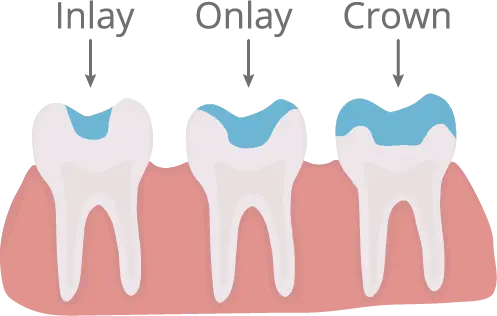
Root Canals Often Increase Total Cost
Many patients assume the crown itself is expensive when the larger expense is actually the treatment before the crown.
For example:
A tooth needing:
- root canal therapy
- buildup
- post placement
- crown
…will cost substantially more overall than a straightforward crown alone.
And sometimes patients see a large estimate without realizing several procedures are bundled together.
Cosmetic Expectations Can Raise the Price
Front teeth usually require more artistry than back teeth.
This is especially true if:
- you have very visible teeth when smiling
- you want exact shade matching
- you have translucency variations
- you want symmetry with surrounding teeth
A highly esthetic front crown may involve:
- custom layering
- premium ceramics
- detailed lab communication
- additional adjustments
That level of customization takes more work than a standard molar crown.
The Dental Lab Matters More Than Most Patients Know
This is one of the least discussed pricing factors.
Some crowns are mass-produced through large discount labs.
Others are handcrafted through higher-end dental labs with advanced technicians.
That difference can affect:
- fit
- comfort
- bite alignment
- appearance
- longevity
A poorly fitting crown may lead to:
- gum irritation
- bite pain
- food trapping
- repeated adjustments
- premature failure
Here’s the reality:
Better labs usually cost dental offices more money.
But they can also create crowns that feel more natural and last longer.
Same-Day Crowns vs. Traditional Crowns
Some offices use same-day crown technology with in-office milling systems.
Others use outside labs.
Neither is automatically better.
Same-Day Crowns
Benefits:
- fewer visits
- no temporary crown
- faster treatment
Possible downsides:
- material limitations in some cases
- less external lab artistry for cosmetic cases
Traditional Lab Crowns
Benefits:
- often more customization
- excellent for cosmetic detail
- more material options
Downsides:
- requires temporary crown
- two appointments
- longer turnaround
Different offices invest differently in technology, which can affect pricing.
Insurance Complicates Crown Pricing
This is where many patients become frustrated.
A dental insurance plan may say it “covers crowns,” but that does not necessarily mean:
- the crown is fully covered
- every material is covered
- the office is in-network
- annual maximums are sufficient
Many dental plans still have annual maximums around $1,000–$1,500, which has not kept pace with modern dentistry costs.
So even with insurance, patients may still owe a significant portion.
Why One Office May Charge More Than Another
Patients sometimes compare crown pricing the same way they compare gas stations.
But dentistry is not a commodity.
Different offices may vary in:
- experience
- technology
- lab quality
- appointment time
- materials
- warranty policies
- diagnostic approach
- continuing education
A lower fee does not automatically mean poor care.
But extremely low pricing sometimes means corners are being cut somewhere:
- cheaper materials
- rushed appointments
- lower-cost labs
- less customization
- less comprehensive diagnosis
That matters more with dentistry because the work stays in your mouth for years.
Is a More Expensive Crown Worth It?
Sometimes yes.
Sometimes no.
Here’s how we usually frame it for patients.
Paying More Often Makes Sense When:
- the tooth is highly visible
- you grind your teeth
- you want maximum longevity
- the tooth is structurally compromised
- cosmetic detail matters
- you’ve had crowns fail before
A Lower-Cost Option May Be Reasonable When:
- the tooth is less visible
- the situation is straightforward
- esthetics are less important
- budget is a major concern
- the tooth has uncertain long-term prognosis
There is not always one “correct” answer.
Good dentistry should involve discussing tradeoffs honestly.
The Cheapest Crown Can Become the Most Expensive
This is important.
When crowns fail early, patients often pay twice:
- once for the original crown
- again for replacement treatment
And sometimes failed crowns lead to:
- root canals
- fractures
- extractions
- implants
That does not mean every premium-priced crown is automatically better.
But it does mean long-term value matters more than upfront price alone.
When a Crown May Not Be Necessary
This is another important conversation patients appreciate hearing.
Not every damaged tooth automatically needs a crown.
Sometimes:
- a filling is sufficient
- bonding may work
- monitoring is reasonable
- conservative treatment makes more sense
Other times, delaying a needed crown significantly increases fracture risk.
The recommendation depends on:
- remaining tooth structure
- bite forces
- crack patterns
- decay extent
- long-term predictability
A good exam and x-rays usually clarify this fairly quickly.
Questions Worth Asking Before Getting a Crown
Patients in Anderson often feel more confident when they ask:
- What material do you recommend and why?
- How long should this crown realistically last?
- What happens if I wait?
- Is this tooth at risk of cracking further?
- Is there a lower-cost alternative?
- What does insurance actually cover?
- Will I likely need a root canal later?
- Do you use a local or outside dental lab?
Those are smart questions — not difficult ones.
The Bottom Line
Dental crowns vary from $900 to $1,800 in Anderson because the treatment itself varies dramatically from patient to patient.
The material, tooth condition, cosmetic demands, lab quality, technology, and insurance coverage all influence the final cost.
The goal should not simply be finding the cheapest crown.
It should be understanding:
- what you’re paying for
- what risks exist
- how long the restoration is likely to last
- whether the recommendation makes sense for your situation
At Cornerstone Dentistry, Dr. Andrew Wilson and Dr. Dale Hardy spend a lot of time helping patients understand those tradeoffs before moving forward with treatment.
Because most patients are not just buying a crown.
They’re trying to make a confident long-term decision about their health, comfort, and budget.
Wondering Why Dental Crown Costs Vary?
Get clear answers and trusted crown treatment from an Anderson dental team. Call today to schedule your visit.