
Table of Contents
If you’re missing a tooth, the first question is usually simple:
“Should I get an implant or a bridge?”
The second question is usually more honest:
“Which one is going to cost me less in the long run?”
Here’s the practical answer:
A dental bridge often costs less upfront. A dental implant often has better long-term value over 15 years — if you’re a good candidate and it heals well.
Nationally, a single dental implant with the implant, abutment, and crown often falls around $3,000–$6,000+, while a traditional bridge can vary widely depending on the number of teeth involved and materials.
But upfront cost is only part of the story.
A bridge may need replacement within that 15-year window. An implant crown may also need repair or replacement, but the implant post itself can often last much longer when healthy and well maintained. The ADA describes implants as a long-term tooth replacement option and notes that bridges usually require removing some healthy tooth structure from neighboring teeth.
Let’s compare this the way patients actually need to think about it.
Don't Wait to Replace a Missing Tooth
Protect your oral health with a customized tooth replacement plan. Call now to book your consultation.
The Simple 15-Year Cost Picture
For one missing tooth, the comparison often looks something like this:
| Option | Typical Upfront Cost | Possible 15-Year Costs | Main Financial Risk |
| Traditional bridge | Often lower | Replacement, decay under crowns, future root canals | Neighboring teeth may become involved |
| Dental implant | Often higher | Crown replacement, maintenance, possible grafting | Higher surgical cost upfront |
A bridge may look better financially on day one.
An implant may look better financially by year 10 or 15.
That’s the part patients often miss.
What Is a Dental Bridge?
A traditional dental bridge replaces a missing tooth by using the teeth on both sides as anchors.
Those anchor teeth are prepared for crowns, and the replacement tooth is attached between them.
A bridge can make sense when:
- the neighboring teeth already need crowns
- surgery is not a good option
- cost needs to be lower upfront
- bone levels are not ideal for an implant
- the patient wants a faster solution
The downside:
A bridge usually requires reshaping the teeth next to the missing tooth.
If those teeth are already heavily filled or damaged, that may not be a major issue.
But if they are healthy, dentists are more cautious.
Here’s what we usually tell patients at Cornerstone Dentistry:
A bridge can be a very good treatment. But it turns a one-tooth problem into a three-tooth restoration.
That does not make it wrong.
It just means the tradeoff should be clear.
What Is a Dental Implant?
A dental implant replaces the missing tooth root with a small titanium or ceramic post placed in the jawbone.
After healing, a crown is attached to the implant.
An implant can make sense when:
- the neighboring teeth are healthy
- the patient wants a long-term option
- there is enough bone
- the bite is stable
- the patient can tolerate a surgical procedure
- oral hygiene is good
The downside:
Implants cost more upfront and take longer.
They may require:
- 3D imaging
- bone grafting
- extraction site healing
- surgery
- several months of integration
- implant crown placement
So while implants are often excellent long-term dentistry, they are not “quick and cheap.”
The 15-Year Cost Difference Most Patients Miss
Let’s say a patient chooses a bridge because it costs less upfront.
That may be completely reasonable.
But over 15 years, several things can happen:
- the bridge may wear out
- porcelain may chip
- decay may form under one of the supporting crowns
- one anchor tooth may need a root canal
- the bridge may need replacement
- one supporting tooth may eventually fail
That is the hidden financial risk.
With an implant, the neighboring teeth are left alone.
That is one of the biggest long-term advantages.
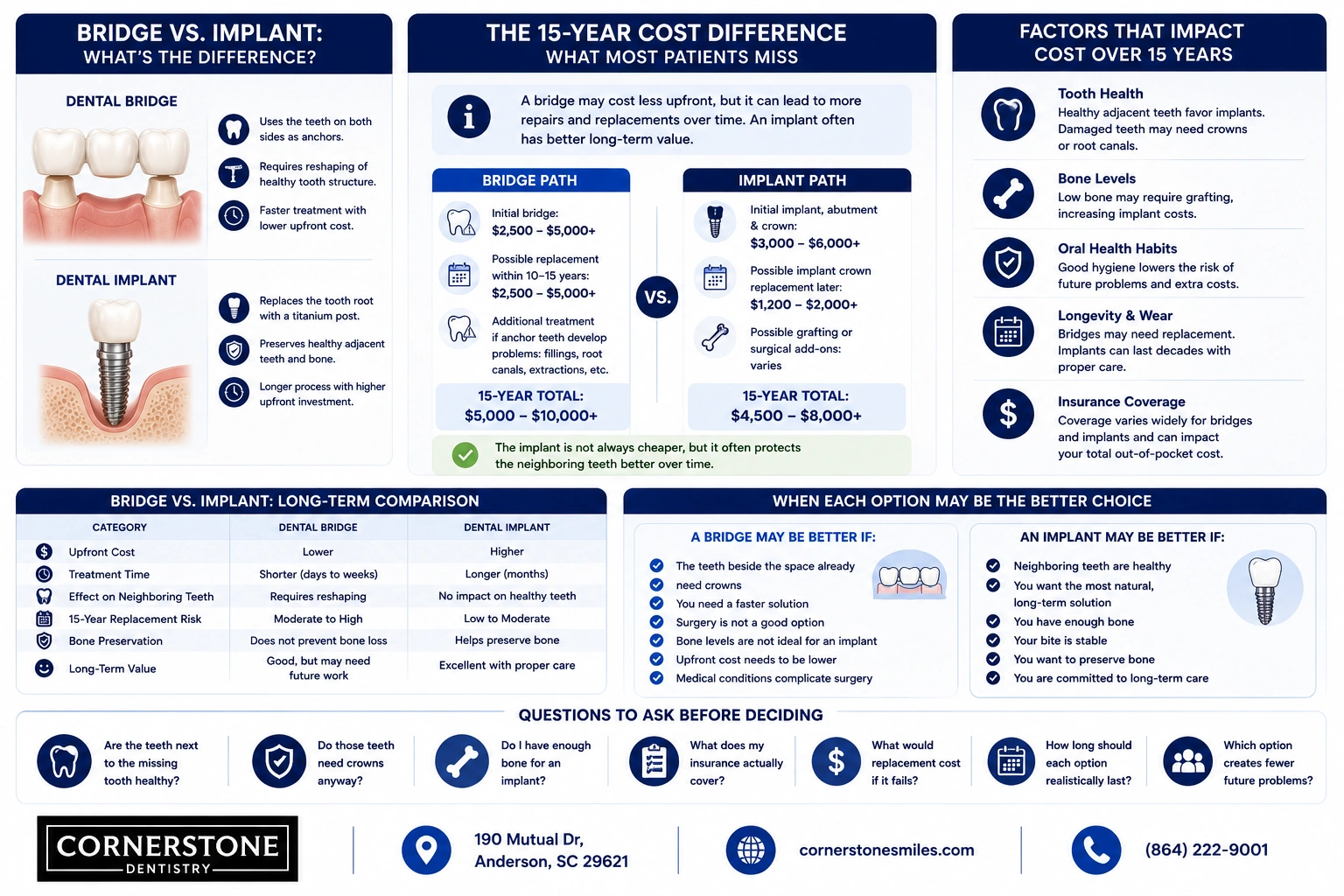
Example: Bridge vs. Implant Over 15 Years
This is only a simplified example, not a quote.
Bridge Path
Initial bridge:
$2,500–$5,000+
Possible replacement within 10–15 years:
another $2,500–$5,000+
Possible additional treatment if anchor teeth develop problems:
fillings, root canals, buildups, or extractions
15-year total:
Potentially $5,000–$10,000+
Implant Path
Initial implant, abutment, and crown:
$3,000–$6,000+
Possible implant crown replacement later:
$1,200–$2,000+
Possible grafting or surgical add-ons:
varies
15-year total:
Potentially $4,500–$8,000+
The implant is not always cheaper.
But it often protects the neighboring teeth better.
That can matter a lot over time.
When a Bridge May Actually Be the Better Choice
Implants are not automatically better for every patient.
A bridge may be the smarter option if:
- the teeth beside the space already need crowns
- the patient has medical conditions that complicate surgery
- bone grafting would make the implant too expensive
- the patient wants treatment completed faster
- finances make implant treatment unrealistic
- the missing tooth area has poor bone support
- the patient smokes heavily or has uncontrolled gum disease
A good bridge is not a “second-rate” option.
It can be reliable, comfortable, and attractive.
The key is choosing it for the right reasons.
Dental Implants and Long-Term Facial Structure
Most people think dental implants are just about filling a gap. But there’s more going on beneath the surface. When…
Learn More
When an Implant May Be Worth the Higher Upfront Cost
An implant is often worth considering when:
- the adjacent teeth are healthy
- the patient wants to avoid grinding down natural teeth
- the patient is younger or expects decades of use
- the bite is strong and stable
- the missing tooth is in a chewing-heavy area
- the patient wants the most tooth-like replacement possible
For many patients, the biggest implant benefit is not just replacing the missing tooth.
It is avoiding damage to the teeth next door.
Insurance Can Change the Decision
Dental insurance often complicates this comparison.
Some plans help with bridges more predictably than implants.
Some plans cover implant crowns but not implant surgery.
Some have waiting periods.
Some have annual maximums that are too low to make a major dent in either option.
That means a treatment that is “covered” may still leave a patient with a significant balance.
This is why patients should ask:
- Does my plan cover implants?
- Does it cover bridges?
- Is there a missing tooth clause?
- Is there a waiting period?
- What is my annual maximum?
- Will the crown portion be covered?
- What happens if I need grafting?
Insurance does not always line up with the best long-term dental decision.
The Biggest Mistake: Choosing Only by Upfront Price
This is where patients can accidentally spend more.
A cheaper bridge may work beautifully.
But a cheaper choice becomes expensive when it leads to repeated repairs, failed supporting teeth, or eventual implant treatment anyway.
On the other hand, choosing an implant when the prognosis is poor can also waste money.
That can happen with:
- uncontrolled gum disease
- heavy smoking
- poor home care
- inadequate bone
- severe grinding
- untreated bite problems
The best option is not the one with the flashiest promise.
It is the one with the best long-term odds for your mouth.
Questions to Ask Before Deciding
Before choosing between an implant and a bridge, ask:
- Are the teeth next to the missing tooth healthy?
- Would those teeth need crowns anyway?
- Do I have enough bone for an implant?
- Would I need a bone graft?
- How long should each option realistically last?
- What would replacement cost if it fails?
- What does my insurance actually cover?
- Which option creates fewer future problems?
Those questions usually make the decision much clearer.
The Bottom Line
Over 15 years, dental implants often provide better long-term value, especially when the teeth beside the missing tooth are healthy.
But bridges still make sense in many situations.
A bridge may be better when cost, timing, medical concerns, or neighboring tooth condition make implant treatment less practical.
An implant may be better when you want to preserve healthy teeth and reduce the chance of turning one missing tooth into a larger dental problem.
At Cornerstone Dentistry in Anderson, Dr. Andrew Wilson and Dr. Dale Hardy help patients compare these options based on the tooth, the bite, the budget, and the long-term risk — not just the price on day one.
Missing a Tooth? Choose the Right Long-Term Solution
Get expert guidance on dental implants and bridges. Call today to schedule your personalized consultation.