
Table of Contents
options.
On one side, there are dental offices offering professional whitening treatments that may cost several hundred dollars. On the other, there are mall kiosks advertising dramatic results in a single visit for a fraction of the price.
It’s a fair question:
If both claim to whiten your teeth, why is there such a big difference in cost?
Many patients in Anderson ask us this before deciding whether whitening is worth it. Some have already tried over-the-counter products, while others are comparing professional whitening to what they’ve seen advertised at malls, spas, salons, or online.
Here’s what we usually tell patients:
The cheapest whitening option isn’t always the least expensive in the long run, and the most expensive option isn’t always necessary.
The real question is whether you’re paying for stronger whitening, safer treatment, longer-lasting results, or simply marketing.
Let’s break down what whitening actually costs, what you’re getting for your money, and how to decide which option makes sense for you.
Ready for a Brighter Smile That Lasts?
Skip temporary results. Schedule professional teeth whitening for a safer, longer-lasting smile.
The Short Answer: Professional Whitening Usually Costs More Because It’s Customized
In most cases:
| Whitening Option | Typical Cost Range |
| Whitening toothpaste | $5-$20 |
| Whitening strips | $25-$70 |
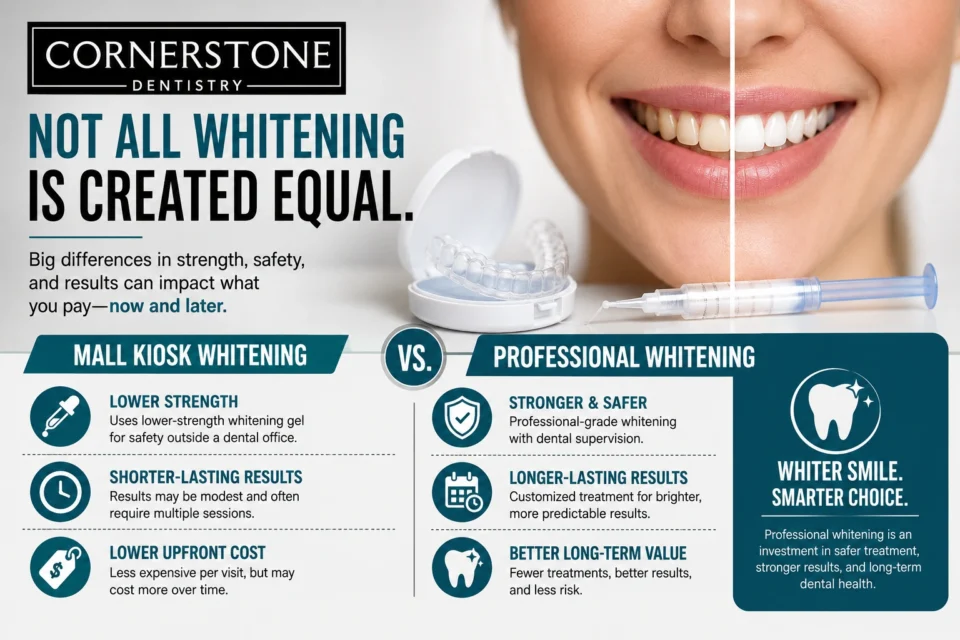
| Mall kiosk whitening | $75-$250 |
| Store-bought LED kits | $50-$200 |
| Professional take-home whitening | $250-$500 |
| In-office professional whitening | $400-$900+ |
At first glance, mall kiosks often appear to offer the best value.
But cost alone doesn’t tell the whole story.
The biggest differences usually involve:
- Strength of whitening ingredients
- Safety of application
- Supervision by dental professionals
- Ability to address sensitivity
- Longevity of results
- Whether existing dental work is considered
- Overall predictability
A lower price may be reasonable if you’re looking for minor improvement. It may be less attractive if you end up paying for multiple treatments that never achieve the results you wanted.
What Are Mall Whitening Kiosks Actually Selling?
Most mall whitening businesses focus on convenience and affordability.
The typical process involves:
- A brief consultation
- Application of a whitening gel
- Exposure to an LED light
- A treatment lasting 20-60 minutes
The appeal is obvious:
- No dental appointment
- Lower upfront cost
- Immediate treatment
- Fast marketing claims
For some people, these treatments can produce visible whitening.
However, there are limitations that aren’t always obvious from the advertising.
Many kiosks use lower-strength whitening agents than dental offices because they operate outside a traditional dental setting.
That doesn’t automatically make them ineffective.
It does mean the results may be more modest and may require additional treatments to maintain.
Why Professional Whitening Costs More
When whitening is performed through a dental office, you’re paying for more than whitening gel.
You’re also paying for evaluation, customization, safety, and oversight.
Before recommending whitening, dentists typically evaluate:
- Existing fillings
- Crowns and veneers
- Gum health
- Tooth sensitivity
- Areas of enamel wear
- Sources of discoloration
This matters because not every stain responds to whitening.
For example:
Surface Stains
Often caused by:
- Coffee
- Tea
- Red wine
- Tobacco
These typically respond well to whitening.
Internal Discoloration
May result from:
- Trauma
- Certain medications
- Developmental conditions
- Aging changes inside the tooth
These stains can be much more difficult to improve.
A patient may spend money on multiple whitening treatments without realizing their particular discoloration isn’t likely to respond well.
That’s one reason professional evaluation can be valuable.
The Hidden Cost of Whitening That Doesn’t Work
One of the biggest misconceptions about whitening is that cheaper always saves money.
Sometimes it does.
Sometimes it doesn’t.
Consider two scenarios.
Scenario 1
A patient spends:
- $150 at a mall kiosk
- $150 for another session
- $60 on whitening products afterward
Total investment: $360
Result: moderate improvement but still dissatisfied.
Scenario 2
A patient spends:
- $450 on professional whitening
Total investment: $450
Result: achieves desired outcome with one treatment plan.
The second option costs more upfront but may cost less frustration, less time, and fewer repeat purchases.
That’s why comparing whitening options purely by price can be misleading.
Does the LED Light Actually Matter?
This is one of the most common questions patients ask.
The answer is:
Usually less than the advertising suggests.
Many whitening systems prominently feature blue LED lights.
The light can play a role in some systems, but the whitening gel generally does the majority of the work.
The concentration of active ingredients and the length of exposure often matter more than the light itself.
Patients sometimes assume the light is the reason for dramatic results when, in reality, the whitening chemistry is doing most of the heavy lifting.
This doesn’t mean LED systems are a gimmick.
It simply means the light alone isn’t what determines whether a whitening treatment succeeds.
Why Some People Experience Sensitivity After Whitening
Sensitivity is one of the biggest concerns surrounding whitening treatments.
Temporary sensitivity can occur with:
- Mall whitening
- Store-bought products
- Professional whitening
The difference is often how the sensitivity is managed.
Professional whitening programs can often be adjusted by:
- Changing gel concentration
- Modifying wear time
- Using desensitizing products
- Creating customized treatment schedules
Mall kiosks and retail products generally provide less flexibility.
For patients who already struggle with sensitive teeth, this distinction can be important.
What About Whitening If You Have Crowns or Veneers?
This is an area where many consumers are surprised.
Whitening only affects natural tooth structure.
It does not whiten:
- Crowns
- Veneers
- Composite fillings
- Bonding material
Imagine someone has a crown on a front tooth.
They whiten their surrounding teeth several shades lighter.
Now the crown may appear darker by comparison.
That’s not necessarily a problem if it’s planned for.
But it can create cosmetic concerns if the patient wasn’t aware beforehand.
This is one reason dental evaluation is often helpful before beginning whitening treatment.
Which Option Lasts Longer?
The honest answer is that whitening longevity depends heavily on the individual.
Factors include:
- Coffee consumption
- Tea consumption
- Smoking
- Vaping
- Red wine intake
- Oral hygiene habits
- Genetics
- Age
That said, professionally guided whitening programs often include maintenance strategies that help results last longer.
These may include:
- Custom whitening trays
- Touch-up treatments
- Personalized instructions
- Periodic maintenance schedules
Mall whitening treatments may improve color initially, but some patients find themselves returning more frequently to maintain results.
When Mall Whitening May Be a Reasonable Choice
Not everyone needs professional whitening.
A mall kiosk may make sense if:
- You want a modest improvement
- Your teeth are generally healthy
- You have minimal sensitivity
- You understand the limitations
- You are comfortable with less supervision
For some people, this is entirely reasonable.
There is no rule that everyone needs the highest-end whitening treatment available.
When Professional Whitening Is Usually Worth Considering
Professional whitening often makes the most sense when:
- You have significant discoloration
- You have crowns or veneers
- You have sensitive teeth
- You want predictable results
- You have experienced whitening failure before
- You are preparing for a wedding, reunion, or major event
- You want the most dramatic improvement possible
In these situations, the additional cost may provide meaningful value.
The Most Expensive Whitening Mistake
The costliest mistake we see isn’t choosing a mall kiosk.
It’s assuming all discoloration responds the same way.
Some stains whiten beautifully.
Others may require:
- Bonding
- Veneers
- Crowns
- Internal bleaching
- Alternative cosmetic treatments
Patients sometimes spend hundreds of dollars trying whitening after whitening without understanding why the color isn’t changing.
A professional evaluation can often identify that issue before additional money is spent.
How to Decide Which Whitening Option Is Right for You
If your primary goal is affordability and you’re comfortable with modest improvement, a mall kiosk may be worth exploring.
If your goal is maximum whitening, predictable results, and personalized treatment, professional whitening is usually the stronger option.
The right choice depends less on the advertised price and more on:
- Your current tooth color
- Your cosmetic goals
- Your sensitivity level
- Existing dental work
- How long you want results to last
The cheapest whitening option is not always the best value.
The most expensive option is not always necessary.
The best choice is the one that helps you achieve the result you actually want.
Before You Spend Money on Whitening, Find Out What Will Actually Work
One of the most valuable things a whitening consultation can provide is clarity.
Sometimes whitening is exactly the right solution. Sometimes another cosmetic option will produce a better result. And sometimes patients discover their teeth are already close to the maximum shade whitening can achieve.
If you’re considering whitening and aren’t sure which option makes sense, an exam can help identify what’s causing the discoloration, what kind of results are realistic, and whether professional treatment is likely to be worth the investment.
At Cornerstone Dentistry in Anderson, Dr. Andrew Wilson and Dr. Dale Hardy help patients understand their cosmetic options without pressure, so they can make confident decisions about their smile and their budget.
Don't Waste Money on Short-Term Whitening
Get expert whitening treatment designed for noticeable results and a healthier smile.