
Table of Contents
If you’ve ever sat in a dental office and thought, “Wait a minute—I have Delta Dental. Why am I still paying out of pocket?” you’re not alone.
In fact, this is one of the most common frustrations we hear from patients in Anderson and throughout Upstate South Carolina.
Many people assume dental insurance works like medical insurance. They expect that if they have coverage, most—or all—of their treatment should be paid for. Then they receive an estimate for a crown, root canal, implant, or even a filling and discover they still owe hundreds or sometimes thousands of dollars.
The reality is that most dental insurance plans, including many Delta Dental plans, were never designed to cover 100% of dental care.
Here’s what we usually tell patients: dental insurance is better viewed as a financial assistance plan than a comprehensive health insurance plan.
Understanding why can help you avoid surprises and make better decisions about your dental health.
Questions About Your Dental Coverage?
Don’t wait until you receive the bill to understand your benefits. Call now to learn how your Delta Dental plan applies to your care.
The Short Answer: Delta Dental Was Designed to Share Costs, Not Eliminate Them
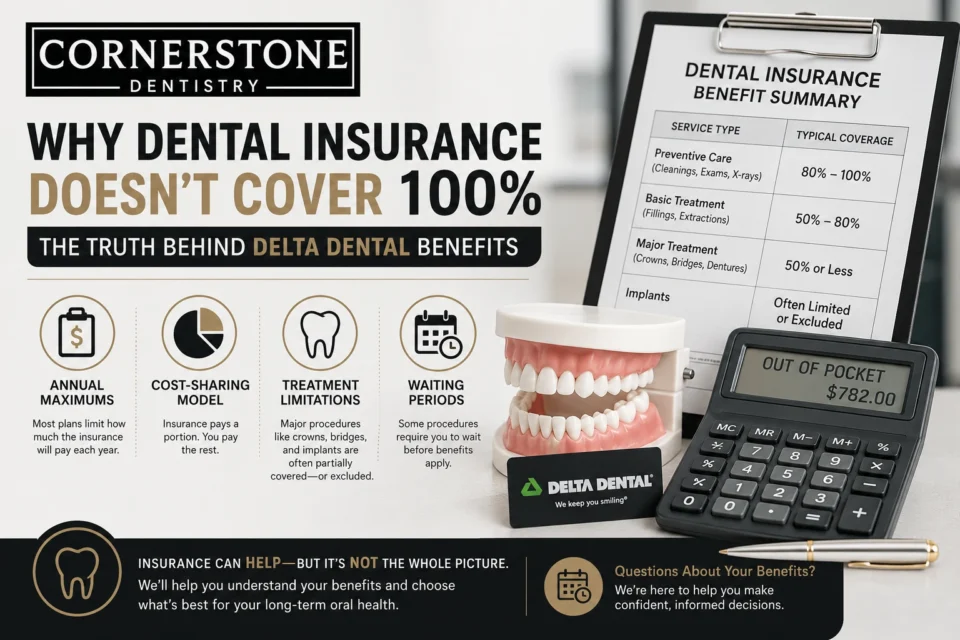
Most Delta Dental plans operate on a cost-sharing model.
That means:
- The insurance company pays a portion.
- The patient pays a portion.
- Annual maximums limit how much the insurance company contributes.
- Certain treatments may be partially covered or not covered at all.
Even patients with what they consider “good insurance” often discover there are limits once treatment is needed.
This isn’t unique to Delta Dental.
Most dental insurance carriers use a similar structure.
The biggest difference is that many patients don’t realize these limitations until they need significant dental work.
Why Dental Insurance Is Different Than Medical Insurance
One of the biggest misconceptions we see is comparing dental insurance to health insurance.
Medical insurance is designed primarily to protect patients from catastrophic expenses.
Dental insurance was originally designed to encourage preventive care while helping offset some treatment costs.
Many dental plans haven’t fundamentally changed their annual maximums in decades.
Meanwhile:
- Dental materials have improved.
- Technology has improved.
- Treatment options have expanded.
- Costs have increased.
Insurance benefits often have not kept pace.
As a result, patients sometimes feel like insurance is covering less than expected, even when the plan is technically functioning exactly as designed.
Understanding the Typical Delta Dental Coverage Structure
While every employer plan is different, many Delta Dental plans follow a similar pattern.
| Service Type | Typical Coverage |
| Preventive care (cleanings, exams, x-rays) | 80% to 100% |
| Basic treatment (fillings, simple extractions) | 50% to 80% |
| Major treatment (crowns, bridges, dentures) | 50% or less |
| Implants | Often limited or excluded |
This structure is why patients are often surprised.
Their routine cleaning may be covered completely, but when they need a crown, insurance may only pay a portion of the cost.
The Annual Maximum Most Patients Don’t Know About
If there is one thing we wish every dental patient understood, it’s the annual maximum.
Most Delta Dental plans have a yearly maximum benefit.
This is the total amount the insurance company will pay during a calendar year.
Many plans still have annual maximums ranging from:
- $1,000
- $1,250
- $1,500
- $2,000
After that amount is reached, additional treatment becomes the patient’s responsibility.
Here’s where confusion happens.
A patient may need:
- A crown
- Two fillings
- A root canal
All in the same year.
Even if those procedures are technically covered, they may exceed the annual maximum.
At that point, insurance stops contributing.
The patient is left wondering why their “covered” treatment suddenly isn’t covered.
Why a Crown Isn’t Usually Covered at 100%
Crowns are one of the most misunderstood dental treatments when it comes to insurance.
Patients often assume:
“I’ve paid my premiums. Why isn’t my crown fully covered?”
Insurance companies typically classify crowns as major restorative treatment.
That means coverage is usually reduced compared to preventive care.
For example:
- Crown cost: $1,200 to $1,800+
- Insurance coverage: 50%
- Insurance payment: $600 to $900
- Remaining balance: Patient responsibility
Exact numbers vary by plan, but the concept remains the same.
Insurance generally helps with the cost.
It rarely eliminates the cost.
Dental Implants Create Even More Confusion
Dental implants are one of the best long-term tooth replacement options available.
However, many Delta Dental plans either:
- Provide limited implant coverage
- Cover only portions of treatment
- Exclude implants entirely
Patients often ask:
“If implants are the best solution, why won’t insurance pay for them?”
The answer is simple.
Insurance coverage and clinical recommendations are not always the same thing.
Insurance companies determine benefits based on plan design and financial considerations.
Dentists determine recommendations based on oral health, longevity, function, and patient goals.
Those two things do not always align.
What About Waiting Periods?
Another surprise for many patients is the waiting period.
Some Delta Dental plans require patients to wait before major procedures become eligible for benefits.
Common waiting periods may apply to:
- Crowns
- Bridges
- Dentures
- Root canals
- Major restorative care
A patient may have active insurance but still be unable to receive full benefits because the waiting period has not been satisfied.
This often feels unfair to patients, but it is a common insurance provision.
Virtual Dentist Appointments: The Future of Remote Oral Care
The landscape of dental care is undergoing a seismic shift, thanks in large part to the integration of digital technology.…
Learn More
Why Two People with Delta Dental Can Have Completely Different Coverage
This is something many people don’t realize.
Delta Dental is not one plan.
It is a network that includes many different plans.
Two coworkers may both say:
“I have Delta Dental.”
Yet their benefits could be dramatically different.
Factors include:
- Employer-selected plan level
- Deductibles
- Annual maximums
- Coverage percentages
- Waiting periods
- Implant coverage
- Network participation
This is why comparing benefits with friends or family members rarely provides an accurate picture of your own coverage.
Sometimes Insurance Decisions Don’t Match What Is Best for Your Teeth
This is an uncomfortable truth that deserves discussion.
Insurance companies decide what they will pay for.
Dentists decide what they believe is clinically appropriate.
Those are not always the same thing.
For example:
A tooth may technically qualify for a large filling under insurance guidelines.
However, the tooth may have enough structural damage that a crown provides a more predictable long-term outcome.
Insurance may prefer the cheaper treatment.
That doesn’t automatically make it the better treatment.
We often encourage patients to ask:
- What does insurance cover?
- What would you recommend if insurance wasn’t involved?
- Why?
Those answers can provide valuable perspective.
Should You Delay Treatment Until Next Year?
Patients often ask whether they should postpone treatment to maximize insurance benefits.
Sometimes that makes sense.
Sometimes it doesn’t.
Delaying treatment may be reasonable when:
- The condition is stable.
- The tooth is not symptomatic.
- There is minimal risk of progression.
Delaying treatment may be risky when:
- A crack is worsening.
- Decay is progressing.
- Infection is present.
- Pain is increasing.
A crown that could have prevented a root canal today may become a crown plus root canal later if treatment is postponed too long.
The savings from insurance timing can disappear quickly if the problem becomes more complex.
How We Recommend Looking at Dental Insurance
The healthiest way to view dental insurance is as a benefit—not a guarantee.
Insurance can:
- Reduce costs
- Help with preventive care
- Offset treatment expenses
But it should not be the only factor guiding treatment decisions.
When evaluating care, we encourage patients to consider:
- What problem exists today?
- How likely is it to worsen?
- What are the treatment options?
- What does insurance contribute?
- What will provide the best long-term outcome?
Those answers usually lead to better decisions than focusing exclusively on what insurance will pay.
Frequently Asked Questions
Does Delta Dental ever cover treatment at 100%?
Many plans cover preventive services such as cleanings, exams, and routine x-rays at or near 100%.
Major restorative treatment is rarely covered at 100%.
Why is my crown only covered at 50%?
Most plans classify crowns as major services and apply lower reimbursement percentages.
Does Delta Dental cover implants?
Some plans offer implant benefits while others exclude them entirely. Coverage varies significantly by employer and plan type.
Why did I reach my annual maximum so quickly?
Most annual maximums range between $1,000 and $2,000. A crown, root canal, or multiple fillings can use a large portion of that benefit.
Can my dentist tell me exactly what insurance will pay?
Dental offices can provide estimates based on available information, but final payment decisions are made by the insurance company after claims are processed.
Understanding Your Benefits Before You Need Them
The best time to understand your dental insurance is before you need major treatment.
If you’re unsure what your Delta Dental plan covers, ask questions early.
A benefits review can often clarify:
- Annual maximums
- Deductibles
- Coverage percentages
- Waiting periods
- Major treatment limitations
At Cornerstone Dentistry, Dr. Andrew Wilson and Dr. Dale Hardy spend a lot of time helping patients understand not only what their insurance may contribute, but also what makes sense for their long-term oral health.
Because while insurance is important, the goal is not simply to maximize benefits.
The goal is to make confident decisions that keep your teeth healthy for years to come.
Still Unsure What Your Delta Dental Plan Will Actually Pay For?
Insurance documents can be confusing, and online benefit summaries often leave out the details patients care about most.
If you’re facing treatment and aren’t sure what your Delta Dental plan covers, a dental exam and benefits review can usually provide much more clarity. We’ll help you understand what insurance may contribute, what your options are, and whether delaying treatment makes sense—or could create bigger problems later.
Get More From Your Delta Dental Plan
Know what your insurance pays and what could be out of pocket. Call today for help navigating your benefits with confidence.