
Table of Contents
If you’ve been putting off a dental appointment for months—or even years—you’re far from alone.
Feeling emotional after a procedure is common. Here’s what to know about emotional recovery after a tooth extraction.
Every week, we meet patients in Anderson who know they should schedule a visit but keep finding reasons not to.
Sometimes it’s because they’re busy.
Sometimes it’s because they’re worried about cost.
But very often, the real reason is something deeper:
Dental anxiety.
In fact, dental anxiety is one of the most common barriers to oral healthcare in the United States. Some people feel mildly nervous before an appointment. Others experience enough fear that they avoid dental care altogether until they’re dealing with severe pain or a dental emergency.
Here’s what we usually tell patients:
Dental anxiety is incredibly common, and it doesn’t mean there’s anything wrong with you.
Many people who avoid the dentist are not avoiding their health. They’re avoiding a situation that makes them feel vulnerable, uncomfortable, embarrassed, or out of control.
Understanding where that anxiety comes from—and what can be done about it—can often be the first step toward overcoming it.
Nervous About Your Next Dental Visit?
Discover gentle, patient-focused care designed to help you feel comfortable and confident. Schedule your visit today.
The Hidden Cost of Avoiding the Dentist
One of the biggest misconceptions about dental anxiety is that it only affects people who dislike dental procedures.
In reality, anxiety often affects people who genuinely care about their health.
Many patients know they need treatment.
They know they should schedule an exam.
They know delaying isn’t ideal.
Yet months turn into years.
The unfortunate reality is that dental problems rarely improve on their own.
A small cavity typically doesn’t become a smaller cavity.
Early gum disease rarely resolves without intervention.
A cracked tooth generally doesn’t heal itself.
As a result, the cost of delaying care often increases over time.
Not just financially.
Emotionally as well.
Many anxious patients tell us they spend years worrying about problems that could have been addressed much earlier and more comfortably.
Why Dental Anxiety Is So Common
Dental anxiety isn’t usually caused by a single factor.
For most people, it’s a combination of experiences, fears, and uncertainties.
Let’s look at some of the most common reasons patients avoid dental care.
Fear of Pain
This is probably the reason most people think of first.
Many adults carry memories from dental experiences that occurred decades ago.
The challenge is that dentistry has changed dramatically.
Procedures, technology, anesthetics, and patient comfort techniques have evolved significantly over the years.
Yet many patients still picture dentistry based on experiences they had as children or young adults.
Even patients who haven’t had a painful dental experience may worry about:
- Injections
- Drilling
- Root canals
- Extractions
- Recovery discomfort
The fear of anticipated pain can sometimes feel worse than the procedure itself.
Embarrassment About Oral Health
This is a reason patients don’t talk about nearly enough.
Many people avoid the dentist because they’re ashamed of the condition of their teeth.
They may worry the dentist will judge them for:
- Cavities
- Missing teeth
- Broken teeth
- Bad breath
- Gum disease
- Years without dental visits
We hear comments like:
“I know you’re going to be upset with me.”
Or:
“I should have come in years ago.”
The reality is that dentists see dental problems every day.
Their job is not to judge how you got there.
Their job is to help you move forward.
Most dentists would much rather see a patient after five years away than never see them at all.
Fear of Bad News
Sometimes anxiety isn’t about treatment.
It’s about information.
Many patients worry they’ll hear something they don’t want to hear.
They fear discovering:
- They need a root canal
- They need an extraction
- They need expensive treatment
- They have advanced gum disease
- Multiple problems have developed
This fear creates a strange cycle.
The longer someone waits, the more worried they become about what might be found.
The more worried they become, the longer they delay.
Meanwhile, uncertainty continues to grow.
In many cases, the actual situation turns out to be less severe than the patient imagined.
Loss of Control
This is a major contributor to dental anxiety that often gets overlooked.
Think about the typical dental appointment.
You’re lying back.
Someone is working inches from your face.
Your mouth is open.
You may not be able to speak easily.
You don’t always know what’s happening next.
For people who value control, that situation can feel uncomfortable.
Even if the procedure itself isn’t painful, the feeling of vulnerability can trigger anxiety.
Patients who understand this about themselves often benefit from discussing their concerns openly before treatment begins.
Simple communication strategies can make a tremendous difference.
Previous Negative Experiences
Some patients can point to a specific event that created their dental anxiety.
Examples include:
- Painful childhood dental visits
- Difficult extractions
- Feeling rushed during treatment
- Not feeling listened to
- Unexpected costs
- Poor communication
Negative experiences tend to stick.
Unfortunately, one unpleasant appointment years ago can shape how someone views dentistry for decades.
This doesn’t mean future experiences will be the same.
But it does explain why some patients feel anxious before they ever sit in the chair.
Fear of Cost
For many families in Anderson and throughout Upstate South Carolina, cost concerns are very real.
Dental treatment can represent a significant investment.
Patients often worry about:
- Unexpected bills
- Insurance limitations
- Needing extensive work
- Being pressured into treatment
This fear sometimes causes people to avoid appointments entirely.
Ironically, delaying care often allows smaller issues to become larger and more expensive ones.
That doesn’t mean every recommendation should be accepted immediately.
But understanding your options is usually better than avoiding the conversation altogether.
How Dental Anxiety Affects Oral Health
Dental anxiety doesn’t just influence appointments.
It can affect long-term oral health outcomes.
Patients who delay care are more likely to experience:
- Larger cavities
- Tooth fractures
- Gum disease progression
- Dental infections
- Tooth loss
- More complex treatment needs
This isn’t because anxious patients care less.
It’s because problems have more time to develop.
The earlier an issue is discovered, the more conservative treatment often can be.
The Good News: Dental Anxiety Can Be Managed
One of the most encouraging things we see is how many anxious patients eventually discover dentistry isn’t as stressful as they expected.
Often, the hardest part is scheduling the first appointment.
Once patients feel heard and understand what to expect, anxiety frequently begins to decrease.
That doesn’t mean fear disappears overnight.
But confidence often grows with positive experiences.
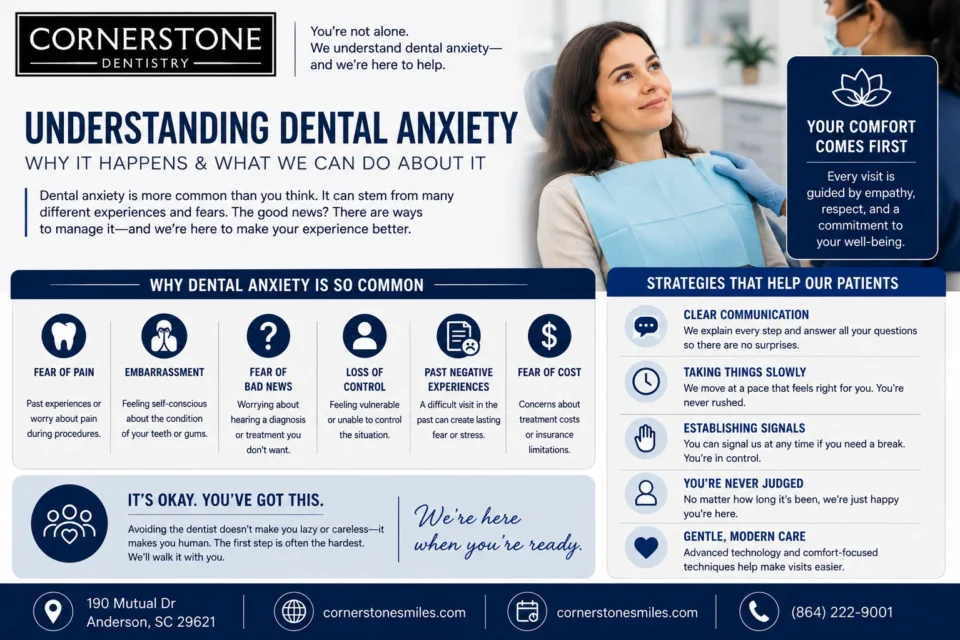
What Helps Patients Feel More Comfortable?
Different patients need different approaches.
Some common strategies include:
Clear Communication
Many patients feel calmer when they understand:
- What is happening
- Why treatment is recommended
- What sensations to expect
- How long treatment will take
Uncertainty often fuels anxiety.
Information tends to reduce it.
Taking Things Slowly
Not every issue needs to be solved in a single appointment.
For some patients, breaking treatment into smaller steps feels more manageable.
Establishing Signals
Patients often feel more comfortable when they know they can pause treatment if needed.
Simple hand signals can restore a sense of control.
Bringing Questions
Many anxious patients hesitate to ask questions.
In reality, asking questions often reduces fear significantly.
The more you understand, the less room anxiety has to fill in the blanks.
Dental Facts & Myths: What’s Actually True About Your Smile
Some of the most common questions about teeth aren’t really about symptoms or treatment — they’re about the surprisingly strange,…
Learn More
What If You’ve Avoided the Dentist for Years?
This is one of the most common concerns we hear.
Patients often say:
“I’m probably your worst patient.”
The truth is they’re usually not.
Dentists regularly treat patients who haven’t had dental care in:
- Five years
- Ten years
- Twenty years
- Even longer
The important thing is not how long it’s been.
The important thing is what happens next.
Most dentists would rather help you today than discuss why you didn’t come in sooner.
You Don’t Have to Love the Dentist
Sometimes people think overcoming dental anxiety means becoming completely comfortable with every aspect of dental care.
That’s not realistic for everyone.
You don’t have to love dental visits.
You don’t have to enjoy procedures.
You don’t even have to stop feeling nervous.
Many patients continue experiencing some anxiety while still receiving regular care.
The goal isn’t perfection.
The goal is preventing fear from making healthcare decisions for you.
The Biggest Myth About Dental Anxiety
The biggest myth is that you’re the only one feeling this way.
You’re not.
Many successful, intelligent, responsible adults experience dental anxiety.
Teachers.
Business owners.
Parents.
Healthcare professionals.
Retirees.
College students.
People from every background.
Dental anxiety is remarkably common.
And it is something dental teams encounter every day.
A Better Dental Experience Often Starts With One Honest Conversation
Many patients spend years worrying about treatment before ever speaking with a dentist about their concerns. In reality, simply sharing those concerns can change the entire experience.
If anxiety has kept you away from dental care, you don’t need to arrive with perfect teeth or a perfect dental history. You simply need a place to start.
At Cornerstone Dentistry in Anderson, Dr. Andrew Wilson and Dr. Dale Hardy understand that dental anxiety is real. For many patients, the first appointment isn’t about treatment at all—it’s about understanding what’s going on, discussing options, and creating a plan that feels manageable and comfortable. Sometimes the most important step isn’t fixing a tooth. It’s discovering that visiting the dentist doesn’t have to be as stressful as you’ve imagined.
Dental Anxiety Keeping You Away?
Compassionate dental care can make your next visit easier. Call now and take the first step toward a healthier smile.