
Table of Contents
Root canal treatment has an outdated reputation for being painful. In reality, modern root canal treatment is performed with local anesthesia, and most patients describe the in-chair experience as similar to getting a routine filling, according to the American Association of Endodontists. What often causes more uncertainty is the recovery afterward: knowing which sensations are part of normal healing and which ones deserve a call to your dentist. Here’s what the typical recovery process looks like.
Key Takeaways
- Mild tooth tenderness and jaw soreness can be normal for the first few days and should gradually improve.
- Root canal treatment has a success rate of more than 90% when the tooth is properly restored and cared for afterward.
- Most people can return to normal daily activities quickly, although Cornerstone Dentistry recommends taking it easy for the remainder of the treatment day.
- Avoid heavy chewing with the treated tooth until your dentist has completed the recommended permanent restoration.
- A crown is commonly recommended for root canal-treated molars and premolars, but not every treated tooth automatically requires one.
What happens during the procedure itself. A typical root canal takes about 60 to 90 minutes, although some teeth require more than one visit. Your dentist first numbs the area and isolates the tooth before creating a small opening to reach the pulp chamber. The inflamed or infected pulp is removed with small instruments, and the canals are cleaned, shaped, disinfected, and filled with a rubber-like dental material called gutta-percha. The opening is then sealed, often with a temporary filling until the final restoration is completed. Saving the natural tooth through root canal treatment is generally a more conservative approach than removing it and replacing it with a bridge or dental implant when the tooth can predictably be restored.
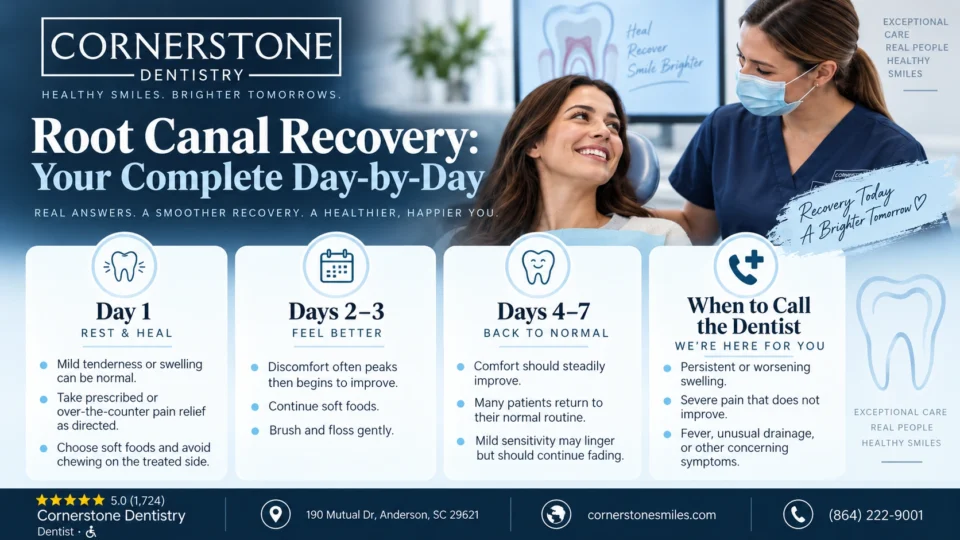
Day 1: the first 24 hours. Your mouth may remain numb for several hours after treatment. Cornerstone Dentistry recommends avoiding eating or chewing until the numbness has completely worn off so you do not accidentally bite your cheek, tongue, or lip. Plan to take it easy for the rest of the treatment day and avoid strenuous activity. Mild tenderness in the tooth and some jaw soreness from keeping your mouth open during treatment can occur as the anesthesia wears off. These symptoms are often manageable with over-the-counter pain medication when appropriate, although you should follow the specific medication instructions provided by your dentist. Cornerstone also recommends resuming gentle brushing around the treated area the following day.
Days 2 through 5. Some tenderness when biting or touching the treated tooth can continue for several days, but it should generally become less noticeable rather than more intense. The Cleveland Clinic notes that most people recover from the procedure itself in less than a week. Soft foods such as yogurt, mashed potatoes, smoothies, eggs, soups, and well-cooked pasta may be more comfortable during the first few days. As you feel better, you can gradually return to firmer foods, but continue avoiding heavy chewing directly on the treated tooth until your dentist says it is ready for normal use.
If you have a temporary filling or crown, treat it carefully. The American Association of Endodontists notes that losing a thin surface layer of a temporary restoration can occur and is usually not a concern. If the temporary filling or crown comes out completely, however, contact your dental office.
After the first week: protecting the treated tooth. Most procedure-related soreness should continue settling down during this period, although the treated tooth may feel slightly different from neighboring teeth for some time. That sensation alone does not necessarily mean something is wrong. What matters is that symptoms are improving rather than becoming more painful, swollen, or uncomfortable.
This is also when following through with your permanent restoration becomes especially important. The American Association of Endodontists recommends arranging the final restoration promptly once root canal treatment is complete. The exact timing and type of restoration depend on the tooth, how much healthy structure remains, and the treatment plan your dentist recommends.
Red flags that mean it’s time to call us. Recovery is usually straightforward, but certain symptoms should be evaluated rather than ignored:
- Severe pain or pressure that lasts more than a few days or gets worse instead of better.
- Visible or increasing swelling inside your mouth or on your face.
- A bite that feels uneven or as though the treated tooth hits before your other teeth.
- A temporary filling or crown that comes out completely.
- The return of symptoms you experienced before treatment.
- An allergic reaction to medication, such as a rash, hives, or itching.
- Fever or worsening swelling that could indicate an infection or another problem.
- Persistent numbness or tingling involving the lips, tongue, or chin.
An uneven bite does not automatically mean the root canal has failed. Sometimes a temporary or permanent restoration simply needs to be adjusted because it is receiving too much biting pressure. Likewise, the return of previous symptoms can have several possible causes, so it should be evaluated rather than automatically assumed to mean the original infection was never removed.
If you notice any of these concerns, contact us so the tooth can be checked.
Why the permanent restoration matters. Root canal treatment addresses infection or inflammation inside the tooth, but the tooth still needs to be properly restored afterward so it can function normally and remain protected. Teeth that require root canal treatment have often already lost some healthy structure because of deep decay, cracks, previous fillings, or the access required during treatment.
For back teeth such as molars and premolars, the final restoration is often a dental crown because these teeth absorb significant chewing forces. A crown covers and protects the remaining tooth structure while restoring normal function. Front teeth do not always require crowns after root canal treatment. Depending on the location of the tooth and how much healthy structure remains, a dentist may recommend a filling or another type of permanent restoration instead.
The American Association of Endodontists reports that root canal treatment has a success rate of more than 90%, with long-term success supported by timely permanent restoration, good oral hygiene, regular dental visits, and protection of the treated tooth from excessive forces. Delaying or damaging the final restoration can allow bacteria to re-enter the tooth or leave the remaining tooth structure more vulnerable to fracture.
Frequently asked questions.
What’s the actual success rate of root canal treatment?
The American Association of Endodontists reports success rates of more than 90%. With proper restoration, good oral hygiene, regular dental care, and protection from excessive force, a root canal-treated tooth can remain functional for many years and may last a lifetime.
Is it normal to still feel the tooth?
Yes. The tissue and ligaments surrounding the tooth can remain sensitive while they heal, even though the pulp has been removed from inside the tooth. The AAE also notes that a treated tooth may feel slightly different from neighboring teeth for some time. What matters is that discomfort gradually improves. Increasing pain, pressure, or swelling should be evaluated.
Can I go to work the next day?
In many cases, yes. The AAE notes that many patients can return to their normal routine quickly after treatment. Cornerstone Dentistry recommends resting and avoiding strenuous activity for the remainder of the procedure day, so most patients who feel well can generally return to normal daily activities afterward. If sedation was used, follow the specific driving, work, and activity restrictions your dentist gives you.
How long until I can eat normally again?
Soft foods are usually easier for the first few days, and you can gradually return to firmer foods as your comfort improves. The important exception is the treated tooth itself. Avoid hard or heavy chewing with that tooth until your dentist has completed the recommended permanent restoration and cleared you to use it normally.
Does every root canal need a crown?
No. Crowns are frequently recommended for root canal-treated molars and premolars because back teeth handle substantial chewing pressure. Front teeth may sometimes be restored without a crown if enough healthy tooth structure remains. Your dentist will determine the appropriate restoration based on the tooth’s location and condition.
Why not just pull the tooth instead?
Extraction is appropriate in some situations, particularly when a tooth cannot predictably be restored. When the natural tooth can be saved, however, root canal treatment allows you to keep that tooth and maintain its role in chewing and supporting your bite. Removing a tooth may eventually require additional treatment, such as a bridge or dental implant, if replacement is recommended. The AAE generally encourages preserving natural teeth whenever doing so is clinically appropriate.