
Table of Contents
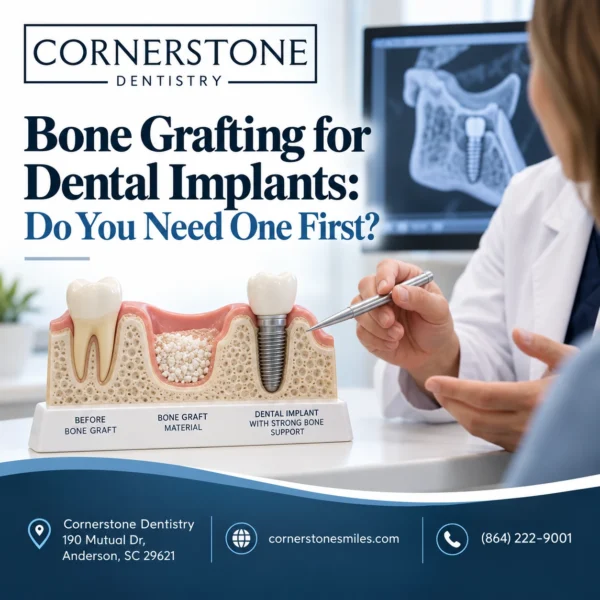
Told you might need a bone graft before your implant? It’s a common part of implant dentistry and doesn’t mean anything went wrong. It usually means the area where the implant needs to go doesn’t currently have enough bone volume or the right anatomy to provide a stable foundation. Sometimes the graft is completed months before the implant. In other cases, a smaller graft can be performed at the same appointment as implant placement. The right approach depends on how much bone is missing and where.
Key Takeaways
- Dental implants need enough healthy bone to achieve initial stability and ultimately integrate with the jaw through a process called osseointegration.
- After a tooth is lost or extracted, the bone that once supported it can gradually shrink or resorb.
- Four commonly used graft-material categories are autograft, allograft, xenograft, and synthetic or alloplastic material.
- When grafting and implant placement are staged separately, the graft often needs at least about three months to heal. Large grafts may require nine to 12 months.
- Some smaller bone deficiencies can be grafted at the same time the implant is placed, so needing a graft doesn’t automatically add a separate surgery or a year to treatment.
Why implants specifically need bone. A dental implant is placed into the jawbone, where the bone gradually forms a direct structural connection with the implant surface. That process is called osseointegration.
For an implant to be positioned predictably, the site needs enough bone in the appropriate dimensions to surround and support it. The American Association of Oral and Maxillofacial Surgeons describes the purpose of bone grafting as establishing adequate quantity and quality of bone at the treatment site for proper form and function.
Bone grafting doesn’t simply drop a permanent block of replacement bone into the jaw. Many graft materials act partly as a scaffold that supports new bone growth as the patient’s own tissues remodel the area over time.
The amount of bone required isn’t identical for every implant. Tooth location, implant dimensions, nearby nerves or sinuses, bite forces, restorative plans, and the shape of the remaining ridge all influence whether augmentation is necessary.
What actually causes the bone loss in the first place. One of the most common reasons is simply losing a tooth.
Natural teeth help maintain the surrounding alveolar bone through the forces transmitted through their roots. Once a tooth is extracted or lost, that local stimulation disappears, and the bone that previously supported the tooth can gradually resorb.
AAOMS specifically notes that extraction or tooth loss can cause the surrounding jawbone to shrink over time, which may affect future treatments such as dental implants.
Other reasons someone may have insufficient bone include:
- Periodontal disease that has destroyed supporting bone around teeth
- Long-standing infection
- Dental or facial trauma
- Previous extractions followed by ridge resorption
- Naturally thin or limited bone anatomy
- Enlargement or position of the maxillary sinus in the upper back jaw
- Previous surgery or other conditions that altered the jaw
The amount of bone loss after tooth extraction varies from patient to patient. Losing a tooth years ago doesn’t automatically mean you need a graft, just as a recent extraction doesn’t guarantee you have enough bone. Imaging and examination are what determine that.
The four graft material types, and what actually differs between them.
- Autograft — bone taken from another part of your own body. For oral procedures, smaller grafts can sometimes come from another area of the jaw. Larger reconstructive procedures may use bone from locations such as the hip or lower leg. Because the tissue comes from you, there is no donor-to-patient disease transmission risk. The tradeoff is that harvesting the bone creates an additional surgical site.
- Allograft — human donor bone obtained through a tissue bank. The material is screened and processed to reduce the risk of disease transmission and eliminate the need to harvest bone from another part of your body. Allografts are commonly used as scaffolding for your own bone to grow into and remodel.
- Xenograft — graft material derived from another species, commonly bovine or porcine sources. It is processed for clinical use and provides a scaffold that supports bone regeneration. Like allografts, it avoids a second surgical harvest site.
- Alloplast — a synthetic bone substitute manufactured from biocompatible materials. Hydroxyapatite is one example. Because the material isn’t obtained from a human or animal donor, there is no donor-related disease-transmission risk. Different synthetic materials have different biological and handling characteristics, so whether one is appropriate depends on the defect and treatment goal.
There isn’t one universally “best” graft material. Surgeons may also combine materials rather than using only one source.
AAOMS notes that autogenous bone, donor tissues, animal-derived grafts, synthetic materials, membranes, and other regenerative products can all play different roles depending on the amount and shape of bone that needs to be rebuilt.
What about BMP? Bone morphogenetic protein, or BMP, is different from the four graft-source categories above. It’s a biologic signaling protein that can stimulate bone formation and may be used in selected oral and maxillofacial procedures.
AAOMS lists engineered BMP among the regenerative options that can reduce or eliminate the need for harvesting bone from another part of the patient’s body in certain cases.
That doesn’t mean every graft should use BMP. The choice depends on the defect, surgical technique, patient factors, product indications, and clinician’s treatment plan.
What the grafting procedure actually involves. The exact procedure depends on whether you’re having socket preservation after an extraction, ridge augmentation, a sinus lift, grafting around an implant, or a larger reconstruction.
For a typical localized dental bone graft, Cleveland Clinic describes a general sequence:
- The area is numbed with local anesthesia. Sedation may also be used when appropriate.
- An incision is made in the gum when access to the underlying bone is needed.
- The gum tissue is gently moved aside.
- The area is cleaned and prepared.
- The grafting material is placed where additional bone is needed.
- A membrane may be placed over the graft to protect it and help guide healing.
- The gum is repositioned and closed with stitches.
Not every graft requires all of those steps. Socket grafting immediately after a tooth extraction, for example, can look quite different from rebuilding a severely resorbed ridge.
Cleveland Clinic describes dental bone grafting as a relatively minor procedure for many patients and says most report little to no pain during the procedure because the area is anesthetized. Tenderness, swelling, and bruising afterward are expected and generally improve over the first week or two.
The healing timeline, honestly. There are two different recovery clocks to understand.
The first is how long you feel like you’re recovering from surgery. Initial tenderness, swelling, and bruising generally settle substantially within about a week or two.
The second is how long the graft takes to become incorporated into the jaw. That takes considerably longer.
Cleveland Clinic says a dental bone graft generally needs at least about three months to heal, while a large graft can require approximately nine to 12 months.
That does not mean every patient has to wait three to 12 months before receiving an implant.
In selected cases, an implant can be placed at the same time as bone augmentation if enough existing bone is present to provide the implant with adequate initial stability. AAOMS similarly notes that implants can sometimes be placed at the same time as grafting, while other cases require graft healing before implant placement.
A simplified timeline looks like this:
- Small defect with adequate implant stability: grafting and implant placement may sometimes happen together.
- Moderate deficiency requiring staged grafting: the graft may be allowed to heal for several months before the implant is placed.
- Large reconstruction: healing may take nine to 12 months before the site is considered ready.
If the graft was specifically placed to prepare for a future implant, Cleveland Clinic recommends not delaying implant placement indefinitely once the graft has matured. Its guidance says placement is generally best within about six to 12 months after the graft heals, because unused grafted bone can gradually lose volume and density over time.
Your actual timeline should come from follow-up imaging and clinical examination rather than the calendar alone.
Smoking, vaping, and healing. Cigarette smoking is one of the better-established patient-related risk factors in implant dentistry.
A 2026 systematic review found lower implant survival and greater crestal bone loss among cigarette smokers compared with nonsmokers. Other recent reviews have likewise associated smoking with impaired osseointegration, delayed wound healing, increased peri-implant inflammation, and a higher risk of implant failure.
Cleveland Clinic specifically advises patients not to smoke or vape during dental bone graft recovery.
The evidence needs one important distinction, though: the clinical research connecting cigarette smoking with poorer dental implant outcomes is much stronger than the current long-term evidence for vaping and other smoke-free products. A 2026 systematic review found insufficient implant-outcome data for smoke-free products.
So it is accurate to advise avoiding both smoking and vaping while a graft heals, but it would be too strong to claim that vaping has been proven to carry exactly the same graft or implant risk as cigarette smoking.
If you use nicotine, tobacco, or vaping products, tell your dentist or surgeon during treatment planning rather than waiting until after surgery.
Risks and what can go wrong. Dental bone grafting is generally considered safe, but no surgical procedure is risk-free.
Cleveland Clinic lists potential complications including:
- Infection
- Significant bleeding
- Nerve injury
- Anesthesia-related complications
- Graft failure
Signs that a graft may not be healing normally include pain or swelling that gets worse rather than better after the initial recovery period, pus or drainage from the site, gum recession around the grafted area, or failure to develop the expected bone volume.
Small granules of grafting material can occasionally work their way out of the surgical site during the first few days. Cleveland Clinic notes that a small amount can be normal. Losing a large amount or noticing other concerning symptoms is a reason to contact your dental provider.
Fever, severe pain, increasing swelling, pus, or persistent bleeding also deserves a call.
Frequently asked questions.
Does insurance cover bone grafting? It depends on the dental plan and why the graft is being performed. Some plans provide benefits for certain grafting procedures, while others exclude grafting associated with dental implants or limit how much they’ll pay. Coverage also depends on deductibles, annual maximums, waiting periods, and other plan terms. The safest approach is to have the specific procedure codes and treatment plan checked against your benefits before treatment rather than assuming coverage based on whether the implant itself is covered.
Is there any alternative to grafting? Sometimes, but not for every anatomy or treatment goal. Short implants may be an option in selected patients with reduced vertical bone height, and recent systematic-review evidence supports them as a less invasive alternative to standard-length implants with augmentation in appropriately selected cases.
For severe bone loss in the upper jaw, zygomatic implants are another specialized option. AAOMS describes them as longer implants that anchor in the cheekbone rather than relying entirely on an atrophic upper jaw, potentially avoiding extensive grafting in selected patients.
Tilted or strategically positioned implants may also allow clinicians to use available native bone in certain full-arch cases.
These aren’t interchangeable shortcuts. Zygomatic implants in particular are complex procedures with their own risks and are intended for specific cases. Whether grafting or a graftless approach makes more sense depends on the amount and location of remaining bone and the type of final restoration being planned.
Does smoking really affect healing that much? Cigarette smoking is consistently associated with poorer implant outcomes. A 2026 systematic review of 44 studies found significantly reduced implant survival among smokers and greater crestal bone loss around implants. Smoking isn’t an absolute contraindication to every implant, but cessation counseling is strongly recommended as part of implant treatment planning.
Exactly how long you should stop before and after grafting or implant surgery should come from the clinician performing the procedure, because the appropriate recommendation depends on your health and treatment.
How do I know if I need a graft before I’ve even had a consultation? Usually, you can’t know for certain from how long the tooth has been missing or from looking at the area in a mirror.
Your dentist begins with an examination and imaging. A panoramic image can provide an initial overview of the jaws and tooth sites, but detailed implant planning often requires three-dimensional imaging.
Current ADA and American Academy of Oral and Maxillofacial Radiology recommendations support CBCT imaging for presurgical dental implant planning and specifically identify it as useful for assessing bone volume, sites that may require grafting or reconstruction, the maxillary sinus, and previously augmented areas.
That means the decision isn’t based simply on whether the bone “looks thin” on a two-dimensional image. The clinician needs to know the width, height, contour, and relationship of the planned implant to nearby structures.
Some people who lost a tooth years ago still have enough bone for an implant. Others may need grafting after a much shorter period. Imaging is what separates those cases.
Can I get the graft and implant placed in the same appointment? Yes, in selected cases.
If there’s enough native bone to achieve adequate primary implant stability, the implant and bone graft may sometimes be placed during the same operation. This is commonly referred to as simultaneous implant placement and bone augmentation.
AAOMS also states that implants may sometimes be placed at the same time as sinus augmentation. Research has evaluated simultaneous implant placement with several bone-augmentation techniques and found that it can be successful in appropriately selected patients.
When a bone defect is too extensive to securely support the implant at the initial surgery, the graft is usually allowed to integrate first and implant placement is staged later.
So needing a bone graft doesn’t automatically tell you whether treatment will involve one surgical appointment or two. The size and configuration of the defect do.
Does everyone who loses a tooth eventually need a graft for an implant? No. Bone resorption after tooth loss is real, but patients don’t all lose bone at the same rate or to the same extent. Some implant sites retain enough native bone for straightforward placement, while others require augmentation.
Socket preservation performed at the time of extraction can help maintain ridge dimensions, but it also doesn’t guarantee that no additional grafting will ever be needed. Implant position and restorative requirements still have to be assessed later.
For a sense of what the full process and investment can look like, our 2026 dental implant cost guide and our bone grafting buyer’s guide are good next reads. Dental Implants and Bone Health also explains why bone volume remains an important part of implant planning beyond the initial procedure.
If you’ve been told you need a graft and want to understand whether it can be done with your implant or needs a separate healing period, call Cornerstone Dentistry at (864) 222-9001 or schedule an implant consultation.