
Table of Contents
Jaw pain, clicking, or a jaw that feels like it’s catching can send one person to a dentist and another to a physical therapist. In many cases, the starting point is similar: identify what type of temporomandibular disorder, or TMD, is actually present and begin with conservative, reversible care. Many TMD symptoms improve without invasive treatment, and current guidance specifically recommends avoiding permanent changes to the teeth, bite, or jaw joint unless there’s a clear reason for them.
Key Takeaways
- TMD can involve the jaw joint, chewing muscles, or both, and the exact cause is often difficult to identify.
- Conservative treatment comes first: temporarily modifying the diet, heat or cold, gentle exercises, reducing clenching habits, pain relief when appropriate, and physical therapy are common starting points.
- Splints or night guards may be useful in selected cases, particularly when clenching or grinding is involved, but evidence that they reliably relieve TMD pain is limited.
- Some people improve within a week or two, while others have symptoms that require longer-term management.
- Clicking or popping without pain or limited jaw function is common and generally doesn’t require treatment.
- Open-joint surgery should be reserved for carefully selected patients with severe persistent symptoms or significant structural joint damage.
What actually causes TMJ pain. First, a terminology point: the TMJ is the temporomandibular joint itself. TMD refers to the group of disorders involving that joint, the muscles used for chewing, or both.
There isn’t one universal cause.
The National Institute of Dental and Craniofacial Research (NIDCR) says that, in most cases, the exact cause isn’t clear. Jaw trauma can lead to some TMDs, while other cases may involve a combination of biological factors, stress, how a person’s nervous system processes pain, muscle tension, or joint problems.
The American Association of Oral and Maxillofacial Surgeons lists several conditions associated with TMD symptoms, including jaw injuries, arthritis and other joint damage, connective-tissue diseases, chronic clenching or grinding, inflammation of the surrounding muscles, and displacement or damage involving the joint’s internal disc.
Teeth grinding and clenching can certainly matter, particularly when they contribute to muscle soreness, tooth wear, or excess loading of the jaw system. Stress may also increase jaw-muscle tension or clenching in some people.
One commonly repeated explanation needs more caution, though: a “bad bite” shouldn’t automatically be blamed for TMD. NIDCR states that current research does not support the belief that malocclusion or orthodontic treatment causes TMD. That matters because permanently changing a patient’s bite isn’t considered a routine evidence-based solution for jaw pain.
Start conservative: what actually helps first. Current guidance from NIDCR, AAOMS, and the Cleveland Clinic supports beginning with simple, reversible approaches rather than jumping into procedures that permanently alter the teeth or joint.
Early self-care may include:
- Temporarily choosing softer foods when chewing hurts
- Avoiding gum and very hard or chewy foods
- Applying heat or cold to the jaw
- Using gentle jaw stretching or strengthening exercises when appropriate
- Becoming aware of daytime clenching
- Avoiding habits such as nail biting or chewing on pens
- Using over-the-counter pain medication such as an NSAID when medically appropriate
- Reducing stress-related jaw tension
- Improving sleep and daily habits that may aggravate symptoms
These measures aren’t meant to hide a serious problem indefinitely. If pain, locking, restricted opening, or other symptoms persist, an evaluation helps determine whether the problem is primarily muscular, joint-related, dental, neurologic, or something else.
Physical therapy and, in selected cases, an intraoral splint may then become part of the treatment plan.
How physical therapy specifically helps. Physical therapy is one of the better-supported conservative options for TMD.
NIDCR notes that research suggests manual therapy can improve function and relieve pain. The American Physical Therapy Association’s patient guide likewise describes conservative management, including physical therapy, as a first-line approach.
A physical therapist with experience treating the jaw may evaluate more than the TMJ itself. They can assess jaw movement, neck mobility, muscle tenderness, posture, breathing patterns, and habits that may be contributing to symptoms.
Treatment may include:
- Manual therapy: hands-on treatment of tight or painful muscles around the jaw, face, head, and neck. In some cases, treatment may include appropriate intraoral techniques.
- Joint mobilization: gentle techniques aimed at improving restricted jaw or neck movement.
- Therapeutic exercises: individualized movements designed to improve mobility, coordination, and muscle function.
- Education: guidance on jaw-rest position, eating habits, posture, clenching awareness, and self-management.
- Home exercises: movements performed between appointments to maintain improvements and build function.
Some physical therapists also use heat, cold, ultrasound, electrical stimulation, light therapy, or similar modalities as adjuncts.
Those modalities shouldn’t all be treated as equally proven therapies. NIDCR, for example, notes that studies of TENS for TMD have generally been small and short-term. The stronger rationale for PT is the combination of appropriate movement, manual therapy, exercise, education, and self-management.
Posture can also be addressed, particularly if neck and jaw muscle tension seem to occur during prolonged computer or phone use. APTA identifies forward-head posture as one factor that may contribute to jaw and neck muscle tension. That doesn’t mean poor posture is proven to be the underlying cause of every TMD case.
Night guards and splints: useful for some patients, but not a universal cure. Intraoral appliances go by several names, including night guards, occlusal splints, stabilization appliances, and bite splints.
They’re not the same thing as an athletic mouthguard.
A sports mouthguard is intended primarily to protect against trauma during athletic activity. A dental splint used for TMD or bruxism is designed for a different purpose and should be selected based on the patient’s diagnosis.
NIDCR says intraoral appliances can protect the teeth and may help with habits such as clenching, but it also makes an important point: there isn’t a large amount of evidence showing that splints reliably improve TMD pain.
If one is recommended, NIDCR advises that it:
- Shouldn’t be designed to permanently change the bite
- Should be monitored for fit and response
- Should be discontinued and evaluated if it causes pain
AAOMS describes both soft and hard custom splints as possible noninvasive options, but it’s too simplistic to say that everyone with muscle pain needs a soft guard while everyone with joint pain needs a hard one. Appliance design depends on the diagnosis, tooth condition, grinding pattern, joint findings, and treatment goal.
For someone who grinds or clenches, an appliance may also have a separate benefit by protecting the teeth from wear even when its effect on TMD pain is uncertain.
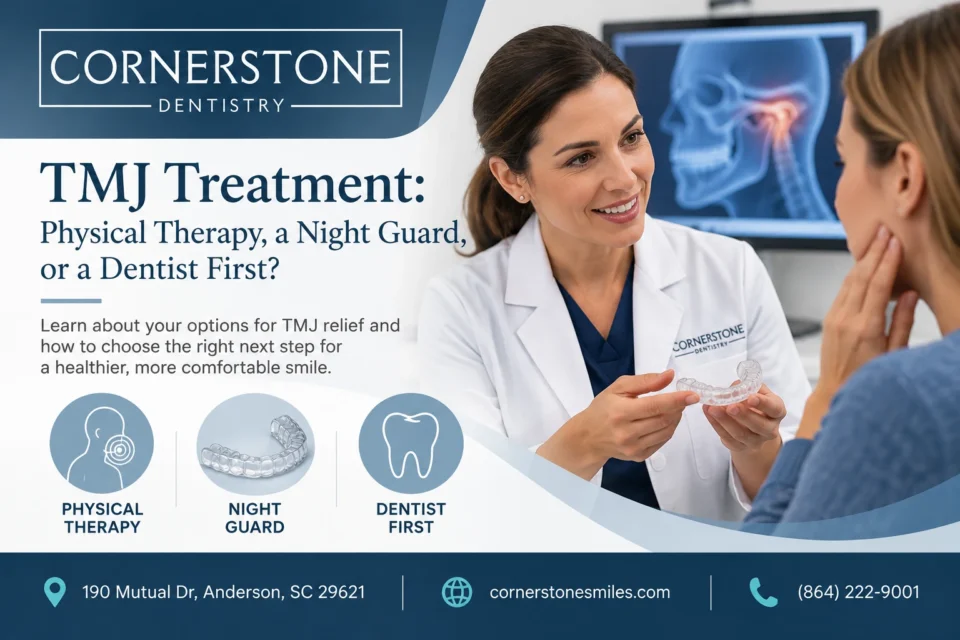
Our TMJ/TMD services page covers how Cornerstone evaluates jaw symptoms and when a custom appliance may be considered.
When to get the symptoms evaluated. Occasional painless clicking isn’t automatically a reason to seek treatment. Persistent pain or limitation is different.
Cleveland Clinic recommends seeing a healthcare provider when jaw pain, clicking, or stiffness doesn’t improve. Evaluation is particularly worthwhile if you have:
- Persistent or recurring jaw or facial pain
- Difficulty opening or closing your mouth
- Jaw locking or catching
- Painful clicking or grinding
- Significant difficulty chewing
- A noticeable change in jaw movement
- Symptoms after an injury
- New or unexplained facial swelling
- Symptoms that interfere with sleep or normal daily activities
Jaw and facial pain can also come from conditions unrelated to TMD. Dental infections, headaches, nerve disorders, ear problems, sinus conditions, and other causes may need to be ruled out.
Jaw pain accompanied by symptoms such as chest pain, shortness of breath, nausea, dizziness, or pain spreading into an arm requires urgent medical attention because jaw discomfort can occasionally occur with a heart attack.
If conservative care isn’t enough. Not every procedure beyond home care is the same.
For patients with persistent joint-specific problems, an oral and maxillofacial surgeon may sometimes consider minimally invasive options such as arthrocentesis, in which fluid is used to flush the joint, or arthroscopy, in which a small camera and instruments are introduced into the joint.
NIDCR notes that arthrocentesis has helped some patients with certain disc problems, although study results aren’t consistent for everyone. Arthroscopy can allow direct inspection of the joint and treatment of problems such as adhesions or displaced disc tissue and has shown moderate benefit for pain and function in appropriate cases.
Open-joint surgery is a much bigger step.
NIDCR says open surgery should only be considered when there is joint destruction that can’t be corrected with other procedures or when severe pain or difficulty opening the mouth continues despite other treatments. It also emphasizes that open surgery permanently changes the joint and that long-term evidence regarding its safety and effectiveness remains limited.
AAOMS similarly states that surgery may be indicated when nonsurgical treatment hasn’t worked or when there is clear joint damage.
So the general progression is conservative and reversible care first, then more targeted treatment when a clear diagnosis justifies it. Surgery shouldn’t be the default response to clicking, occasional soreness, or an assumption that the bite needs to be “fixed.”
Frequently asked questions.
Can TMJ symptoms go away on their own? Yes. NIDCR says signs and symptoms of TMD resolve without treatment for many people. Cleveland Clinic notes that some people feel better within a week or two, while others have longer-lasting symptoms that require ongoing care. There isn’t one recovery timeline for every type of TMD.
Is TMJ linked to headaches or ear pain? Headaches, earaches, ringing in the ears, facial pain, and neck discomfort can occur alongside TMD symptoms. Both AAOMS and Cleveland Clinic include headaches and ear-related symptoms among possible presentations. But those symptoms aren’t specific to TMD, so recurring headaches or ear symptoms shouldn’t automatically be assumed to originate in the jaw.
How long does treatment typically take to show improvement? It depends on the type of problem and how long the symptoms have been present. Some people improve within a week or two with simple self-care. Muscular or persistent TMD may require a longer period of physical therapy, habit modification, stress management, or other conservative treatment. Our post on TMJ: The Root of Your Pain goes into more detail about jaw symptoms and treatment considerations.
Should I see a dentist or a physical therapist first? Either may be part of appropriate TMD care, but they contribute different things. A dentist can evaluate the teeth, signs of grinding, oral health, jaw movement, and whether dental conditions could be causing the pain. A physical therapist can assess movement, muscle function, neck involvement, and posture and provide rehabilitation when appropriate.
NIDCR recommends consulting a dentist or doctor if you think you have TMD, while APTA notes that physical therapists can directly evaluate and treat TMD in settings where direct access is allowed. Persistent or complicated cases may involve a dentist, physician, physical therapist, orofacial pain specialist, or oral and maxillofacial surgeon working together.
Is TMJ the same as a “clicking jaw” with no pain? No. In fact, NIDCR specifically states that clicking or popping sounds without pain are common, considered normal, and don’t require treatment. Clicking becomes more clinically important when it is painful or accompanied by locking, limited movement, difficulty eating, or other symptoms.
Does fixing my bite cure TMD? Current evidence doesn’t support routinely changing a patient’s bite as a TMD treatment. NIDCR says research does not show a strong link between malocclusion and TMD and advises against irreversible occlusal treatments such as grinding down teeth, placing crowns solely to alter the bite, or using orthodontics specifically to treat TMD. These treatments may not help and can sometimes make symptoms worse.
Do I automatically need a night guard if I grind my teeth? Not automatically for TMD pain. A dentist may recommend an appliance to protect teeth from damage associated with bruxism, and it may help some people’s jaw symptoms. But NIDCR notes that evidence for splints as a TMD pain treatment remains limited. The appliance should be selected for your individual situation and shouldn’t permanently alter your bite.
Living with TMD day to day. During a flare-up, reducing unnecessary stress on the jaw can make everyday activities easier.
That may include cutting food into smaller pieces, temporarily choosing softer foods, avoiding gum and very chewy or hard foods, and limiting extremely wide mouth opening when the jaw is painful.
Pay attention to what your jaw does when you’re concentrating or stressed. Your teeth don’t need to be clenched together when you’re at rest. Becoming aware of daytime clenching can be one of the simplest behavioral changes to make.
Neck and head posture may also be worth addressing if long hours at a desk, computer, or phone coincide with muscle tension. The goal isn’t to maintain a rigid “perfect” posture all day, but to reduce prolonged positions that aggravate symptoms and change position regularly.
Sleep deserves separate attention when symptoms suggest a sleep disorder. TMD symptoms, grinding, morning headaches, and sleep complaints can coexist, but TMD by itself doesn’t diagnose obstructive sleep apnea. Snoring, witnessed pauses in breathing, gasping during sleep, or significant daytime sleepiness deserve their own appropriate evaluation.
Our post on TMJ and sleep apnea discusses that possible overlap, while Sleep Apnea, TMD/TMJ, and Dental Technology covers Cornerstone’s approach to evaluating related symptoms.
If jaw pain, locking, or difficulty opening your mouth isn’t improving with simple measures, have it evaluated rather than assuming you just need a different bite or a stronger mouthguard. Call Cornerstone Dentistry at (864) 222-9001 or schedule online to discuss what’s actually causing the symptoms and which conservative options make sense.