
Table of Contents
Some of the most common questions about teeth aren’t really about symptoms or treatment — they’re about the surprisingly strange, and sometimes surprisingly useful, trivia behind how our mouths work and how we think about them. Here are 9 of the ones we get asked about most, sorted fact from myth.
Myth: George Washington had wooden teeth
This one is completely false, and the real story is more interesting than the myth. By the time he became president, Washington had only one of his natural teeth left — a combination of genetics, tooth-damaging “calomel” medicine of the era, and abrasive early toothpaste made from tree bark and brick dust.
His actual dentures were built from human and animal teeth, elephant and hippopotamus ivory, gold, lead, and metal springs — never wood. He’s said to have kept his mouth closed in public and smiled rarely to hide the discomfort and embarrassment, which some historians argue actually affected how he was perceived as a leader.
It’s a genuine reminder of how far dentistry has come: today, roughly 20–30% of U.S. adults still have gum disease severe enough to threaten tooth loss, but modern dentures and implants look and function nothing like Washington’s.
The biofilm you can’t see, but can definitely feel
Every mouth develops a biofilm — a thin, living layer of bacteria, fungi, and food debris that clings to teeth the same way it clings to river rocks or the inside of a pipe.
Left alone, it’s what drives tooth decay, gum disease, and eventually tooth loss; research suggests 30-40% of the population will develop severe periodontitis in their lifetime.
It’s also part of why oral health connects to the rest of the body — if the bacteria in an untreated infection reach the bloodstream, it’s been linked to everything from heart disease to Alzheimer’s risk in ongoing research.
The fix is genuinely simple, even if it’s not glamorous: daily brushing and flossing physically break up biofilm before it hardens into tartar, backed up by professional cleanings roughly twice a year.
Does whiter teeth actually help your career (or your dating life)?
A well-known Crest-sponsored study found that people with whiter smiles were rated as more likely to get hired, get a raise, and be seen as successful and attractive — and smile psychologist Dr. Dacher Keltner has noted that a smile is “the intense focus of what other people look at” in a first impression.
Interestingly, even lipstick shade plays into this: a cooler, blue-based lipstick (a true red or a berry over a coral or brown) tends to make teeth look whiter by color-wheel contrast, while warm, orange- or brown-toned shades tend to emphasize any yellow tint.
The real driver behind all of this isn’t the shade of white itself — it’s what causes staining in the first place: coffee, red wine, cola, dark berries, and tobacco are the most common culprits, and professional teeth whitening addresses the underlying enamel condition rather than just masking it.
How your mouth is actually built
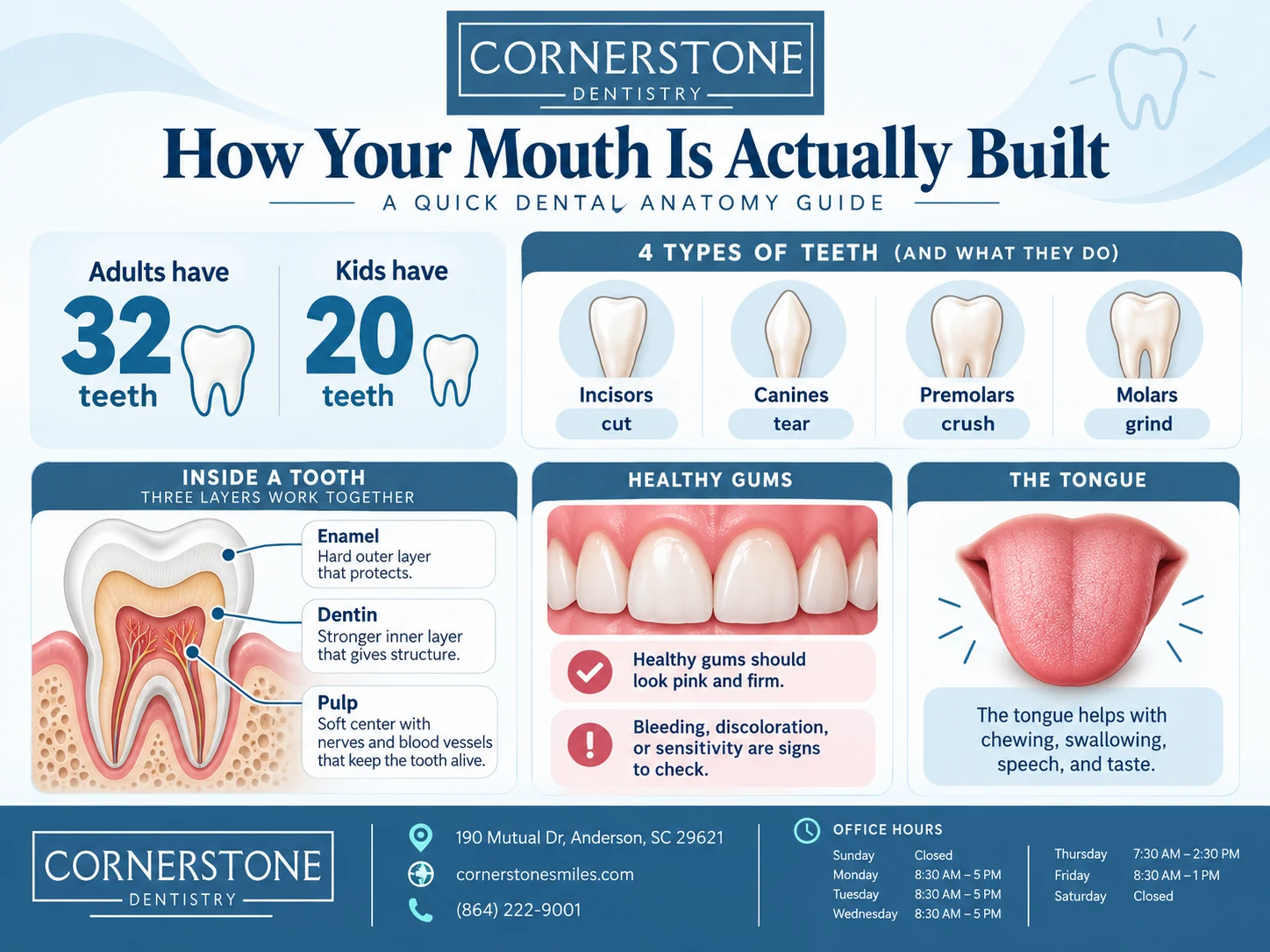
Adults have 32 teeth (kids have 20), split into four types — incisors, canines, premolars, and molars — each shaped for a different job, from cutting to grinding. Every tooth has three layers: enamel on the outside, dentin underneath, and the pulp at the center, which is why decay that reaches the dentin or pulp can genuinely threaten the tooth rather than just its appearance.
Healthy gums should look pink and firm — bleeding, discoloration, or sensitivity are signs worth paying attention to, not something to wait out. And your tongue, often overlooked, is the largest structure in your mouth and does far more than taste: it helps with chewing, swallowing, speech, and even a bit of natural self-cleaning.
When something’s actually wrong: the basics of oral pathology
Good hygiene prevents most problems, but oral pathology is the diagnostic side of dentistry — figuring out what’s actually causing a symptom when brushing and flossing alone haven’t been enough.
The World Health Organization names the main risk factors for oral disease as an unhealthy diet, tobacco use, harmful alcohol use, poor oral hygiene, and social/economic factors that limit access to care.
The conditions this discipline covers span from ordinary cavities and gum disease to oral cancer, where warning signs include discolored patches on the tongue or gums, open sores that don’t heal, and unexplained lumps — worth a look at a routine dental exam rather than waiting for pain.
What your teeth reveal about human history
Teeth are a genuine scientific record. Human jaws today are measurably smaller than our ancestors’ jaws from roughly 4 million years ago — which is part of why wisdom teeth so often cause crowding and eruption problems now: there’s simply less room than there used to be.
Researchers use the chemistry and wear patterns in ancient teeth (sometimes called a “foodprint”) to reconstruct what early humans actually ate and even track migration to regions with very different diets and soil composition.
It’s a striking contrast to what we can detect today with modern dental technology — forming cavities, enamel wear, and jawbone density, often before you’d notice anything yourself.
Why it’s worth smiling anyway
Beyond the trivia, there’s a simple, well-supported reason to take care of your smile: smiling itself measurably affects how you feel. It triggers the brain chemistry associated with reduced stress and pain, and frequent smilers tend to be perceived as more genuine, more youthful, and more approachable — a small, contagious effect that tends to make the people around you more at ease too.
As Dr. Dale Hardy, who’s practiced in Anderson for nearly three decades, puts it: the biggest barriers to a healthy smile are rarely about the teeth themselves — they’re time, fear, and cost. Patients who’ve worked through those barriers, at any age, often describe changes well beyond their teeth: more confidence at work, in relationships, and in day-to-day interactions they used to avoid.
Frequently asked questions
Is it true that whiter teeth alone make a big difference in first impressions?
The research points more toward overall smile health and confidence than the exact shade — but enamel condition (which whitening addresses) is a real, measurable part of that impression.
What actually causes tooth staining?
Mostly diet and habits — coffee, tea, red wine, dark berries, cola, and tobacco are the most consistently named culprits, alongside a few medications like tetracycline.
Why do so many people need their wisdom teeth removed today?
Modern human jaws are smaller than our ancestors’, which often leaves too little room for a third set of molars to come in properly — a genuine evolutionary mismatch, not just bad luck.
Curious how your own smile is actually doing, trivia aside? Call Cornerstone Dentistry at (864) 222-9001 or schedule a real exam — no myths, just a straight answer.