
Table of Contents
A toothache can leave you wondering whether you have a small cavity or something more serious. Maybe your tooth hurts when you eat something sweet, or you’ve noticed sensitivity that lingers long after drinking something cold. Does that mean you need a filling, or could it be time for a root canal?
Both treatments help restore damaged teeth, but they address different problems. A filling repairs a cavity, while a root canal treats damaged or infected tissue inside the tooth. The difference depends on how far the damage has progressed and whether the tooth’s nerve can recover.
Here’s how to recognize potential warning signs and what your dentist checks before recommending treatment.
Quick Answer: Root Canal vs. Filling
A filling is usually enough when tooth decay can be removed and the pulp inside the tooth remains healthy or capable of recovery. A root canal may be necessary when the pulp becomes irreversibly inflamed, infected, or damaged. Lingering sensitivity, spontaneous tooth pain, and swelling can suggest deeper problems, but only a dental examination and appropriate testing can determine which treatment is needed.
When Is a Filling Usually Enough?
Dental fillings are commonly used to repair teeth affected by cavities, small fractures, or other localized damage.
When bacteria cause tooth decay, they gradually weaken and break down the tooth’s hard outer structures.
If the damage can be removed without leaving the pulp irreversibly damaged, a filling may be sufficient.
Small to moderate cavities
A filling is often appropriate when decay affects the enamel or dentin but hasn’t caused irreversible inflammation or infection inside the tooth.
Your dentist removes the damaged tooth structure and restores the area with a suitable filling material.
This helps protect the remaining tooth and restore its normal shape and function.
Symptoms that may occur with a cavity
Some patients notice:
- Brief sensitivity to sweet foods
- Mild discomfort with cold drinks
- Food getting caught in a particular tooth
- A visible hole or dark spot
- Occasional discomfort while chewing
However, these symptoms don’t confirm that you only need a filling.
A cracked tooth, exposed root surface, or irritated pulp can produce similar sensations.
Cavities don’t always cause pain
One important point is that early tooth decay may develop without noticeable symptoms.
You might feel perfectly fine even though a cavity needs treatment.
That’s why routine dental examinations and appropriate X-rays are useful for identifying problems before they become more extensive.
Treating a cavity early may help preserve more natural tooth structure and reduce the need for complicated restorative procedures later.
When Does Tooth Decay Reach the Nerve?
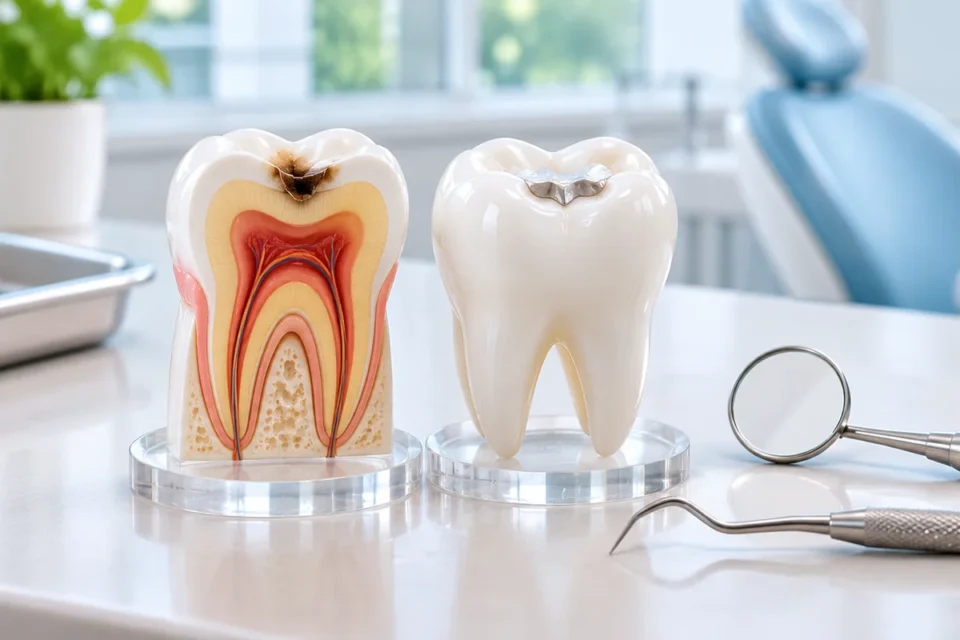
To understand the difference between a filling and a root canal, it helps to know how your tooth is structured.
A natural tooth contains several layers.
Enamel: The hard outer surface that protects the tooth.
Dentin: The layer beneath the enamel that contains microscopic tubules capable of transmitting sensations.
Pulp: The soft inner tissue containing nerves, blood vessels, and connective tissue.
When decay begins, it generally affects the enamel first.
If untreated, it may spread into the dentin and eventually approach or reach the pulp.
What happens when the pulp becomes irritated?
As a cavity gets deeper, bacteria and their byproducts may cause inflammation inside the tooth.
In some cases, this inflammation is temporary and the pulp can recover after the source of irritation is removed.
Dentists refer to this as reversible pulpitis.
A filling or another appropriate conservative treatment may be enough in these situations.
What happens when the pulp cannot recover?
More advanced inflammation may become irreversible.
The pulp may also become infected or eventually lose its vitality.
When this happens, root canal treatment may be needed to remove the affected tissue and preserve the tooth.
However, not every deep cavity or pulp exposure automatically requires a root canal. Selected cases may be suitable for vital pulp treatment, depending on clinical findings.
Your dentist must assess the condition of the tooth before choosing the treatment.
What Symptoms May Point to a Root Canal?
Certain symptoms can suggest that the pulp inside your tooth is significantly inflamed or infected.
However, symptoms alone cannot confirm the diagnosis.
Some patients with severe pulp damage experience substantial pain, while others have few noticeable symptoms.
Lingering sensitivity to hot or cold
Brief sensitivity is relatively common and can have several causes.
However, pain that continues after you stop drinking something hot or cold may indicate deeper pulp inflammation.
For example, if cold water causes a sharp pain that continues for an extended period after you’ve swallowed it, the tooth deserves professional evaluation.
Spontaneous tooth pain
Pain that begins without an obvious trigger may suggest a problem inside the tooth.
You might notice aching or throbbing while resting, working, or trying to sleep.
Spontaneous pain is one possible sign of irreversible pulpitis, although other conditions can cause similar symptoms.
Pain when biting or chewing
If one tooth hurts when you bite down, the problem may involve a crack, inflammation around the root, or another dental condition.
A painful bite doesn’t automatically mean you need a root canal.
Your dentist will need to identify the source.
Swelling or a bump on the gums
A small pimple-like bump near a tooth may indicate a draining dental infection.
Swelling, tenderness, or a persistent unpleasant taste can also occur when infection is present.
These symptoms should be evaluated promptly.
Tooth discoloration after an injury
A tooth that becomes darker following trauma may have experienced damage to the pulp.
However, discoloration alone doesn’t establish whether the pulp is alive or whether root canal treatment is necessary.
An examination is needed.
Can you need a root canal without pain?
Yes.
In some cases, the pulp may become nonvital and no longer respond normally to temperature changes.
An infection around the root can also develop with minimal discomfort.
This is one reason dentists don’t rely on pain levels alone when deciding whether root canal treatment is needed.
Can Tooth Sensitivity Mean You Only Need a Filling?
Sometimes. Tooth sensitivity can occur with relatively small cavities, but it can also indicate other dental concerns.
The important details include what triggers the discomfort, how long it lasts, and whether other symptoms are present.
Brief sensitivity
A quick response to cold or sweet foods that stops shortly after the stimulus is removed may occur with:
- A cavity
- Exposed dentin
- Gum recession
- A worn or damaged filling
- Early pulp irritation
Some of these conditions can be managed without root canal treatment.
Lingering sensitivity
Pain that continues after the hot or cold stimulus is removed raises greater concern about inflammation inside the tooth.
The American Association of Endodontists identifies prolonged temperature sensitivity as a possible sign of irreversible pulp damage.
However, your dentist must confirm the diagnosis through examination and testing.
Comparing common symptoms
| Symptom | Possible explanation |
| Brief sensitivity to sweets | Cavity or exposed dentin |
| Short-lived cold sensitivity | Minor decay, recession, or reversible pulp irritation |
| Lingering temperature pain | Possible irreversible pulp inflammation |
| Spontaneous throbbing pain | Possible significant pulp inflammation or infection |
| Pain when biting | Crack, decay, or inflammation around the root |
| Gum swelling or a draining bump | Possible dental infection |
| No pain | Could be a healthy tooth, a silent cavity, or a nonvital tooth |
This comparison is meant to help you recognize symptoms, not diagnose yourself.
A tooth that feels only mildly sensitive may still need significant treatment, while a painful tooth may have a problem that doesn’t involve the pulp.
How Do Dentists Diagnose the Problem?
Your dentist looks at more than the size of a visible cavity when deciding between a root canal and a filling.
The goal is to determine the extent of the tooth damage and whether the pulp is healthy, temporarily irritated, or irreversibly affected.
1. Reviewing your symptoms
Your dentist may ask:
- When did the discomfort begin?
- Does the tooth hurt when you bite?
- Is the pain triggered by hot, cold, or sweet foods?
- Does the discomfort continue after the trigger is removed?
- Have you experienced spontaneous pain or swelling?
- Has the tooth been injured or treated previously?
Your answers help identify possible causes.
2. Examining the tooth
The dentist checks for visible decay, cracks, damaged restorations, and other abnormalities.
The surrounding gums and supporting tissues are also evaluated.
3. Taking dental X-rays
X-rays can help reveal decay between teeth, deep cavities, and changes in the bone surrounding the roots.
However, an X-ray alone may not show whether pulp inflammation is reversible or irreversible.
4. Testing the tooth’s response
Your dentist may use cold testing or other pulp sensibility tests to assess how the tooth responds to stimulation.
They may also gently tap the tooth or evaluate discomfort when biting.
These findings are compared with nearby teeth and your reported symptoms.
5. Determining which treatment is appropriate
After reviewing the findings, your dentist may recommend a filling, another conservative restorative procedure, root canal treatment, or referral to an endodontist.
If the tooth is too damaged to restore predictably, extraction may also need to be discussed.
The decision is based on the tooth’s diagnosis and restorability, not simply whether your toothache feels mild or severe.
What Happens During a Filling?
A dental filling repairs a damaged area while preserving as much healthy tooth structure as practical.
The procedure is generally straightforward when the cavity is accessible and doesn’t involve significant pulp damage.
At Cornerstone Dentistry, we use tooth-colored composite fillings for many restorative cases.
Step 1: Numbing the area
Local anesthesia may be used to keep you comfortable during treatment.
Step 2: Removing the decay
Your dentist carefully removes the decayed or damaged tooth structure.
Step 3: Placing the filling material
The prepared area is restored using a suitable dental material.
For composite fillings, the resin is shaped and hardened using a special curing light.
Step 4: Checking your bite
Your dentist checks that the filling fits properly and doesn’t interfere with normal chewing.
The restoration is then adjusted and polished as needed.
Most routine fillings can be completed in one appointment.
Some temporary sensitivity may occur afterward, but persistent or worsening pain should be reported to your dentist.
A filling restores the damaged part of the tooth. It does not remove infected pulp or treat irreversible inflammation inside the root canals.
What Happens During Root Canal Treatment?
Root canal treatment is designed to preserve a tooth when the pulp has become irreversibly inflamed, infected, or nonvital.
Instead of removing only the decayed outer tooth structure, the dentist treats the affected tissues inside the tooth.
Step 1: Numbing and isolating the tooth
Local anesthesia is used to help keep you comfortable.
The tooth is isolated to maintain a clean treatment environment.
Step 2: Accessing the pulp chamber
A small opening is created so the dentist can reach the pulp chamber and root canals.
Step 3: Removing the affected pulp
The inflamed, infected, or nonvital pulp tissue is removed.
Step 4: Cleaning and sealing the canals
The root canals are carefully cleaned, shaped, disinfected, and filled with a suitable sealing material.
Step 5: Restoring the tooth
The tooth receives a temporary or permanent restoration, depending on the treatment plan.
Many back teeth require crowns afterward because they need additional protection from chewing forces and fracture.
Other teeth may be restored differently depending on how much healthy structure remains.
Does root canal treatment hurt more than a filling?
Both procedures are typically performed with local anesthesia.
Modern root canal treatment is generally manageable, although the level of discomfort depends on the tooth’s condition and individual response.
Some tenderness may continue for a few days after treatment.
Your dentist will explain what to expect and when to report unusual symptoms.
What Can Happen If You Wait Too Long?
Delaying treatment can allow tooth decay or infection to progress.
A cavity that could initially be treated with a relatively small filling may eventually require a larger restoration or more extensive care.
Decay may spread deeper
Untreated cavities can continue affecting the enamel and dentin.
As bacteria approach the pulp, the risk of significant inflammation increases.
Early diagnosis may help preserve more natural tooth structure.
Infection may develop
If the pulp becomes infected or nonvital, bacteria can spread into the tissues surrounding the root.
This can lead to an abscess, swelling, and discomfort.
A dental abscess requires professional treatment and generally won’t resolve permanently on its own.
The tooth may become harder to save
Extensive decay or structural damage can reduce the amount of healthy tooth remaining.
In some cases, the tooth may no longer be suitable for predictable restoration.
Extraction may then become necessary.
Pain relief doesn’t always mean recovery
Sometimes, significant tooth pain decreases when the pulp loses vitality.
That doesn’t necessarily mean the underlying problem has healed.
An infection may remain or continue developing despite reduced discomfort.
When should you seek care?
Schedule a prompt dental evaluation if you have lingering tooth sensitivity, spontaneous pain, discomfort when chewing, or a suspected cavity.
Seek urgent dental care for severe pain, swelling, fever, or a possible abscess.
If facial or mouth swelling causes difficulty breathing or swallowing, seek emergency medical attention immediately.
The sooner the cause is identified, the more options you may have for preserving the tooth.
Restorative Dental Care at Cornerstone Smiles
If you’re dealing with tooth pain or sensitivity, you shouldn’t have to guess whether you need a filling or root canal treatment.
At Cornerstone Dentistry in Anderson, SC, we help patients identify the source of their dental discomfort and explore appropriate treatment options.
Our goal is to preserve natural teeth whenever possible while addressing decay, inflammation, and infection before additional damage occurs.
Personalized Tooth Pain Evaluations
When you visit our office with tooth sensitivity or discomfort, we begin by reviewing your symptoms and examining the affected area.
We use digital dental imaging and appropriate diagnostic testing to evaluate the tooth and surrounding structures.
This helps us determine whether a filling may be sufficient or whether root canal treatment or another procedure should be considered.
Tooth-Colored Fillings and Root Canal Care
Our restorative services include tooth-colored composite fillings and root canal treatment.
For smaller cavities, we focus on removing decay while preserving healthy tooth structure.
When the pulp is irreversibly damaged or infected, root canal treatment may help save the natural tooth and restore comfortable function.
We explain the findings and available treatment options before proceeding, so you can make an informed decision.
Get Your Tooth Pain Checked in Anderson, SC
Whether you’re experiencing occasional sensitivity or persistent tooth pain, identifying the cause early can help prevent further problems.
Cornerstone Dentistry serves patients in Anderson and surrounding South Carolina communities, including Clemson, Seneca, Powdersville, and Belton.
Contact Cornerstone Dentistry at (864) 222-9001 to schedule an appointment and find out which treatment is appropriate for your tooth.
FAQs About Fillings and Root Canals
How do I know if my cavity needs a filling or a root canal?
A filling may be enough when the cavity can be repaired and the pulp remains healthy or capable of recovery. A root canal may be needed when the pulp is irreversibly inflamed or infected. Your dentist determines this through examination, imaging, and appropriate testing.
Does lingering tooth sensitivity mean I need a root canal?
Not always, but it can be a warning sign. Pain that continues after hot or cold exposure may suggest significant pulp inflammation. A dental examination is necessary to identify the cause.
Can a deep cavity be treated with a filling?
Sometimes. A deep cavity doesn’t automatically require root canal treatment. The appropriate approach depends on the pulp’s condition, the remaining tooth structure, and the dentist’s clinical findings. Selected teeth may also be candidates for other conservative pulp treatments.
Is a root canal more painful than a filling?
Both procedures are usually performed with local anesthesia. Most patients can undergo root canal treatment comfortably, although soreness may occur afterward. The experience varies depending on the tooth and severity of inflammation.
Can a tooth need a root canal without hurting?
Yes. A tooth with a nonvital or infected pulp may have little or no pain. Dental examinations and imaging can identify certain problems even when symptoms are absent.
Can antibiotics replace a root canal?
Generally, no. Antibiotics cannot reliably eliminate infection inside a nonvital tooth because the infected tissue and bacterial source remain. Root canal treatment or extraction may be necessary. Antibiotics are used only when clinically indicated.
Can a filling turn into a root canal later?
Yes. A tooth that previously received a filling may eventually develop deeper decay, a crack, or irreversible pulp inflammation. This doesn’t necessarily mean the original filling was unsuccessful.
Will I need a crown after a root canal?
Many back teeth require crowns after root canal treatment because of the amount of remaining tooth structure and chewing forces. Other teeth may be restored differently depending on their condition.
What should I do if my toothache suddenly stops?
Don’t assume the problem has been resolved. In some cases, pain decreases when the pulp becomes nonvital. If you’ve experienced persistent tooth pain, swelling, or prolonged sensitivity, have the tooth evaluated even if symptoms improve.