
Table of Contents
Missing teeth can change how you eat, speak, and smile. If you’re exploring ways to replace them, two options you’ll likely come across are dentures and dental implants. Both can restore your smile, but they can feel quite different during everyday activities.
Dentures rest against your gums, while dental implants provide support through posts placed in the jawbone. That difference can affect stability, chewing comfort, and daily maintenance. However, the most natural-feeling option isn’t necessarily the same for everyone. Your oral health, jawbone condition, budget, and personal preferences all matter.
Here’s how dentures and dental implants compare when it comes to daily comfort and function.
Quick Answer: Dentures vs. Dental Implants
Dental implants generally provide greater stability and a more natural tooth-like feel than traditional removable dentures because they are anchored in the jawbone. However, properly fitted dentures can also restore comfortable eating, speaking, and smiling. The right option depends on your jawbone health, remaining teeth, treatment goals, budget, and willingness to undergo surgery.
Implant-supported dentures offer another option for patients who want more stability while retaining some benefits of removable dentures.
How Do Dentures Feel Day to Day?
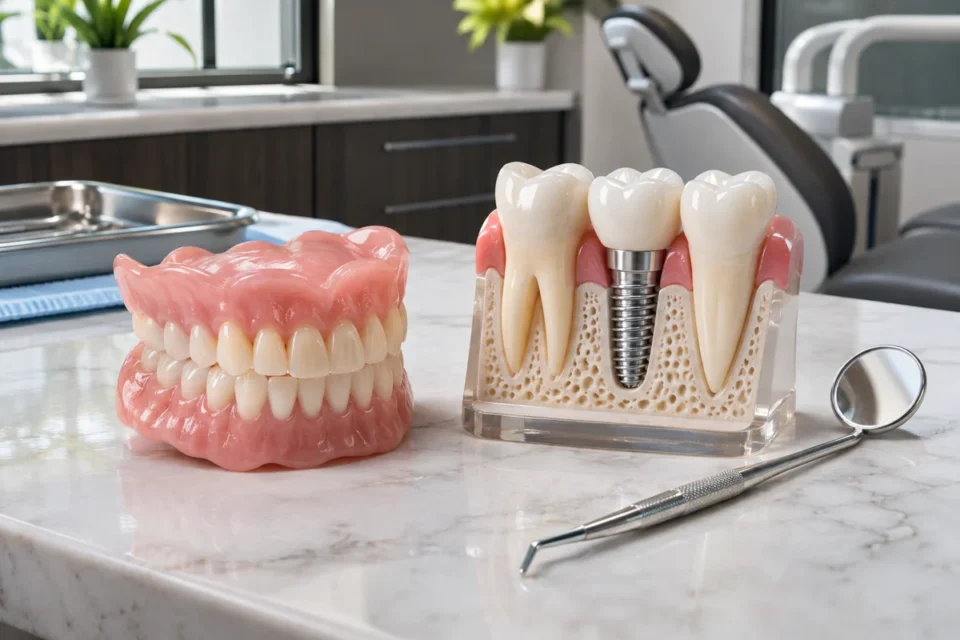
Dentures are removable appliances designed to replace several or all missing teeth. They rest against the gums and are shaped to fit the contours of your mouth.
Modern dentures can provide a natural-looking smile and comfortable function, but getting used to them usually takes some time.
The initial adjustment period
When you first receive dentures, they may feel bulky or unfamiliar.
You might notice:
-
Increased saliva production
-
Mild gum irritation or pressure
-
Changes in how your tongue moves
-
Difficulty pronouncing certain words
-
A feeling that the denture takes up extra space
These sensations often improve as your mouth adapts.
However, persistent soreness or discomfort shouldn’t simply be ignored. Your dentist may need to adjust the fit.
Can dentures feel comfortable?
Yes. Well-fitting dentures can feel comfortable for many patients, especially after the adjustment period.
Upper dentures may benefit from suction against the palate, while lower dentures can be more challenging to stabilize because of tongue movement and the shape of the lower jaw.
The comfort of your dentures depends on their design, the condition of your gums, and how well they fit.
Over time, the jawbone and gum tissues may change, requiring adjustments or relining.
Will dentures always feel like natural teeth?
Not exactly.
Even properly fitted dentures rest on oral tissues rather than being anchored like natural tooth roots.
You may notice some movement or pressure during certain activities.
However, many people adapt well and find that dentures allow them to enjoy meals, conversations, and social activities with greater confidence than leaving teeth missing.
How Do Dental Implants Feel Day to Day?
Dental implants are small posts, commonly made from titanium, surgically placed into the jawbone.
After healing, they provide support for replacement teeth such as crowns, bridges, or implant-supported dentures.
Because implants are anchored in bone, they generally provide a more stable foundation than conventional removable dentures.
A secure, tooth-like feel
A single dental implant supporting a crown can feel similar to a natural tooth during normal chewing.
Unlike a removable denture, the restoration doesn’t rest loosely against the gums or depend on suction to remain in place.
However, dental implants don’t reproduce every feature of natural teeth.
Natural teeth have periodontal ligaments that help provide sensory feedback during biting. Implants do not have these same ligaments, so pressure sensations may feel different.
Comfort after healing
Once an implant has healed and the final restoration is fitted, many patients find that it feels comfortable during everyday activities.
However, implant treatment involves surgery and a healing period.
Some patients may need additional procedures, such as bone grafting, before implant placement.
Temporary discomfort, swelling, and dietary restrictions may occur during recovery.
The long-term comfort of an implant also depends on proper placement, healthy surrounding tissues, and a well-designed restoration.
Implant-supported dentures
Not all dentures rely entirely on gum support.
Implant-supported dentures attach to implants placed in the jawbone.
Some are removable by the patient, while others are fixed and removed only by a dental professional when necessary.
These options can provide greater stability than traditional dentures, particularly for patients who struggle with loose lower dentures.
Which Option Feels More Stable When Eating?
Eating is one of the biggest daily differences patients notice when comparing dentures and dental implants.
Both options can improve chewing compared with having missing teeth, but they provide different levels of support.
Eating with traditional dentures
Removable dentures rely on the shape of the gums, surrounding muscles, and sometimes adhesives for retention.
During chewing, pressure is transferred to the gum tissues supporting the denture.
Some foods may be more challenging, particularly those that are hard, sticky, or require substantial biting force.
New denture wearers often benefit from starting with softer foods and gradually becoming comfortable with a wider variety of meals.
Cutting food into smaller pieces and chewing evenly can also help.
Eating with dental implants
Implant-supported restorations are anchored to the jawbone, which generally reduces movement during chewing.
This stability can make biting and chewing feel more predictable.
For example, someone with an implant-supported crown may find it easier to chew on the restored side compared with using a loose removable appliance.
However, implants don’t guarantee unrestricted eating.
During healing, patients may need to follow a soft-food diet. Even after recovery, unusually hard foods can damage implant restorations or natural teeth.
What if you already have loose dentures?
If your dentures move when chewing, the first step is to have their fit evaluated.
Relining, adjustments, or replacement may help.
For some patients, implant-supported dentures may provide additional stability.
You don’t necessarily need to replace every missing tooth with an individual implant to benefit from implant support.
How Do Dentures and Implants Affect Speaking?
Missing teeth can affect pronunciation, particularly for sounds that require contact between the tongue, lips, and teeth.
Both dentures and dental implants may help restore clearer speech, but the adjustment experience can differ.
Speaking with dentures
When you first receive dentures, certain words may sound different.
You might notice difficulty pronouncing sounds such as “s,” “f,” or “th.”
This happens partly because the denture changes the space available for your tongue and how it contacts the teeth.
Many people improve with practice as they become accustomed to the appliance.
Reading aloud and speaking regularly can help with adaptation.
However, dentures that shift or click during conversation may need adjustment.
Speaking with dental implants
Implant-supported crowns and bridges generally remain more stable during speech.
This can reduce concerns about an appliance moving while talking.
However, speech may still feel different initially, particularly when replacing several teeth or using a full-arch restoration.
The shape and positioning of the replacement teeth influence pronunciation.
Which sounds more natural?
Implants may provide an advantage in stability, but speaking comfortably depends on more than the type of tooth replacement.
The design of the restoration, tongue position, bite, and individual adaptation all matter.
Some patients speak very comfortably with well-fitting dentures, while others need more time to adjust to implant restorations.
What Are the Cleaning and Maintenance Differences?
Both dentures and dental implants require consistent care.
The main difference is how the replacement teeth are cleaned and which supporting tissues need attention.
Cleaning removable dentures
Traditional removable dentures should be cleaned every day to remove food particles, plaque, and other buildup.
Daily care generally includes:
-
Removing and rinsing the dentures
-
Brushing them with a suitable nonabrasive denture cleaner
-
Cleaning the gums, tongue, and remaining natural teeth
-
Following the dentist’s instructions for removing and storing dentures overnight
-
Attending regular dental appointments to check fit and tissue health
Ordinary toothpaste may be too abrasive for certain denture materials.
Dentures should also be kept moist when they’re not being worn, according to the manufacturer’s and dentist’s instructions.
Cleaning dental implants
Implant-supported crowns and bridges require daily plaque control.
Although implants cannot develop cavities, the surrounding gums and bone can be affected by inflammatory conditions such as peri-implant mucositis and peri-implantitis.
Daily cleaning may involve a soft toothbrush, floss, interdental brushes, or other tools recommended for the restoration.
Regular dental evaluations help monitor the implants and surrounding tissues.
Caring for implant-supported dentures
Maintenance depends on whether the denture is removable or fixed.
Removable implant-supported dentures require cleaning of the appliance and accessible implant attachments.
Fixed full-arch restorations need specialized cleaning around and beneath the prosthesis.
Attachment components, screws, or other parts may also require maintenance over time.
Neither dentures nor implants are maintenance-free. The right care routine depends on the type of restoration and your individual oral health.
How Do Cost and Long-Term Value Compare?
Cost is often an important part of choosing between dentures and dental implants.
Traditional dentures generally have a lower initial cost, while dental implants involve additional procedures, materials, and treatment planning.
However, the upfront price doesn’t tell the whole story.
Denture costs
The cost of dentures depends on the type of appliance, number of teeth being replaced, materials, and any necessary extractions or preparation.
Over time, dentures may require relining, adjustments, repairs, or replacement.
Changes in the jawbone and gum tissues can affect their fit.
Dental implant costs
Implant treatment generally has a higher initial cost because it can involve surgery, imaging, implant components, and custom restorations.
Additional procedures, such as bone grafting, can increase the total expense.
However, implants may provide long-term functional benefits for suitable patients.
The implant itself can remain functional for many years, but crowns, bridges, and denture components may need maintenance or replacement.
Comparing the options
Think about the complete treatment cost
When comparing options, ask your dentist about the total estimated expense.
This should include any necessary preparatory procedures, the final restoration, follow-up appointments, and likely maintenance considerations.
Dental insurance coverage varies, so confirm what your plan may contribute.
The most affordable option upfront isn’t always the least expensive over many years, but implants aren’t automatically the better financial choice for every patient.
Who Is a Better Candidate for Dentures?
Dentures may be a practical choice for patients who have lost several or all of their teeth and want a removable replacement option.
They may also suit people who prefer to avoid implant surgery or have medical circumstances that make surgery less appropriate.
Dentures may be worth considering if you:
-
Are missing multiple teeth or an entire arch
-
Prefer a non-surgical tooth replacement
-
Want a lower initial treatment cost
-
Have limited jawbone support for implants
-
Are comfortable removing and cleaning an appliance
-
Need a replacement option while considering future treatment
Dentures can also be appropriate for patients who still have healthy natural teeth.
A removable partial denture can replace selected missing teeth while using the remaining teeth for additional support.
What affects denture comfort?
The shape of your gums, jawbone ridge, bite, and saliva flow all influence how a denture fits.
If substantial bone loss has occurred, achieving stability may be more challenging.
Your dentist may recommend adjustments, a different denture design, or implant support if appropriate.
Choosing dentures doesn’t mean you’re accepting an inferior treatment. For some patients, they provide an effective balance of comfort, function, affordability, and convenience.
Who Is a Better Candidate for Dental Implants?
Dental implants may be suitable for patients who want a stable replacement for one or more missing teeth and are willing to undergo the necessary surgical and healing process.
However, implant candidacy requires a careful evaluation.
Implants may be worth considering if you:
-
Want a fixed alternative to removable dentures
-
Have healthy gums or controlled periodontal disease
-
Have sufficient jawbone or qualify for bone grafting
-
Are medically suitable for implant surgery
-
Can maintain thorough oral hygiene
-
Prefer greater stability during chewing and speaking
-
Are comfortable with the treatment timeline and cost
Why jawbone health matters
Dental implants require adequate bone support.
When teeth have been missing for a long time, the surrounding jawbone may shrink.
In some cases, bone grafting can help prepare the area for implant placement.
However, not every patient needs grafting, and additional procedures don’t guarantee candidacy.
Medical and lifestyle considerations
Certain health conditions, medications, smoking habits, and uncontrolled periodontal disease can influence implant treatment and healing.
For example, poorly controlled diabetes and tobacco use may increase the risk of complications.
These factors don’t always rule out implants, but they should be discussed during the consultation.
What if you want more stability but still prefer dentures?
Implant-supported dentures may offer a middle ground.
They combine the replacement of multiple teeth with additional support from implants.
This can be particularly useful for patients who have difficulty keeping conventional lower dentures stable.
Your dentist can explain whether a removable implant overdenture or fixed restoration would be appropriate.
Tooth Replacement at Cornerstone Smiles
Choosing between dentures and dental implants isn’t simply about which option looks better.
It’s about finding a replacement that allows you to eat comfortably, speak confidently, and maintain your oral health.
At Cornerstone Dentistry in Anderson, SC, we help patients explore tooth replacement options based on their needs, oral health, and long-term goals.
Personalized Denture and Implant Consultations
We understand that every patient’s experience with missing teeth is different.
Some patients have lost a single tooth, while others are dealing with several missing teeth or uncomfortable existing dentures.
During your consultation, we assess your gums, remaining teeth, jawbone support, and bite.
We also discuss your priorities, including stability, appearance, maintenance, treatment time, and budget.
Our services include full and partial dentures, implant-supported dentures, single-tooth dental implants, implant-supported bridges, and full-arch implant restorations.
Find a Comfortable Tooth Replacement Option
If you’re concerned about dentures slipping or wondering whether implants would feel more natural, we’re here to help you understand the differences.
Our team uses digital imaging and personalized treatment planning to evaluate your options.
We also help patients with existing dentures who may need adjustments, repairs, or a discussion about more stable replacement choices.
You don’t have to decide which treatment you want before your consultation.
At Cornerstone Dentistry, we explain the available options and help you make an informed decision based on your oral health and preferences.
Contact Cornerstone Dentistry at (864) 222-9001 to schedule a tooth replacement consultation in Anderson, SC.
FAQs About Dentures and Dental Implants
Do dental implants feel more natural than dentures?
Dental implants generally provide greater stability because they are anchored in the jawbone. However, well-fitting dentures can also feel comfortable after an adjustment period. The experience depends on the restoration and individual oral conditions.
Can you eat normally with dentures?
Many patients can enjoy a wide variety of foods after becoming accustomed to their dentures. However, certain hard or sticky foods may remain difficult. Proper fit and regular adjustments help improve chewing comfort.
Are dental implants more comfortable than dentures?
Implants may offer greater stability and reduce movement during chewing, but they require surgery and healing. Comfort depends on implant placement, restoration design, oral health, and individual adaptation.
Do dentures affect the way you speak?
Dentures can temporarily change pronunciation, particularly when they’re new. Many patients adapt with practice. If the dentures continue slipping or clicking during speech, an adjustment may be needed.
Do dental implants require less cleaning than dentures?
Not necessarily. Implants need careful daily cleaning to protect the surrounding gums and bone. Removable dentures require cleaning outside the mouth, while fixed implant restorations may need specialized cleaning underneath.
Can you switch from dentures to dental implants later?
Sometimes. Patients who already wear dentures may qualify for implants or implant-supported dentures. The dentist must evaluate jawbone support, gum health, medical history, and the existing restoration.
Are dentures cheaper than dental implants?
Traditional dentures generally cost less upfront. Dental implants involve additional surgical and restorative expenses. However, long-term costs depend on maintenance, repairs, replacement needs, and the selected treatment.
Are implant-supported dentures removable?
Some implant-supported dentures are removable by the patient for cleaning, while others are fixed in place and can only be removed by a dental professional. Your dentist can explain which design is suitable for your needs.
Which option is better for older adults?
Age alone doesn’t determine whether dentures or implants are more appropriate. Overall health, jawbone condition, oral hygiene abilities, preferences, and budget are more useful considerations.
How do I decide between dentures and implants?
Start with a dental consultation. Your dentist can evaluate your gums, bone support, remaining teeth, and medical history, then explain how each option compares for comfort, function, cost, and maintenance.