
Table of Contents
Losing a tooth can be frustrating, but if the empty space doesn’t hurt or affect your smile, replacing it might not seem urgent. You may even get used to chewing on the other side of your mouth and decide to address the gap later.
The problem is that a missing tooth can affect more than your appearance. Over time, nearby teeth may move, the jawbone can change, and everyday activities such as chewing may become less comfortable. These changes don’t happen to everyone at the same rate, but knowing what to watch for can help you make informed decisions about your dental health.
Quick Answer: Why Missing Teeth Should Not Be Ignored
Leaving a missing tooth untreated can allow neighboring teeth to shift, affect your bite, contribute to jawbone loss, and make chewing or speaking more difficult. However, the extent of these changes depends on the missing tooth’s location, your oral health, and how long the space remains. A dentist can evaluate whether replacement is recommended and discuss options such as implants, bridges, or dentures.
How Can Nearby Teeth Shift Into Empty Space?
Your teeth work together to maintain a stable bite. Each tooth has a position within the dental arch, supported by the surrounding bone, gums, and neighboring teeth.
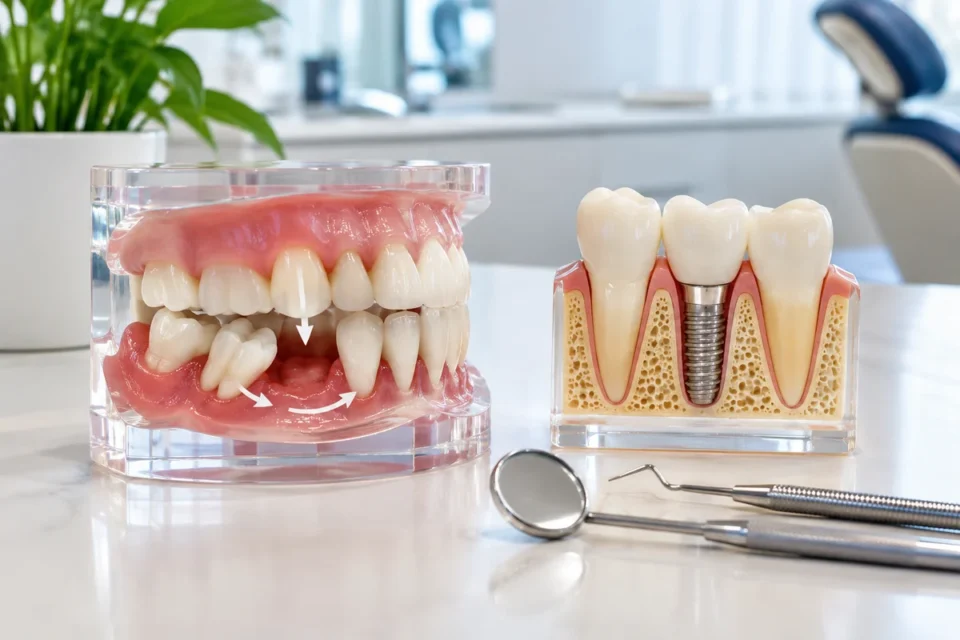
When a tooth is lost, the empty space may allow nearby teeth to gradually change position.
Adjacent teeth may tilt toward the gap
Teeth on either side of an empty space may slowly lean or drift toward it.
For example, if you lose a lower molar, the teeth next to it may begin tilting into the available space.
This can affect how the teeth contact one another during chewing.
It may also create areas where food becomes trapped more easily.
The opposing tooth may move
Teeth normally contact their opposing teeth when you bite.
If an upper tooth no longer has a lower tooth to bite against, it may gradually extend farther into the empty space.
Dentists call this supra-eruption or overeruption.
This change can affect the relationship between your upper and lower teeth.
Does every missing tooth cause shifting?
No.
The likelihood and amount of tooth movement depend on several factors, including:
- Which tooth is missing
- The position of neighboring teeth
- Your existing bite alignment
- The condition of your gums and supporting bone
- Whether other teeth are already missing
- How long the space has been present
Some gaps remain relatively stable, while others develop noticeable changes.
Your dentist can monitor the space and determine whether replacement would help preserve your bite.
What Bite Problems Can Develop Over Time?
Your bite describes how your upper and lower teeth fit together when you close your mouth.
When a tooth is lost, the remaining teeth may need to accommodate the missing contact.
In some cases, these changes affect how chewing forces are distributed.
Uneven chewing pressure
Missing a molar may cause you to favor the opposite side of your mouth.
This doesn’t automatically damage your remaining teeth, but it may change your chewing habits.
If you already have worn teeth, large restorations, or bite problems, losing another tooth may make your dental situation more complicated.
Changes in tooth alignment
When nearby teeth tilt or opposing teeth overerupt, your bite contacts may change.
For example, a tooth that has moved into the gap may interfere with the placement of a future replacement.
You may also notice that your teeth no longer seem to fit together as comfortably as before.
Can a missing tooth cause jaw pain?
Sometimes, people with missing teeth experience chewing discomfort or muscle fatigue.
However, jaw pain has many possible causes, including teeth grinding, temporomandibular disorders, and muscle tension.
A missing tooth doesn’t automatically cause a TMJ disorder.
If you develop persistent jaw pain, clicking accompanied by discomfort, or difficulty chewing, a dental evaluation can help identify the cause.
Why alignment matters for future treatment
Significant tooth movement can make replacement planning more challenging.
For instance, your dentist may need to assess whether enough space remains for an implant or bridge.
In some cases, orthodontic treatment or additional restorative planning may be considered before replacing the tooth.
This is one reason it can be useful to discuss replacement options before noticeable shifting occurs.
Why Does Bone Loss Happen After Tooth Loss?
Your jawbone supports your natural teeth through their roots and the surrounding periodontal tissues.
When a tooth is removed or lost, the bone around its former root no longer receives the same functional stimulation.
As the extraction site heals, the supporting ridge naturally changes shape.
This process is called alveolar bone remodeling or resorption.
What happens to the bone after extraction?
Following tooth removal, the socket heals and bone remodeling begins.
Over time, the ridge may become narrower or shorter.
Some changes occur relatively early after extraction, while others continue gradually.
The amount of change varies based on the extraction site, surrounding bone, gum health, and individual healing.
Can bone loss affect your appearance?
When several teeth are missing, changes in the jawbone and surrounding tissues may affect facial support.
For example, extensive tooth loss can contribute to changes in the lips, cheeks, and lower facial appearance.
However, losing one tooth doesn’t necessarily cause noticeable facial changes.
The effect depends on the tooth’s location and the extent of bone remodeling.
Does replacing the tooth stop bone loss?
Different replacement options affect the jawbone differently.
A conventional dental bridge or removable denture replaces the visible tooth but does not replace its natural root.
Dental implants are placed within the jawbone and transfer functional forces through the implant.
This can help maintain bone around a functioning implant, although implants don’t prevent every type of bone change.
What if you’ve already lost bone?
Bone loss doesn’t automatically mean you’re unable to receive a dental implant.
In some cases, bone grafting may help create adequate support for future implant placement.
However, grafting isn’t suitable or necessary for every patient.
Your dentist will need imaging and a clinical examination to assess the available bone.
Can a Missing Tooth Affect Chewing?
Yes. A missing tooth can change how you bite and break down food, especially when the tooth is a molar or premolar.
Back teeth play an important role in grinding and crushing food.
When one is missing, the surrounding teeth may need to take on more of the chewing work.
You may favor one side
If chewing near the gap feels uncomfortable, you may begin using the opposite side more often.
This can become a habit, even when the original extraction site has completely healed.
Certain foods may become harder to eat
People missing multiple back teeth may find it more difficult to chew foods such as:
- Raw vegetables
- Nuts and seeds
- Tougher cuts of meat
- Crunchy fruits
- Other foods requiring repeated grinding
The extent of difficulty depends on how many teeth are missing and the condition of your remaining teeth.
A single missing molar may cause relatively little noticeable difficulty for one person while significantly affecting another.
Does tooth loss affect nutrition?
Extensive tooth loss can limit food choices, especially when chewing becomes difficult.
Some people may avoid nutritious foods that require more chewing.
However, having one missing tooth doesn’t automatically lead to nutritional problems.
The concern is whether the gap affects your ability to maintain a varied, comfortable diet.
If you’ve changed your eating habits because of missing teeth, mention this during your dental appointment.
Can Tooth Loss Affect Speech or Appearance?
The effect of a missing tooth on speech and appearance depends heavily on its location.
Losing a front tooth usually creates different concerns from losing a back molar.
Front teeth help form certain sounds
Your tongue, teeth, and lips work together when you speak.
Missing front teeth may affect sounds that require contact between these structures.
For example, some people notice changes in the pronunciation of certain “s,” “f,” or “th” sounds.
However, speech changes aren’t inevitable.
Your mouth may adapt, and the effect depends on the number and position of missing teeth.
A gap can change your smile
Missing a visible tooth may affect how comfortable you feel smiling in photos or speaking with others.
Some patients become self-conscious, while others aren’t particularly bothered by the appearance.
Both responses are understandable.
Replacement decisions should consider your personal preferences alongside your dental health.
Multiple missing teeth may affect facial support
Your teeth and supporting tissues contribute to the structure of your smile.
When several teeth are missing, changes in bone and soft tissue can alter the appearance of the mouth and lower face.
Dentures, bridges, or implant-supported restorations may help restore some of the lost support, depending on the situation.
What if the missing tooth isn’t visible?
A missing back tooth may have little effect on your smile’s appearance.
However, it’s still worth having the gap evaluated because potential changes in chewing, tooth position, and bone support may not be obvious.
A tooth doesn’t have to be visible to play an important role in your mouth.
What Replacement Options Are Available for Missing Teeth?
If you’re missing a tooth, several treatment options may be available.
The right choice depends on the location of the gap, health of nearby teeth, available bone, budget, and long-term goals.
Not every missing tooth needs to be replaced in the same way. For example, wisdom teeth are often removed without replacement, and certain spaces may be monitored or managed differently.
Dental implants
A dental implant is placed in the jawbone and supports a replacement tooth.
For a single missing tooth, an implant-supported crown may restore function without requiring the neighboring teeth to support a bridge.
Implants can also support bridges or dentures when multiple teeth are missing.
However, implant treatment involves surgery, adequate bone support, and a healing period.
Not everyone is an immediate candidate.
Dental bridges
A dental bridge replaces one or more missing teeth using neighboring teeth or implants for support.
A traditional bridge generally involves preparing adjacent teeth to hold supporting crowns.
Bridges may be suitable for patients who prefer a fixed replacement without implant surgery.
However, the supporting teeth must be healthy enough for the restoration.
Removable partial dentures
A partial denture replaces one or more missing teeth while some natural teeth remain.
It can be a practical choice when several teeth need replacement or when a removable option better fits the patient’s needs.
Partial dentures are taken out for cleaning and may require adjustments as the mouth changes.
Full or implant-supported dentures
When many or all teeth are missing, full dentures or implant-supported dentures may be appropriate.
Implant support may provide greater stability than traditional removable dentures.
The suitable design depends on available bone, oral health, treatment preferences, and cost.
Could leaving the space open ever be appropriate?
Yes, in selected situations.
A dentist may recommend monitoring a space when the functional consequences are limited, the patient has a stable bite, or replacement is not advisable for other reasons.
Some patients may also be candidates for orthodontic space closure.
The important distinction is between making an informed decision to leave a space and simply ignoring it without knowing the potential effects.
When Should You Talk to a Dentist?
You don’t need to wait until nearby teeth shift or chewing becomes difficult before discussing a missing tooth.
A consultation can help you understand whether the gap is likely to affect your dental health and which treatment options are available.
If you’ve recently lost a tooth
If you recently had a tooth extracted, ask your dentist whether replacement should be considered.
The timing may matter when planning an implant because the extraction site and surrounding bone change as they heal.
However, immediate implant placement isn’t suitable for every patient.
If bone grafting or another preparation procedure is recommended, your dentist can explain why.
If the tooth has been missing for years
It’s still worth scheduling an evaluation.
You may have enough space and bone for a replacement, or additional planning may be needed.
A long-standing gap doesn’t automatically mean you’ve waited too long for treatment.
If you’re noticing changes
Consider scheduling a dental appointment if you experience:
- Teeth appearing to shift or tilt
- New spaces between neighboring teeth
- Difficulty chewing certain foods
- Changes in how your bite fits together
- Food repeatedly collecting around the gap
- Persistent discomfort in nearby teeth
- Concerns about your smile or speech
Your dentist can determine whether these changes relate to the missing tooth or another dental issue.
What happens during the evaluation?
Your dentist may examine the remaining teeth, gums, bite, and missing-tooth area.
Dental X-rays or other imaging may help assess bone support and nearby structures.
If you’re considering implants, additional three-dimensional imaging may be appropriate for treatment planning.
Your dentist can then explain the benefits, limitations, costs, and expected maintenance of suitable options.
Missing Tooth Care at Cornerstone Smiles
If you’ve been living with a missing tooth, you may wonder whether replacement is still possible or whether the gap has already affected your oral health.
At Cornerstone Dentistry in Anderson, SC, we help patients evaluate missing teeth and explore ways to restore their smiles.
We understand that tooth replacement involves more than choosing a dental procedure. Your remaining teeth, gum health, bite, jawbone, and personal preferences all influence the decision.
Personalized Missing Tooth Evaluations
During your appointment, we examine the area where the tooth is missing and assess the condition of your surrounding teeth.
We may use digital imaging and other diagnostic tools to evaluate your jawbone, bite, and available treatment space.
If you’ve had a missing tooth for several years, we can also assess whether nearby teeth have moved or whether additional preparation may be necessary.
Exploring Your Tooth Replacement Options
Our restorative dentistry services include dental implants, dental bridges, partial dentures, full dentures, and implant-supported restorations.
We discuss the options that may suit your situation, including differences in function, treatment time, maintenance, and cost.
For example, a patient missing one back tooth may have different needs from someone with several missing teeth or an uncomfortable existing denture.
We don’t assume every patient needs the same solution.
Schedule a Missing Tooth Consultation in Anderson, SC
Whether your tooth was recently extracted or you’ve lived with a gap for years, an examination can help you understand the next steps.
At Cornerstone Dentistry, we serve patients in Anderson and surrounding South Carolina communities.
Our goal is to help you make an informed decision about restoring function, protecting your remaining teeth, and maintaining your oral health.
Contact Cornerstone Dentistry at (864) 222-9001 to schedule a consultation and discuss your missing tooth replacement options.
FAQs About Replacing Missing Teeth
What happens if you don’t replace a missing tooth?
Nearby teeth may shift, your bite can change, and bone loss may occur around the missing-tooth area. Chewing or speaking may also become more difficult. However, these changes vary depending on which tooth is missing and your overall oral health.
How long can you go without replacing a missing tooth?
There is no universal deadline. Bone remodeling begins after tooth loss, and some teeth may gradually shift over time. Your dentist can assess whether replacement is recommended and when treatment would be appropriate.
Will my teeth shift if I don’t replace a missing molar?
They may. Teeth next to the gap can tilt or drift, and the opposing tooth may overerupt. However, the amount and likelihood of movement depend on your existing bite, tooth position, and other factors.
Does losing one tooth cause bone loss?
Some localized bone remodeling usually occurs after a natural tooth is removed because the supporting bone no longer functions in the same way. The amount varies by individual and location.
Is it harder to get a dental implant after waiting several years?
It can be. Bone loss or shifting teeth may affect implant placement and require additional planning. However, many patients with long-standing gaps may still qualify for implants, sometimes with preparatory procedures.
Do you need to replace a missing back tooth?
Not always, but it’s worth having the space evaluated. Back teeth help with chewing and bite stability. Your dentist can assess whether leaving the gap is reasonable or whether a replacement may provide functional benefits.
Can a dental bridge prevent teeth from shifting?
A properly designed bridge fills a missing-tooth space and can help maintain tooth position and restore chewing contacts. However, its suitability depends on the health and strength of the supporting teeth.
Is a dental implant better than a bridge for a missing tooth?
Neither option is universally better. Implants replace the missing tooth without relying on adjacent teeth for support, while bridges can provide a fixed restoration without implant surgery. The right choice depends on your oral health, anatomy, budget, and preferences.
Can I replace a tooth that’s been missing for 10 years?
Possibly. Even after many years, replacement options may remain available. Your dentist will evaluate jawbone support, spacing, gum health, and the condition of surrounding teeth before recommending a treatment plan.
Is it ever okay to leave a missing tooth unreplaced?
Yes. Certain teeth, including wisdom teeth, are commonly not replaced. Other spaces may be monitored if your dentist determines that leaving them open is appropriate. The decision should be based on an examination rather than assuming the gap will never cause problems.