
Table of Contents
Waking up with a sore jaw isn’t a pleasant way to start your day. Maybe your cheeks feel tight, your temples ache, or you notice discomfort when you open your mouth for breakfast. Sometimes, the soreness disappears after you’ve been awake for a while. Other times, it follows you throughout the day.
Morning jaw pain can happen for several reasons, including nighttime teeth grinding, clenching, jaw muscle tension, and temporomandibular joint disorders. Your sleeping habits may also play a role.
If you’ve been wondering why your jaw hurts after sleeping, here’s what could be happening and when it’s time to have your symptoms checked.
Quick Answer: What Causes Morning Jaw Pain?
Morning jaw pain is commonly associated with nighttime teeth grinding or clenching, jaw muscle tension, and temporomandibular disorders (TMD). These conditions can leave the jaw sore, stiff, or tired after sleeping. Sleep quality and sleeping position may also contribute to discomfort. However, morning pain alone cannot identify the cause, and persistent symptoms should be evaluated by a dentist.
How Do Teeth Grinding and Clenching Cause Jaw Pain?
One possible explanation for morning jaw pain is bruxism, which refers to grinding, clenching, or gnashing your teeth.
Bruxism can occur while you’re awake or asleep.
When it happens during sleep, you may not realize you’re doing it.
Your jaw muscles may be working overnight
Your chewing muscles are designed to help you bite, chew, and move your jaw.
When you repeatedly clench or grind your teeth, these muscles can become overworked.
For example, clenching involves holding the teeth tightly together, while grinding generally involves moving them against one another.
Both behaviors can place additional demands on your jaw muscles.
As a result, you may wake up with soreness around your cheeks, temples, or jaw.
Signs you might be grinding your teeth
Morning soreness isn’t the only possible symptom of sleep bruxism.
You may also notice:
- Jaw muscles that feel tired after waking
- Headaches around your temples
- Tooth sensitivity
- Flattened or worn tooth surfaces
- Chipped or cracked teeth
- Tightness when opening your mouth
- Facial muscle tenderness
Sometimes, a sleeping partner notices grinding sounds before the person experiencing bruxism becomes aware of the habit.
However, some people clench without making obvious sounds.
What causes nighttime grinding?
The causes of sleep bruxism aren’t always clear.
Several factors may be associated with the behavior, including stress, certain medications, smoking, caffeine, and alcohol consumption.
Genetic factors may also play a role.
That doesn’t mean every person who feels stressed will grind their teeth or that stress is always the cause.
A dentist can examine your teeth and jaw muscles for possible signs of bruxism.
Can TMJ Disorders Cause Pain After Sleeping?
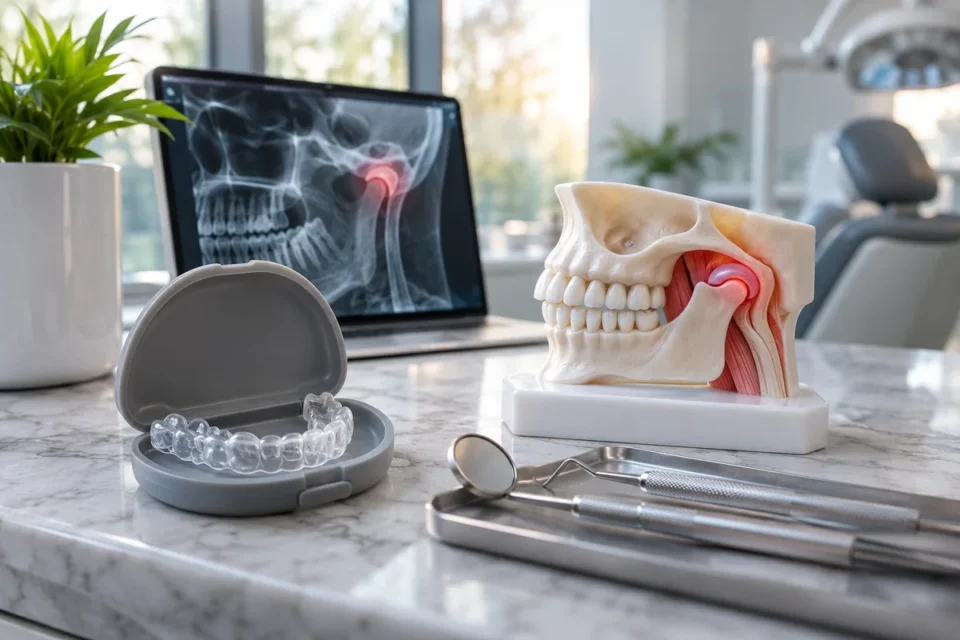
Your temporomandibular joints, commonly called TMJs, connect your lower jaw to your skull.
You have one joint on each side of your face, just in front of your ears.
These joints work with surrounding muscles to help you chew, speak, and open your mouth.
When problems affect the jaw joints or associated muscles, they may be classified as temporomandibular disorders, or TMD.
Why might TMD feel worse in the morning?
People with TMD may experience muscle pain, joint tenderness, or stiffness after a period of rest.
Nighttime clenching may contribute to symptoms in some patients.
Others may notice morning discomfort without any confirmed grinding habit.
The causes of TMD are complex, and symptoms do not always have one identifiable explanation.
Common signs of a TMJ-related problem
Along with morning jaw pain, you might experience:
- Pain near one or both ears
- Difficulty opening your mouth fully
- Pain when chewing
- Tenderness in the cheeks or temples
- Jaw stiffness
- Painful clicking or popping
- Episodes of jaw locking
These symptoms can affect daily activities, including eating and speaking.
Does clicking mean something is wrong?
Not necessarily.
Jaw clicking or popping without pain is relatively common and doesn’t automatically require treatment.
However, clicking accompanied by discomfort, locking, or limited movement deserves professional evaluation.
If your jaw feels stiff every morning or the pain keeps returning, a dentist can help determine whether a TMJ-related condition may be involved.
How Can Sleep Position Affect Jaw Tension?
The position of your head and neck during sleep may influence how comfortable your jaw feels when you wake up.
However, research directly linking particular sleeping positions to TMD symptoms is limited.
Sleeping position should be considered one possible contributing factor, not a confirmed cause of morning jaw pain.
Sleeping with pressure against your face
If you sleep on your stomach with your face pressed firmly into a pillow, the position may place pressure on one side of your jaw.
Some people find that this increases their discomfort, especially when they already have tender jaw muscles.
However, not everyone experiences this problem.
Neck support may matter
A pillow that leaves your head and neck in an uncomfortable position may contribute to muscular discomfort.
For example, if you wake up with both neck stiffness and jaw soreness, it may be worth considering whether your sleeping setup feels supportive.
This doesn’t mean you need to purchase a special pillow.
Small adjustments to head and neck support may help with comfort.
Should you sleep on your back?
There’s no single sleeping position that has been proven best for everyone with jaw pain.
Some people find back sleeping comfortable, while others prefer sleeping on their side.
If you have suspected or diagnosed sleep apnea, sleeping position may also affect breathing, so discuss major positional changes with your sleep healthcare provider.
The goal is to avoid unnecessary pressure and find a comfortable position rather than force yourself into one particular posture.
Is There a Connection Between Sleep Apnea and Nighttime Jaw Stress?
Sleep apnea is a condition that causes breathing interruptions during sleep.
Obstructive sleep apnea occurs when the upper airway repeatedly becomes partially or completely blocked.
Some people with sleep-related breathing problems also experience teeth grinding or jaw discomfort.
However, the relationship between sleep bruxism and obstructive sleep apnea is still being studied.
Does sleep apnea cause teeth grinding?
Not necessarily.
Research has found that the two conditions can occur together, but evidence has not established that sleep apnea directly causes grinding in every affected person.
You can have bruxism without sleep apnea, and you can have sleep apnea without bruxism.
Morning jaw pain by itself is not enough to diagnose either condition.
Signs that deserve further evaluation
If your jaw discomfort occurs alongside sleep-related symptoms, tell your dentist or healthcare provider.
Possible signs of obstructive sleep apnea include:
- Frequent loud snoring
- Breathing pauses noticed by a sleeping partner
- Waking up gasping for air
- Excessive daytime sleepiness
- Morning headaches
- Dry mouth after waking
- Feeling unrefreshed despite adequate time in bed
These symptoms may suggest a sleep-related breathing disorder, although they can have other explanations.
How is sleep apnea diagnosed?
A medical evaluation and appropriate sleep testing may be needed to diagnose sleep apnea.
Your dentist may recognize potential warning signs and recommend evaluation by a qualified sleep healthcare professional.
Dental appliances can be part of treatment for selected patients with diagnosed obstructive sleep apnea, but they aren’t automatically appropriate for everyone.
If your jaw hurts in the morning and you’re also experiencing significant snoring or daytime fatigue, mention both concerns during your appointment.
Why Can Morning Jaw Pain Come With Headaches or Ear Pain?
Your jaw joints and chewing muscles are located close to several important structures in your face and head.
When these muscles or joints become painful, discomfort may extend beyond your jaw.
Headaches around the temples
The temporalis muscles help move your jaw during chewing.
These muscles extend across the sides of your head.
When they’re tender or overworked, you may notice aching around your temples.
Some patients describe this as a tension-like headache that is particularly noticeable after waking.
However, headaches can have many causes, including migraine, sleep disturbances, and other medical conditions.
Morning headaches don’t automatically mean you have a TMJ disorder.
Ear discomfort without an ear infection
The TMJ sits close to the ear.
Jaw-related pain can sometimes be felt around the ear even when the ear itself isn’t the source.
You may experience pressure, aching, or discomfort when chewing.
However, actual ear infections and other ear conditions can cause similar symptoms.
Persistent ear pain, hearing changes, or dizziness should be evaluated appropriately rather than automatically attributed to the jaw.
Facial and neck soreness
Jaw muscle discomfort may also occur alongside tenderness in the cheeks, face, or neck.
Some patients notice that their symptoms become more noticeable during stressful periods or after prolonged chewing.
Because these symptoms overlap with other conditions, a careful examination is important.
When Does Jaw Pain Need Dental Evaluation?
Occasional mild jaw soreness may improve on its own, particularly when it follows an unusual period of chewing or temporary muscle strain.
However, recurring morning pain shouldn’t simply become something you accept as normal.
Symptoms that deserve an appointment
Consider scheduling a dental evaluation if:
- You regularly wake up with jaw pain
- The discomfort lasts throughout the day
- Your jaw feels increasingly stiff
- Chewing becomes painful
- You notice frequent headaches or facial soreness
- Your teeth appear worn or chipped
- You experience painful clicking or popping
- Your jaw movement becomes limited
A dentist can check whether the symptoms appear related to your teeth, jaw muscles, or joints.
How will your dentist examine the problem?
Your dentist may begin by asking when the discomfort occurs and whether you notice grinding, clenching, headaches, or sleep disturbances.
The examination may include checking:
- Jaw movement and range of motion
- Tenderness in the chewing muscles
- Pain or sounds around the joints
- Tooth wear or fractures
- Changes in your bite
- Signs of other dental conditions
Imaging or additional evaluation may be recommended when clinically necessary.
When should you seek urgent care?
Seek prompt dental or medical attention if you have severe or worsening pain, significant facial swelling, fever, difficulty opening your mouth, or a jaw that becomes locked.
If jaw pain occurs with chest pressure, shortness of breath, sweating, or other symptoms of a possible heart attack, seek emergency medical care immediately.
Not every case of jaw pain is caused by grinding or a TMJ problem.
What Treatment Options May Help Morning Jaw Pain?
The best approach depends on what’s causing your symptoms.
Some cases improve with simple changes to daily habits, while others require professional treatment.
A dentist should identify the likely source of discomfort before recommending a specific procedure.
Gentle jaw self-care
For mild muscle-related discomfort, your provider may recommend conservative measures such as:
- Eating softer foods temporarily
- Avoiding chewing gum
- Limiting very wide mouth opening
- Applying a warm or cool compress
- Practicing gentle jaw relaxation
- Reducing habits such as nail biting or daytime clenching
Avoid forcing your jaw through painful stretches or movements.
Becoming aware of daytime clenching
Some people repeatedly hold their teeth together while concentrating, driving, or working.
When you’re not chewing or swallowing, your teeth should generally remain slightly apart, with your jaw relaxed.
Becoming more aware of this habit may help reduce unnecessary muscle activity.
Custom nightguards
If your dentist finds evidence of teeth grinding, a custom nightguard may be recommended.
A nightguard can help protect your teeth from grinding-related damage.
Some patients also experience symptom relief.
However, nightguards don’t reliably stop all sleep bruxism, and evidence that they relieve TMD pain is limited.
The appliance should be selected and monitored according to your individual needs.
Physical therapy and other conservative care
For certain jaw muscle or joint conditions, physical therapy may help improve movement and reduce pain.
Depending on the diagnosis, additional recommendations may include appropriate pain management, guided exercises, or behavioral approaches to managing tension.
Treatments that permanently change your bite or jaw structure are generally not recommended as an initial approach to TMD.
Addressing sleep-related concerns
If symptoms suggest a possible sleep disorder, your provider may recommend further screening or referral.
Treating an identified sleep problem is important for your overall health, but it doesn’t guarantee that jaw pain or bruxism will disappear.
The goal is to address the actual cause of your discomfort, not assume every patient with morning jaw pain needs the same treatment.
TMJ Help at Cornerstone Smiles
Waking up with jaw pain can make eating breakfast, talking, and getting ready for the day uncomfortable.
At Cornerstone Dentistry in Anderson, SC, we help patients investigate jaw discomfort, teeth grinding, clenching, and possible TMJ-related symptoms.
We understand that morning jaw pain may involve several factors, including muscle tension, jaw joint function, dental problems, and sleep-related concerns.
Our approach begins with identifying what’s contributing to your symptoms.
Personalized Jaw Pain Evaluations
During your appointment, we review your symptoms and examine how your jaw moves.
We may assess muscle tenderness, tooth wear, jaw clicking, and other clinical findings that help us understand your discomfort.
If you regularly wake up with headaches or facial soreness, we’ll also discuss whether nighttime grinding or clenching may be contributing.
When symptoms suggest a possible sleep-related breathing issue, we can discuss appropriate screening or referral.
Conservative Treatment Options
Depending on your findings, we may recommend custom nightguards, jaw exercises, habit changes, or other appropriate care.
Our team also evaluates whether additional treatment or collaboration with another healthcare professional may be beneficial.
Not every patient needs an oral appliance or extensive treatment.
Sometimes, conservative changes and appropriate follow-up are the best starting point.
Schedule a Jaw Pain Consultation in Anderson, SC
If morning jaw pain keeps returning, it’s worth finding out what’s behind it.
At Cornerstone Dentistry, we serve patients in Anderson and surrounding South Carolina communities, including Clemson, Seneca, Powdersville, and Belton.
We can help you explore possible causes of your discomfort and discuss appropriate next steps.
Contact Cornerstone Dentistry at (864) 222-9001 to schedule a dental evaluation for morning jaw pain.
FAQs About Morning Jaw Pain
Why does my jaw hurt when I wake up but feel better later?
Morning jaw soreness may be associated with nighttime clenching, grinding, or muscle tension. Symptoms sometimes improve as your jaw moves during the day. However, the pattern alone cannot confirm a diagnosis.
Can stress cause morning jaw pain?
Stress may contribute to jaw clenching or increased muscle tension in some people. However, it isn’t the only possible cause of morning jaw pain. Persistent symptoms should be evaluated rather than attributed to stress alone.
How can I tell if I grind my teeth at night?
Possible signs include morning jaw soreness, headaches, tooth sensitivity, and worn or chipped teeth. A sleeping partner may also notice grinding sounds. A dentist can evaluate these findings, although an examination may not establish exactly when grinding occurs.
Does morning jaw pain always mean I have TMJ?
No. Everyone has temporomandibular joints, but not everyone has a temporomandibular disorder. Morning pain may involve muscle tension, bruxism, dental problems, or other conditions.
Can sleeping on my side cause jaw pain?
Sleeping with pressure against your face may contribute to discomfort for some people, particularly if their jaw is already sensitive. However, there is limited evidence that side sleeping alone causes TMJ disorders.
Can sleep apnea cause morning jaw pain?
Sleep apnea and nighttime teeth grinding can occur together, but a direct cause-and-effect relationship hasn’t been established. If you have jaw pain along with loud snoring, breathing pauses, or daytime sleepiness, discuss possible sleep apnea with a healthcare professional.
Will a nightguard stop my jaw from hurting?
A nightguard may protect your teeth from grinding and may help some patients, but it doesn’t guarantee relief from jaw pain. Treatment depends on the underlying cause, and the appliance should be properly fitted and monitored.
Why does my jaw hurt near my ear in the morning?
The jaw joint is located close to your ear, so problems involving the joint or surrounding muscles can cause discomfort in that area. Ear conditions and other causes should also be considered.
Should I see a dentist if my jaw clicks but doesn’t hurt?
Painless clicking is common and often doesn’t require treatment. However, if clicking becomes painful or occurs with locking or difficulty opening your mouth, schedule an evaluation.
When should I worry about morning jaw pain?
Seek a dental evaluation if pain persists, worsens, or affects chewing, speaking, or jaw movement. Severe swelling, fever, or locking warrants prompt care. Jaw pain accompanied by possible heart attack symptoms requires emergency medical attention.