
Table of Contents
A dental implant may be better for replacing a missing tooth when the surrounding teeth are healthy and you want an independent, long-term replacement. A dental bridge may be more suitable when you prefer a faster, nonsurgical option or the neighboring teeth already need crowns. Both treatments can restore your smile and chewing function, but they differ in cost, longevity, maintenance, and treatment requirements. At Cornerstone Dentistry in Anderson, SC, we help patients compare dental implants and bridges based on their oral health, preferences, and long-term needs.
Dental Implant vs Bridge
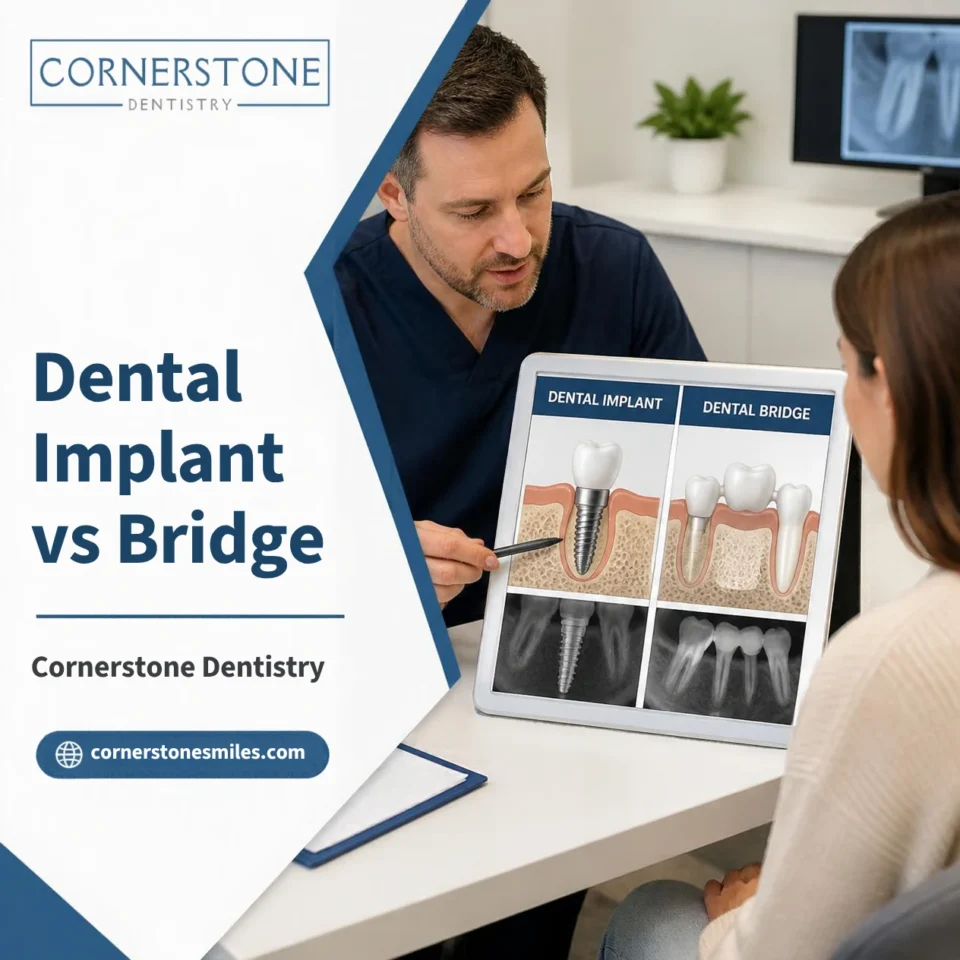
When comparing a dental implant vs bridge for a missing tooth, the main difference is how each restoration receives support.
A dental implant replaces the missing tooth root with a post placed in the jawbone. A crown attaches to the implant after healing.
A traditional dental bridge replaces the missing tooth by attaching an artificial tooth to crowns placed over neighboring natural teeth.
Both are fixed restorations that can look natural and restore everyday function.
Dental Implant vs Bridge: Key Differences
| Factor | Dental Implant | Dental Bridge |
| Support | Anchored in the jawbone | Supported by neighboring teeth |
| Treatment time | Often several months | Usually a few weeks |
| Surgery | Required | Not usually required |
| Nearby teeth | Generally remain unaltered | Usually need reshaping |
| Longevity | Implant post can last decades | Often lasts 5–15 years |
| Jawbone support | Helps maintain bone around the implant | Does not directly stimulate bone beneath the missing tooth |
| Initial cost | Generally higher | Often lower |
| Maintenance | Brushing, flossing, routine dental visits | Brushing and specialized cleaning beneath the bridge |
The better option depends on your jawbone, gum health, neighboring teeth, budget, and treatment goals.
An examination is necessary to determine which restoration offers the most predictable outcome for your situation.
How Dental Implants Replace a Missing Tooth
A dental implant is designed to replace the root of a missing tooth and support an artificial replacement.
For a single missing tooth, treatment typically involves three components:
- Implant post: A small titanium or ceramic fixture placed into the jawbone.
- Abutment: A connector that attaches the replacement tooth to the implant.
- Dental crown: A custom restoration designed to resemble the visible portion of a natural tooth.
Unlike a traditional bridge, a single-tooth implant does not depend on neighboring teeth for support.
What Happens During Implant Treatment?
The process begins with an examination of your teeth, gums, and jawbone.
At Cornerstone Dentistry, we use diagnostic imaging when appropriate to evaluate bone structure and plan implant placement.
If your bone and gum tissues are suitable, the implant is surgically positioned in the jawbone.
The surrounding bone then heals and integrates with the implant through a process called osseointegration.
This stage typically takes several months, although the exact timeline varies.
Once the implant is sufficiently stable, the final crown can be attached.
Some patients need additional procedures, such as tooth extraction or bone grafting, before implant placement.
What Are the Main Advantages?
Dental implants offer several potential benefits:
- Replace a missing tooth without preparing healthy neighboring teeth
- Provide independent support for the replacement crown
- Help maintain jawbone in the area of the missing root
- Restore comfortable chewing when treatment is successful
- Offer the potential for long-term function with proper care
However, implants require surgery, sufficient bone support, and ongoing maintenance.
They are not automatically appropriate for every patient.
How Dental Bridges Replace a Missing Tooth
A dental bridge fills the space left by a missing tooth using a restoration supported by surrounding teeth or implants.
For a traditional bridge replacing one tooth, the dentist usually prepares the two neighboring teeth for crowns.
A replacement tooth, called a pontic, sits between those crowns and fills the gap.
The finished bridge is secured in place, creating a fixed restoration that remains in your mouth.
What Does the Bridge Process Involve?
Treatment generally begins with an examination of the teeth adjacent to the missing space.
If those teeth are healthy enough to support a bridge, they are prepared for the restoration.
Impressions or digital scans help create a bridge designed to fit your bite.
A temporary restoration may be used while the permanent bridge is fabricated.
At a later appointment, the dentist checks the fit, appearance, and bite before securing the bridge.
Because traditional bridge treatment does not require implant surgery or bone integration, it can often be completed more quickly.
Are All Dental Bridges the Same?
No. Traditional bridges are common, but other designs are available.
A Maryland bridge uses bonded attachments to support a replacement tooth and may preserve more natural tooth structure in selected cases.
A cantilever bridge receives support from one side of the missing space.
An implant-supported bridge attaches to dental implants rather than natural teeth and is generally considered when multiple teeth are missing.
The appropriate design depends on the location of the gap, bite forces, and available support.
Which Option Usually Lasts Longer?
Dental implants generally have greater potential longevity than traditional tooth-supported bridges.
However, neither restoration is guaranteed to last for a specific number of years.
How Long Do Dental Implants Last?
The implant post can remain functional for decades and may last a lifetime with successful healing and proper maintenance.
However, the crown attached to the implant may eventually require repair or replacement because of wear, fracture, or other complications.
Implant longevity depends on several factors, including:
- Gum and bone health
- Daily oral hygiene
- Smoking and tobacco exposure
- History of periodontal disease
- Medical conditions affecting healing
- Bite forces and teeth grinding
- Regular professional monitoring
Implants cannot develop cavities, but the tissues surrounding them can become inflamed or infected.
A condition called peri-implantitis can cause bone loss around an implant and may compromise its stability.
How Long Do Dental Bridges Last?
Traditional dental bridges commonly last approximately 5 to 15 years, although some remain functional longer.
Their lifespan depends partly on the health of the teeth supporting them.
Decay, gum disease, fractures, and changes in the supporting teeth may affect the bridge’s stability.
A bridge may also require replacement because of wear or damage to the restoration itself.
Maintenance Matters for Both Options
Brush twice daily, clean between teeth, and attend regular dental examinations.
A bridge requires particular attention beneath its replacement tooth, where food and plaque can accumulate.
Floss threaders, interdental brushes, or other recommended tools can help clean these areas.
An implant also requires consistent cleaning around the crown and gumline.
Neither treatment should be considered maintenance-free.
Which Option Feels More Like a Natural Tooth?
Both implants and fixed bridges can feel comfortable and stable after the mouth adjusts to the restoration.
However, dental implants often function more independently because their support comes directly from the jawbone.
How Dental Implants Feel
A successful implant-supported crown can provide a stable replacement that functions much like a natural tooth.
It does not rely on neighboring teeth when chewing.
However, an implant does not have the same periodontal ligament that surrounds a natural tooth root.
This means it does not provide exactly the same sensory feedback when biting.
Although patients often describe implant crowns as natural-feeling, they are not biologically identical to natural teeth.
How Dental Bridges Feel
A properly fitted bridge can also restore comfortable chewing and speaking.
Because the replacement tooth is connected to neighboring crowns, the restoration functions as a connected unit rather than an independent tooth.
Some patients notice this difference, while others adjust quickly.
The area underneath the pontic also needs attention during daily cleaning.
For either option, comfort depends on the restoration’s fit, bite alignment, surrounding tissues, and overall oral health.
How Do Implants and Bridges Affect Nearby Teeth?
The condition of the teeth beside the missing space is one of the most important considerations when choosing a replacement.
Dental Implants Preserve Neighboring Tooth Structure
A single dental implant can replace one missing tooth without requiring the adjacent teeth to be reshaped.
This is particularly valuable when both neighboring teeth are healthy and do not need crowns.
Because the implant provides independent support, the surrounding teeth do not have to serve as anchors for the restoration.
The implant also transmits chewing forces to the surrounding jawbone, helping maintain bone in the immediate area.
However, implants do not prevent every type of bone loss or eliminate the need to maintain surrounding teeth and gums.
How Much Does a Dental Implant Really Cost in Anderson, SC? 2026 Price Guide
For most patients in Anderson, SC, a single dental implant usually costs about $3,000 to $6,000 when you include the…
Learn More
Bridges Depend on Supporting Teeth
A traditional bridge usually requires removing some enamel from the teeth beside the gap so crowns can fit over them.
This preparation is generally irreversible.
Those supporting teeth must remain healthy enough to carry the additional restoration.
If decay or periodontal problems develop around an anchor tooth, the entire bridge may be affected.
However, preparing neighboring teeth is not always a disadvantage.
If those teeth already have large fillings, fractures, or existing crowns, a bridge may restore multiple dental concerns at the same time.
This is why the condition of adjacent teeth often influences the recommendation more than the missing tooth alone.
What Cost Factors Should You Consider?
Dental implants usually involve a higher initial investment than traditional bridges.
However, treatment cost should be considered alongside longevity, future maintenance, and the health of neighboring teeth.
What Affects Dental Implant Costs?
Implant treatment may involve several separate components and procedures.
Factors that influence the total include:
- Implant post, abutment, and crown
- Diagnostic imaging and treatment planning
- Tooth extraction when necessary
- Bone grafting or other preparatory procedures
- Surgical complexity
- Restoration materials
- Follow-up care
Some patients need more extensive preparation than others, making individual estimates important.
What Affects Dental Bridge Costs?
Bridge pricing depends on the design, number of replacement teeth, supporting teeth, and materials used.
A traditional bridge replacing one missing tooth commonly includes three connected units: two supporting crowns and one replacement tooth.
Additional dental treatment may be needed if the supporting teeth have decay or other problems.
Although bridges often cost less upfront, future replacement or treatment of the supporting teeth can add to long-term expenses.
Does Dental Insurance Cover Implants or Bridges?
Coverage varies by insurance plan.
Some plans provide benefits for bridges but limit implant coverage. Others may cover certain components of implant treatment.
Waiting periods, annual maximums, exclusions, and missing-tooth clauses can affect your out-of-pocket costs.
At Cornerstone Dentistry, we can help you review estimated treatment costs and discuss available payment options.
The most useful comparison is the total treatment plan, not simply the initial procedure price.
For a more detailed financial discussion, read our Dental Implants vs. Bridges: The 15-Year Cost Comparison.
Who Is a Better Candidate for a Dental Implant?
Dental implants may be a strong option for patients who want to replace a missing tooth while preserving healthy neighboring teeth.
However, successful implant treatment requires appropriate conditions for surgical healing and long-term support.
Factors That Favor Dental Implant Treatment
You may be a suitable candidate if:
- You have one missing tooth with healthy teeth on either side.
- Your jaw has enough bone to support an implant.
- Your gums are healthy or existing periodontal disease is appropriately managed.
- Your jaw growth is complete.
- Your medical history is compatible with implant surgery.
- You are willing to maintain regular oral hygiene and professional dental care.
Patients with certain health conditions may still qualify after appropriate assessment.
For example, diabetes does not automatically rule out implants, but poorly controlled blood sugar can increase the risk of complications.
Smoking may also affect healing and long-term implant health.
What If You Have Already Lost Jawbone?
Bone loss does not necessarily eliminate implant treatment as an option.
Some patients may qualify for bone grafting or other procedures to improve available support.
However, treatment feasibility depends on the amount and location of bone loss, surrounding anatomical structures, and overall health.
We evaluate these factors before recommending surgery.
Patients interested in this treatment can learn more about our dental implant services in Anderson, SC.
Who May Be Better Suited for a Dental Bridge?
A dental bridge may be an appropriate option when implant surgery is not preferred, treatment needs to be completed sooner, or neighboring teeth already require restoration.
A bridge is not simply a temporary alternative to an implant. When properly planned and maintained, it can provide years of reliable function.
Situations Where a Bridge May Make Sense
A bridge may be worth considering if:
- The teeth next to the gap already need crowns.
- You prefer to avoid oral surgery.
- You want a shorter treatment timeline.
- Your jawbone is not suitable for implant placement without substantial additional treatment.
- Your medical history makes implant surgery less appropriate.
- A bridge better fits your financial circumstances.
- The neighboring teeth provide sufficient support.
When a Bridge May Not Be the Best Choice
A traditional bridge may be less suitable when the supporting teeth have significant mobility, untreated periodontal disease, or insufficient structural strength.
Likewise, if the neighboring teeth are completely healthy, preparing them for crowns may involve removing tooth structure that would otherwise remain intact.
The ability to clean beneath the bridge should also be considered.
Patients with limited manual dexterity or difficulty maintaining consistent oral hygiene may need additional discussion about which restoration will be easier to manage.
At Cornerstone Dentistry, we assess these considerations before recommending a treatment.
You can also explore our dental bridge services in Anderson, SC for more information.
Missing Tooth Options at Cornerstone Smiles
Losing a tooth can change how you chew, speak, and feel about your smile. Deciding how to replace it should not come down to choosing the most expensive treatment or the fastest procedure.
At Cornerstone Dentistry, we help patients in Anderson, SC, and surrounding communities understand their restorative options based on individual needs.
Our team evaluates your gums, remaining teeth, jawbone, and bite before discussing whether an implant or bridge is appropriate.
How We Help You Compare Your Options
During your consultation, we review your dental and medical history, discuss your concerns, and examine the missing tooth area.
Diagnostic imaging may be used to assess bone support and nearby structures.
We then explain the treatment options, including expected timelines, maintenance requirements, potential risks, and estimated costs.
Our goal is to help you make an informed decision without assuming that one solution is always better.
Schedule Your Missing Tooth Consultation in Anderson, SC
If you are missing a tooth, replacing it may help restore chewing function and reduce the risk of certain changes in your bite or surrounding teeth.
You do not need to decide between an implant and a bridge before visiting us.
We can examine the affected area, explain what each treatment would involve, and recommend options based on your oral health and goals.
Call Cornerstone Dentistry at (864) 222-9001 or request an appointment online to discuss your tooth replacement options.
Visit us at 190 Mutual Drive, Anderson, SC 29621.
FAQs About Dental Implants vs Bridges
Is a dental implant better than a bridge for one missing tooth?
An implant may be preferable when the neighboring teeth are healthy and sufficient bone is available. A bridge may be better when adjacent teeth already require crowns or when surgery is not appropriate. The right choice depends on your dental examination.
Which is more affordable, a dental implant or a bridge?
Traditional bridges generally have a lower upfront cost. Implants usually cost more initially because they require surgery and multiple components. However, future maintenance, replacement, and treatment of neighboring teeth can influence long-term expenses.
Is getting a dental bridge faster than an implant?
Yes, in many cases. A traditional bridge can often be completed over a few appointments within several weeks. Implant treatment typically requires several months to allow the implant to integrate with the jawbone before final restoration.
Can a dental implant last longer than a bridge?
Yes. Implant posts can remain functional for decades with successful treatment and proper maintenance. Traditional bridges often last 5 to 15 years. Both restorations may eventually need repair or replacement, and individual outcomes vary.
Can you get an implant if you have bone loss?
Possibly. Some patients with bone loss can receive implants after bone grafting or another preparatory procedure. However, severe bone loss or certain anatomical limitations may affect eligibility. Diagnostic imaging helps determine whether implant placement is feasible.
Is it harder to clean a bridge than an implant?
A traditional bridge often requires additional cleaning beneath the replacement tooth using floss threaders or interdental brushes. A single implant crown may allow more conventional cleaning around the restoration, but both options require careful oral hygiene and regular dental visits.