
Table of Contents
When a tooth is too damaged for a simple filling, many patients assume a crown is automatically the next step. Sometimes it is, but a more conservative restoration called an onlay may be appropriate when enough healthy tooth remains. The difference isn’t simply which treatment is “stronger.” It comes down to where the damage is, how much tooth structure remains, whether the cusps need protection, and what type of restoration can predictably protect the tooth while preserving healthy enamel.
Does your crown feel off? Learn why a crown can feel weird when you bite down and how it’s fixed.
Not Sure If You Need an Onlay or Crown?
Get the right treatment for your tooth with a professional dental evaluation. Call today to schedule your visit.
Key Takeaways
- An onlay covers part of a tooth and typically extends over one or more damaged cusps; a crown covers the entire visible portion of the tooth.
- Onlays generally require less removal of healthy tooth structure than full crowns.
- Both restorations can provide durable results, but their longevity depends on the tooth, restorative material, bite forces, oral hygiene, and habits such as grinding or chewing hard objects.
- The deciding factor is usually the condition and amount of healthy tooth structure that remains, along with the location and extent of the damage.
What an onlay actually repairs. An onlay or inlay is an indirect restoration designed to repair more substantial damage than a conventional filling without necessarily covering the entire tooth. An inlay fits within the raised cusps of a tooth, while an onlay extends over one or more cusps when those areas need additional protection. Because only the damaged or weakened portion is prepared, an onlay generally preserves more natural tooth structure than a full crown.
At Cornerstone Dentistry, our current inlay and onlay service information describes these restorations as an option for moderate decay, cracked or failing fillings, and weakened teeth when enough healthy structure remains to avoid a full crown. Our onlays and inlays are custom-made from tooth-colored porcelain and bonded to the prepared tooth.
When a crown is the better call. A full dental crown is a tooth-shaped restoration that covers the entire visible portion of a prepared tooth. Because the restoration surrounds the tooth rather than repairing only one section, crown preparation generally requires removing more natural enamel than an onlay.
A crown may be recommended when a tooth has extensive decay, a large fracture, substantial loss of healthy tooth structure, or an existing restoration that leaves the remaining tooth unable to reliably support a more conservative restoration. Crowns are also frequently used when a posterior tooth needs extensive cuspal protection.
Root canal treatment by itself does not mean every tooth automatically requires the same type of restoration. Posterior teeth that have undergone root canal treatment generally need protection of the cusps because they withstand substantial chewing forces, but the final restorative plan should also account for how much healthy tooth structure remains. Research has examined both full crowns and cuspal-coverage onlays for root canal-treated posterior teeth, so the appropriate restoration should be determined individually rather than by a universal rule.
The differences that actually matter, side by side.
| Factor | Onlay | Crown |
| Tooth preparation | Partial coverage that generally preserves more healthy tooth structure | Requires preparation around the tooth to create space for full coverage |
| Tooth coverage | Covers the damaged area and one or more cusps when needed | Covers the entire visible portion of the prepared tooth |
| Common materials | Ceramic or porcelain; other materials may also be used | Ceramic, porcelain, zirconia, metal, porcelain-fused-to-metal, or other dental materials |
| Longevity | Can provide many years of service; clinical studies report high medium- and long-term survival for indirect onlays | Cleveland Clinic reports an average crown lifespan of about 5–15 years with proper care |
| Main advantage | Preserves more unaffected natural tooth structure when partial coverage is appropriate | Provides more extensive coverage for significantly damaged or weakened teeth |
| Cost | Varies by material, tooth, complexity, insurance coverage, and location | Varies by material, tooth, complexity, insurance coverage, and location |
Published research shows high survival rates for both partial-coverage restorations and crowns. A systematic review comparing inlays, onlays, and crowns found five-year survival rates above 90%, but the available evidence does not support promising that every onlay or crown will last a specific number of years. Individual results vary considerably.
How your dentist actually decides. One of the most important considerations is how much sound tooth structure remains, but it isn’t the only factor. Your dentist also evaluates where the damage is located, whether one or more cusps have been weakened, the presence and size of previous fillings, cracks or fractures, your bite, the condition of the tooth’s pulp, and the forces the tooth will experience during chewing.
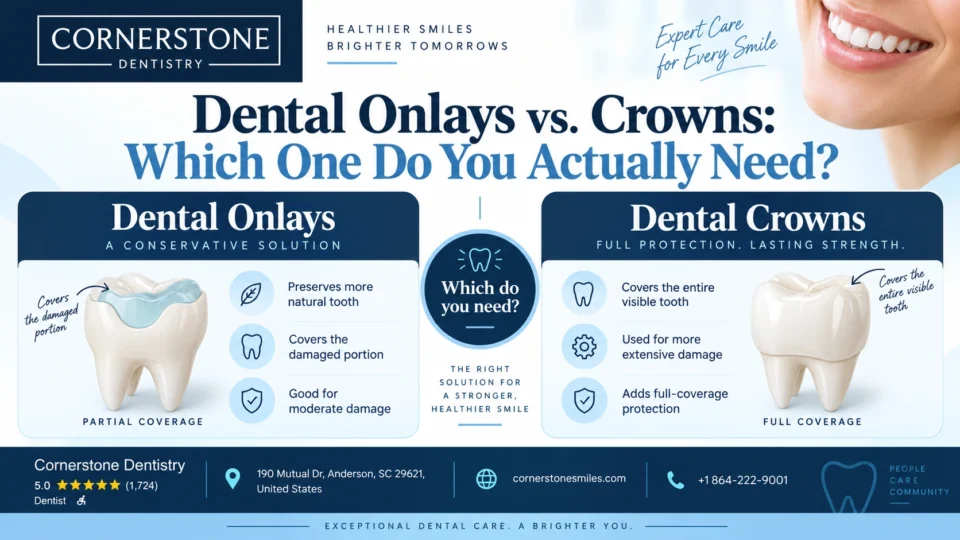
If a tooth still has enough strong enamel and dentin to support a bonded partial restoration, an onlay may allow us to repair the damaged section while preserving more of the natural tooth. If the damage is more extensive or the remaining tooth cannot predictably support partial coverage, a full crown may provide more appropriate protection.
That decision is made from the clinical examination, imaging, and condition of the tooth rather than simply choosing whichever restoration sounds more substantial.
What changes in your appointment. Traditional lab-made crowns and onlays commonly involve more than one visit. During the first appointment, the dentist removes decay or damaged material, prepares the tooth, and takes an impression or digital scan. A temporary restoration may be used while a dental laboratory creates the permanent restoration. At the later visit, the dentist checks the fit and bite before bonding or cementing the finished restoration.
Some dental offices use CAD/CAM technology to design and fabricate certain restorations during a single appointment, so appointment timing depends on the material, technology, and treatment plan being used.
Sometimes the full extent of decay or structural damage becomes clearer once an old filling or damaged tooth structure has been removed. If the pulp inside the tooth is exposed or found to be irreversibly inflamed or infected, root canal treatment may be recommended before the permanent restoration is completed. This isn’t an automatic part of getting an onlay or crown, but it can become necessary when damage extends into the pulp.
Why Does My Crown Feel Weird When I Bite Down? Causes and Fixes
Written and medically reviewed by Dr. Andrew Wilson, DMD, Cornerstone Dentistry, Anderson. Last updated September 2026. Quick answer: If your…
Learn More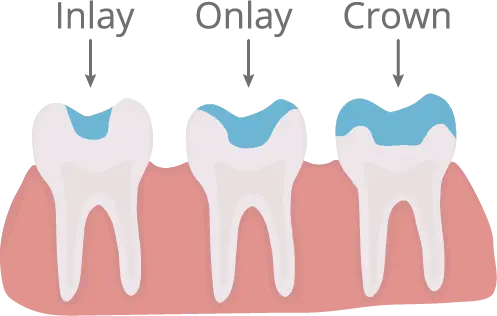
Frequently asked questions.
Does an onlay hurt less than a crown? Not necessarily. An onlay typically requires less tooth preparation, but that doesn’t guarantee less discomfort or sensitivity. Both procedures are generally performed using local anesthesia. Temporary sensitivity afterward can occur with either restoration and depends on factors such as the depth of the preparation, the condition of the tooth, and your individual response.
Can an onlay be replaced with a crown later? Sometimes. If a tooth with an existing onlay later develops additional decay, fractures, or loses more structure, a crown may become one of the treatment options. However, replacing an onlay with a crown isn’t automatically the next step. The dentist needs to evaluate the remaining tooth and determine whether another onlay, a crown, or a different treatment is appropriate.
How long do they really last? There isn’t one guaranteed lifespan for either restoration. Cleveland Clinic gives an average lifespan of approximately 5 to 15 years for dental crowns. Clinical studies of ceramic inlays and onlays have also demonstrated high survival over five and 10 years. How long either restoration lasts depends on the restorative material, the amount of remaining tooth structure, oral hygiene, the bite, tooth location, and habits such as grinding or chewing hard objects.
What if the tooth turns out to need more work once you start? Occasionally, removing an old restoration or decay reveals damage that couldn’t be fully evaluated beforehand. If there isn’t enough healthy structure to support the restoration originally planned, your dentist may recommend a different type of restoration. If decay or damage has significantly affected the pulp, root canal treatment may also become necessary. Your dentist should explain any change in the treatment plan before proceeding whenever possible.
Does getting an onlay or crown hurt? Both procedures are normally performed with local anesthesia to numb the tooth and surrounding area. You may feel pressure or movement during treatment, but the goal is to keep you comfortable. Mild sensitivity after a crown or onlay can occur, particularly once the anesthesia wears off. Contact your dentist if pain is severe, worsens, or doesn’t improve as expected.
Is an onlay always better because it removes less tooth? No. Preserving healthy tooth structure is valuable, but the most conservative treatment is only useful if it can reliably restore and protect the tooth. A significantly compromised tooth may need the greater coverage provided by a crown. The goal is to preserve healthy tissue without under-treating a tooth that needs more extensive protection.
Caring for either restoration long-term. Neither an onlay nor a crown makes the underlying tooth immune to future dental problems. Plaque can accumulate around the margin where the restoration meets the natural tooth, and decay can still develop there. Brush twice daily, floss around the restoration, keep regular dental exams and cleanings, and avoid using your teeth to bite fingernails, open packages, or chew ice and other extremely hard objects.
If you grind or clench your teeth, mention it during your dental visit. Bruxism can place significant forces on natural teeth and dental restorations. A dentist may recommend a custom night guard to help protect your teeth and restorations from those forces. A night guard cannot guarantee that an onlay or crown will last longer, but it can help protect dental work from damage associated with grinding and clenching.
Not sure which restoration your tooth needs? That’s exactly the kind of decision that should be made after examining the tooth rather than guessing based on symptoms alone. For more information about full-coverage restorations, see Dental Crowns 101. If you’re already scheduled for an inlay or onlay, our onlay/inlay post-op instructions explain what to expect after treatment.
Call Cornerstone Dentistry at (864) 222-9001 or schedule online to have the tooth evaluated and discuss which restorative option is appropriate for your situation.
Protect Your Tooth Before Damage Gets Worse
Find out whether a dental onlay or crown can restore your tooth and prevent further problems. Call us today.