
Table of Contents
If you’ve walked down the toothpaste aisle recently, you’ve probably noticed a growing number of products advertising hydroxyapatite instead of fluoride.
Some claim it’s a safer alternative.
Others suggest it’s more natural.
Some even market it as superior to fluoride for preventing cavities.
For many parents in Anderson and throughout South Carolina, this creates a confusing question:
Should you stick with fluoride toothpaste, or switch your family to hydroxyapatite?
Here’s what we usually tell parents:
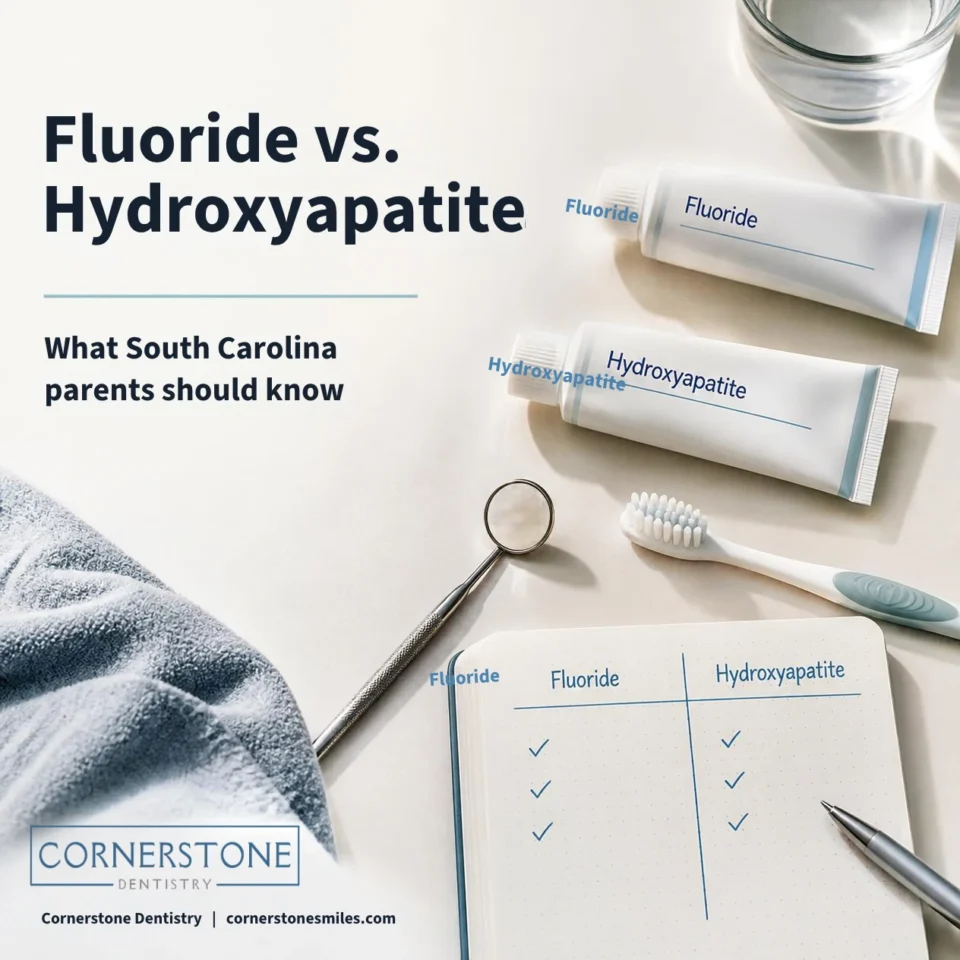
Both fluoride and hydroxyapatite can help protect teeth, but they are not identical, and the amount of evidence supporting them is not the same.
This isn’t a situation where one ingredient is “good” and the other is “bad.”
The better question is:
What do we actually know about each option, and what level of cavity protection does your child need?
Let’s look at the science, the marketing claims, and the practical factors parents should consider before deciding what’s best for their family.
Confused About Fluoride Options?
Get clear answers about fluoride and hydroxyapatite from a dental professional. Call now to book your child’s appointment.
The Short Answer: Fluoride Remains the Gold Standard
If you’re looking for the most evidence-backed ingredient for preventing cavities, fluoride still holds that position.
Decades of research have shown that fluoride can:
- Strengthen enamel
- Reduce cavity risk
- Help repair early tooth damage
- Protect both children and adults
Hydroxyapatite is a newer option that has shown promising results, particularly in helping remineralize enamel.
However, it does not yet have the same depth of long-term research that fluoride has accumulated over many decades.
That doesn’t mean hydroxyapatite doesn’t work.
It means the scientific confidence behind fluoride remains stronger.
What Is Fluoride?
Fluoride is a naturally occurring mineral found in:
- Water
- Soil
- Rocks
- Certain foods
Dentistry has used fluoride for generations because it helps strengthen tooth enamel and make teeth more resistant to acid attacks.
Every day, your child’s teeth are exposed to acids from:
- Sugary snacks
- Juice
- Sports drinks
- Bacteria in plaque
- Everyday eating and drinking
These acids remove minerals from enamel in a process called demineralization.
Fluoride helps reverse that process by supporting remineralization and making enamel more resistant to future damage.
Think of it as reinforcing a wall before the next storm arrives.
What Is Hydroxyapatite?
Hydroxyapatite sounds complicated, but it’s actually a substance that’s already found naturally in the human body.
In fact, tooth enamel is largely made from hydroxyapatite crystals.
That’s one reason manufacturers often market it as a more “natural” option.
The theory behind hydroxyapatite toothpaste is straightforward:
Instead of relying on fluoride to strengthen enamel, microscopic hydroxyapatite particles help replenish lost minerals and support enamel repair.
In other words:
Fluoride strengthens enamel.
Hydroxyapatite attempts to replace minerals that enamel has lost.
Both approaches focus on protecting teeth, but they do so differently.
Why Hydroxyapatite Has Become So Popular
Hydroxyapatite’s popularity isn’t just about science.
It’s also about parent concerns.
Many families are increasingly interested in:
- Fewer additives
- Naturally derived ingredients
- Alternative healthcare approaches
- Reduced exposure to certain chemicals
As a result, hydroxyapatite products are often marketed as:
- Fluoride-free
- Natural
- Biocompatible
- Safe if swallowed
These messages resonate with many parents.
The challenge is separating marketing language from actual clinical evidence.
The Biggest Question: Which One Prevents More Cavities?
This is where the conversation becomes most important.
If the primary goal is preventing cavities, parents deserve a clear answer.
Currently:
Fluoride has substantially more evidence supporting cavity prevention.
Researchers have studied fluoride extensively across:
- Multiple countries
- Several decades
- Millions of patients
- Different age groups
The evidence is remarkably consistent.
Fluoride reduces cavity rates.
Hydroxyapatite research is growing and encouraging.
Some studies suggest it may perform similarly to fluoride under certain conditions.
However, the total body of evidence remains significantly smaller.
That doesn’t mean hydroxyapatite is ineffective.
It simply means the scientific confidence level is different.
Why This Matters for High-Risk Children
Not all children have the same cavity risk.
Some children rarely develop cavities despite average oral hygiene.
Others seem prone to cavities even when parents are doing many things right.
Factors that increase cavity risk include:
- Frequent snacking
- Sugary beverages
- Poor brushing habits
- Deep grooves in teeth
- Previous cavities
- Orthodontic treatment
- Dry mouth conditions
For higher-risk children, many dentists remain more comfortable recommending fluoride because of its extensive track record.
When cavity prevention becomes critically important, evidence matters.
Is Fluoride Safe for Children?
This is often the concern driving the hydroxyapatite conversation.
Many parents have heard alarming claims online about fluoride.
Some of those claims contain kernels of truth.
Others are exaggerated or misleading.
Here’s the practical reality:
When used appropriately, fluoride toothpaste is considered safe for children.
The key phrase is “used appropriately.”
For younger children, dentists generally recommend:
Under Age 3
A smear-sized amount of toothpaste.
Ages 3-6
A pea-sized amount.
Parents should supervise brushing to minimize swallowing.
Like many substances, dosage matters.
Too much fluoride during tooth development can contribute to fluorosis, a cosmetic condition that affects enamel appearance.
This is why proper use remains important.
What About Fluorosis?
Fluorosis is one of the most misunderstood topics in dentistry.
Most fluorosis cases in the United States are mild.
They often appear as:
- Faint white spots
- Small white streaks
- Subtle enamel changes
Many cases are so minor that parents never notice them.
Severe fluorosis is far less common.
The risk can be reduced significantly through:
- Appropriate toothpaste amounts
- Supervised brushing
- Following professional recommendations
For many families, the cavity-prevention benefits of fluoride outweigh the relatively small risk of mild fluorosis.
Does Hydroxyapatite Have Advantages?
Yes.
Hydroxyapatite isn’t just a trend.
There are legitimate reasons some families choose it.
Potential advantages include:
Lower Concern About Swallowing
Because hydroxyapatite is already naturally present in teeth and bones, some parents feel more comfortable using it with younger children.
Remineralization Potential
Research suggests hydroxyapatite may help repair early enamel damage.
Reduced Sensitivity
Some patients report decreased tooth sensitivity with hydroxyapatite products.
Appealing for Fluoride-Avoidant Families
For families who strongly prefer avoiding fluoride, hydroxyapatite may be a reasonable alternative.
The important distinction is that “reasonable alternative” is not necessarily the same as “proven superior.”
What Do Most Pediatric Dentists Recommend?
Most pediatric dentists continue recommending fluoride toothpaste as the first-line option for cavity prevention.
This recommendation is primarily based on evidence, not tradition.
Dentists are generally trying to answer one question:
What has the strongest scientific support for protecting children’s teeth?
Currently, fluoride still occupies that position.
That may change over time as hydroxyapatite research expands.
But as of today, fluoride remains the most extensively studied option.
What About South Carolina Water Fluoridation?
Many South Carolina communities receive fluoridated public water.
This provides an additional layer of cavity protection for many families.
However, water fluoridation levels are carefully controlled and vary by location.
Parents who use well water may have completely different fluoride exposure levels.
If you’re unsure about your family’s fluoride exposure, it’s worth discussing during your child’s dental visit.
Individual recommendations may vary depending on:
- Age
- Cavity history
- Water source
- Oral health risk factors
Should You Switch If You’re Already Using Hydroxyapatite?
Not necessarily.
This isn’t an all-or-nothing decision.
If your child:
- Has healthy teeth
- Has low cavity risk
- Maintains excellent oral hygiene
- Sees a dentist regularly
Hydroxyapatite may be a reasonable part of their oral health routine.
The more important question is whether your current approach is producing healthy outcomes.
Toothpaste is only one piece of cavity prevention.
Diet, brushing habits, flossing, professional care, and genetics all play significant roles.
The Biggest Mistake Parents Make
The biggest mistake isn’t choosing fluoride.
The biggest mistake isn’t choosing hydroxyapatite.
The biggest mistake is assuming toothpaste alone determines whether a child gets cavities.
Parents sometimes spend enormous energy researching toothpaste ingredients while overlooking larger risk factors like:
- Frequent juice consumption
- Bedtime snacks
- Inconsistent brushing
- Missed dental visits
- High-sugar diets
No toothpaste can completely overcome poor oral health habits.
Likewise, good habits can dramatically improve outcomes regardless of which toothpaste is used.
The Right Choice Depends on Your Child—Not Internet Debates
Online discussions about fluoride and hydroxyapatite often become surprisingly emotional. But most parents aren’t looking to win an argument. They simply want to make the best decision for their child.
For some families, fluoride toothpaste remains the most logical choice because of its long history of cavity prevention. For others, hydroxyapatite may align better with their preferences and comfort level. The important thing is understanding the tradeoffs and making an informed decision based on your child’s actual oral health needs.
At Cornerstone Dentistry in Anderson, Dr. Andrew Wilson and Dr. Dale Hardy help parents evaluate cavity risk, discuss preventive strategies, and choose oral health products that fit their family’s goals. Every child is different, and the best recommendation is usually the one based on the child sitting in the chair not a headline, social media post, or internet debate.
Make the Right Choice for Their Teeth
Every child’s dental needs are different. Get personalized recommendations for protecting their growing smile. Call today.