
Table of Contents
Friday night football is a big part of life in Anderson.
Whether you’re cheering under the lights at T.L. Hanna High School, supporting Westside High School, or watching youth football on a Saturday morning, sports bring excitement, community, and unfortunately, occasional injuries.
Most parents expect bumps, bruises, and maybe even a sprained ankle.
What many don’t expect is a dental emergency.
Yet every year, athletes lose teeth during football, basketball, baseball, soccer, and other contact sports.
When it happens, the reaction is usually the same:
Panic.
Parents scramble.
Coaches search for ice.
Teammates gather around.
And everyone asks the same question:
“Can the tooth be saved?”
Here’s what we usually tell parents:
A knocked-out permanent tooth is one of the few true dental emergencies where minutes matter.
The actions taken during the first 30 minutes can dramatically affect whether that tooth can be successfully reimplanted and saved.
The good news is that many knocked-out teeth can survive if handled correctly and treated quickly.
Let’s walk through exactly what to do if a tooth gets knocked out during a game, what mistakes to avoid, and when you should seek emergency dental care immediately.
Dental Emergency at the Game?
Don’t wait after a knocked-out tooth. Get professional dental care right away.
The Short Answer: Time Is Critical
If a permanent tooth is completely knocked out:
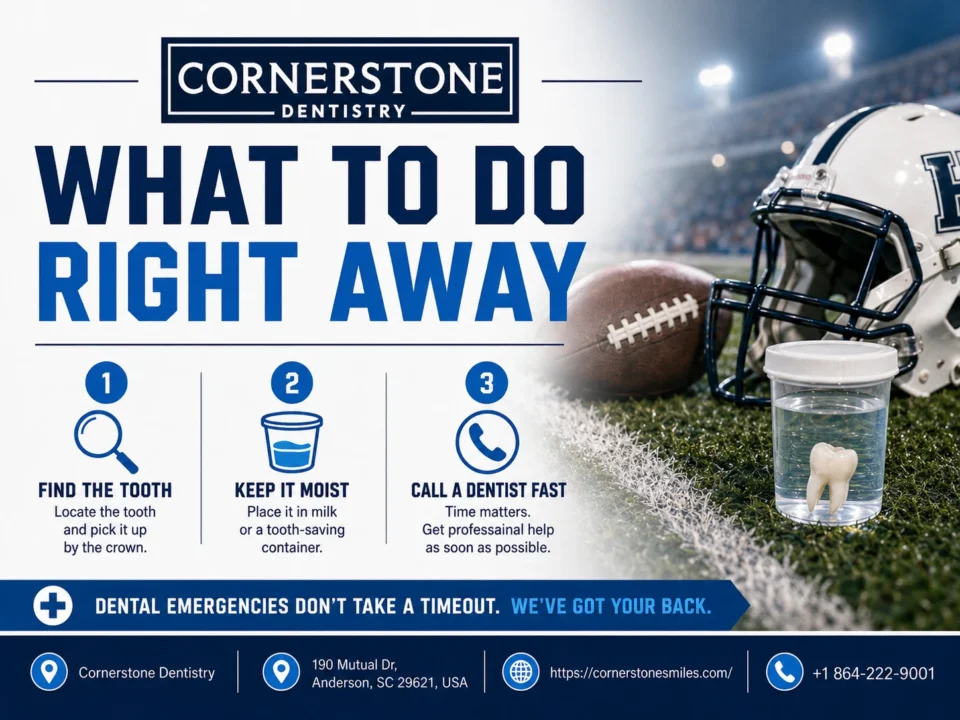
- Find the tooth immediately.
- Pick it up by the crown (the chewing surface).
- Do not touch the root.
- Gently rinse it if dirty.
- Try to place it back into the socket if possible.
- If reinsertion isn’t possible, keep it moist.
- Seek emergency dental treatment immediately.
The best outcomes often occur when a tooth is reimplanted within 30 minutes.
That doesn’t mean all hope is lost after 30 minutes.
But the chances of long-term success generally decrease as more time passes.
First: Make Sure It’s a Permanent Tooth
This distinction is extremely important.
Children may lose either:
- Baby teeth (primary teeth)
- Adult teeth (permanent teeth)
If a baby tooth gets knocked out:
Do not attempt to put it back in.
Reimplanting a baby tooth can potentially damage the developing permanent tooth underneath.
If a permanent tooth gets knocked out:
Immediate action becomes much more important.
For most teenagers playing football at T.L. Hanna or Westside, we’re typically talking about permanent teeth.
The front teeth are the most commonly affected.
Step 1: Find the Tooth
This sounds obvious, but in the chaos of a game, locating the tooth can be surprisingly difficult.
Check:
- The field
- The sideline
- The player’s helmet
- Their mouth
- Their jersey
- Nearby turf or grass
Sometimes the tooth isn’t completely knocked out.
It may be:
- Chipped
- Broken
- Displaced
- Partially attached
These injuries still require urgent evaluation, but they may be managed differently.
Step 2: Hold the Tooth Correctly
This is one of the biggest mistakes people make.
When handling the tooth:
Only touch the crown.
The crown is the part normally visible in the mouth.
Avoid touching the root.
Why?
The root surface contains delicate periodontal ligament cells that help the tooth reattach after reimplantation.
Damaging these cells reduces the likelihood of long-term success.
Think of the root as fragile living tissue rather than a piece of bone.
Handle it as little as possible.
Step 3: If Necessary, Rinse the Tooth Gently
Football fields aren’t exactly sterile environments.
The tooth may be covered with:
- Dirt
- Grass
- Turf pellets
- Blood
If the tooth is visibly dirty:
- Briefly rinse it with milk or saline solution if available.
- Clean water can be used if nothing else is available.
Do not:
- Scrub it
- Brush it
- Use soap
- Use disinfectants
- Wrap it in a towel and wipe it off
Aggressive cleaning can damage the cells needed for successful reattachment.
The goal is gentle rinsing—not sterilization.
Step 4: The Best Option Is Often Putting the Tooth Back In
This surprises many parents.
If the athlete is cooperative and alert, the best place for the tooth is often back in the socket.
After confirming the correct orientation:
- Gently place the tooth back into the socket.
- Have the athlete bite softly on clean gauze or cloth.
This helps protect the root cells while traveling to emergency dental care.
Of course, not every situation allows for this.
The athlete may be:
- Young
- Upset
- Bleeding heavily
- In significant pain
If reinsertion isn’t realistic, move to the next step.
Step 5: Keep the Tooth Moist
One of the worst things that can happen is allowing the tooth to dry out.
Dry roots lose viability quickly.
If the tooth cannot be replaced immediately, place it in:
Best Choices
- Cold milk
- Tooth preservation solution (if available)
Acceptable Alternatives
- Saline solution
- Inside the cheek of an older, cooperative patient
Avoid
- Dry napkins
- Paper towels
- Tissue
- Pockets
- Equipment bags
A tooth carried around dry for an hour has a much lower chance of successful reimplantation than a tooth stored properly.
What If There’s Bleeding?
Bleeding is common with dental trauma.
In most cases:
- Apply gentle pressure using clean gauze.
- Have the athlete bite down lightly.
- Keep pressure consistent.
The bleeding often looks worse than it actually is because blood mixes with saliva.
However, if bleeding appears excessive or difficult to control, medical evaluation should be sought immediately.
What If the Tooth Is Broken Instead of Knocked Out?
Not every football-related dental injury involves a complete avulsion (the dental term for a knocked-out tooth).
You may also see:
Small Chips
Often cosmetic but still worth evaluating.
Larger Fractures
May expose sensitive inner tooth structure.
Cracked Teeth
Can sometimes be difficult to identify immediately.
Teeth That Shift Position
A tooth may become loose or displaced without fully leaving the socket.
All of these injuries warrant prompt dental evaluation.
However, a completely knocked-out permanent tooth is generally the most time-sensitive.
Why Football Players Lose Teeth
Football creates a perfect environment for dental injuries.
Common causes include:
- Helmet-to-helmet contact
- Elbows
- Accidental collisions
- Falls
- Facemask impacts
- Unexpected tackles
Even with helmets, the mouth remains vulnerable.
That’s why mouthguards remain one of the most important pieces of protective equipment for young athletes.
The Mouthguard Conversation Every Parent Should Have
Most parents think mouthguards primarily prevent chipped teeth.
They do much more than that.
A properly fitted mouthguard can help reduce the risk of:
- Knocked-out teeth
- Fractured teeth
- Lip injuries
- Soft tissue trauma
- Certain jaw injuries
No mouthguard can eliminate risk entirely.
But they can significantly reduce the severity of many sports-related dental injuries.
For athletes participating in:
- Football
- Basketball
- Wrestling
- Baseball
- Softball
- Soccer
- Lacrosse
Mouthguards are often one of the best investments parents can make.
What Happens After You Reach the Dentist?
Treatment depends on:
- The athlete’s age
- How long the tooth was out
- Storage conditions
- Root condition
- Associated injuries
The dentist may:
- Reimplant the tooth
- Stabilize it with a splint
- Monitor healing
- Recommend root canal treatment later
- Evaluate surrounding bone and soft tissue
Even when a tooth is successfully reimplanted, follow-up care is often necessary.
The goal is preserving the tooth for as long as possible.
The Biggest Mistake Parents Make During Dental Emergencies
The most common mistake isn’t dropping the tooth.
It isn’t rinsing the tooth.
It isn’t forgetting milk.
The biggest mistake is assuming the situation can wait until Monday.
A knocked-out permanent tooth is not a “let’s see how it feels tomorrow” injury.
The first hour matters.
Every minute spent searching online, calling friends, or debating what to do can reduce the chances of saving the tooth.
Quick action gives the tooth its best opportunity for long-term success.
When a Football Injury Happens, Knowing What to Do Can Make All the Difference
Most parents never expect to face a dental emergency on the sidelines of a football game. But if it happens, preparation matters. Knowing how to handle a knocked-out tooth before an injury occurs can mean the difference between saving a tooth and losing it permanently.
If your child participates in sports in Anderson, it’s worth understanding the basics of dental trauma before the season starts. Emergencies are stressful enough without trying to learn the steps in the moment.
At Cornerstone Dentistry, Dr. Andrew Wilson and Dr. Dale Hardy help patients navigate dental emergencies, sports injuries, and traumatic tooth injuries with prompt evaluation and treatment. When a permanent tooth gets knocked out, acting quickly—and knowing what to do first—can have a lasting impact on your child’s smile for years to come.
Knocked-Out Tooth? Act Fast!
Quick dental care can help save the tooth. Call now for urgent treatment.