
Table of Contents
Most homeowners do not think about fluoride until they have a baby, buy a water filter, hear something online, or get surprised by a cavity at a dental visit.
Then the questions start:
- “Is Anderson water fluoridated?”
- “Is fluoride safe?”
- “Do my kids still need fluoride toothpaste?”
- “Does my refrigerator filter remove it?”
- “What if we drink bottled water or use a well?”
Here’s the practical answer:
Fluoride in drinking water is meant to lower cavity risk. It does not replace brushing, flossing, regular cleanings, or good nutrition. And whether it helps your family depends partly on your water source, your filter, your cavity risk, and your dental habits.
For Anderson homeowners, the first step is knowing where your water actually comes from.
Have Questions About Fluoride in Your Water?
Speak with a dental professional and get clear answers for your family’s oral health.
Is Anderson, SC water fluoridated?
Many Anderson-area public water customers receive water connected to the Anderson Regional Joint Water System’s Hartwell Lake Filter Plant, which draws from Hartwell Lake. The 2024 Anderson Regional Joint Water System report says the plant treated 8.2 billion gallons of water in 2024 and that the water met state and federal standards for appearance and safety.
The details are a little more nuanced when it comes to fluoride.
In the 2024 Anderson Regional Joint Water System report, fluoride appears in two places:
- Under secondary standards/operations data, fluoride is listed at an annual average of 0.60 mg/L, with a note that fluoride was online from January through April in 2024.
- In the compliance sampling table, fluoride is listed as 0.00 ppm for 2024, with no violation.
The City of Anderson/Electric City Utilities 2024 water-quality report shows the same basic pattern: fluoride listed at 0.60 mg/L in secondary standards/operations data with a note that fluoride was online from January through April 2024, and fluoride listed as 0.00 ppm in compliance sampling, with no violation.
So the most honest homeowner answer is:
Do not assume your current tap water has a steady cavity-prevention level of fluoride without checking your specific utility’s latest report or calling your water provider.
That matters because not every Anderson-area home is on the exact same water provider. Some homes use city water, some use another district, and some use private wells.
What level of fluoride is usually recommended?
The U.S. Public Health Service recommendation is 0.7 mg/L fluoride in drinking water for cavity prevention. The CDC explains that this level is intended to maximize dental benefits while minimizing the risk of dental fluorosis.
The CDC also makes an important point: it does not mandate community water fluoridation. State and local governments decide whether to fluoridate public water systems.
That is why the local report matters more than a general internet answer.
What does fluoride actually do?
Fluoride helps strengthen the outer surface of teeth and makes enamel more resistant to acid attacks from bacteria and sugar.
In plain English:
Fluoride does not make teeth cavity-proof. It makes them harder to damage.
The CDC says fluoridated water bathes teeth with a low level of fluoride throughout the day, helping strengthen the tooth surface and making it more resistant to decay.
This matters for:
- kids with developing brushing habits
- adults with dry mouth
- patients with frequent cavities
- people with exposed roots
- patients with braces or clear aligners
- older adults with crowns, bridges, or partials
- families who drink mostly bottled or filtered water
If Anderson water has fluoride, do we still need fluoride toothpaste?
Yes.
Water fluoridation and fluoride toothpaste do different jobs.
Fluoridated water gives low-level exposure throughout the day. Fluoride toothpaste gives a stronger topical dose when you brush.
For most families, the basic routine is still:
- brush twice daily with fluoride toothpaste
- floss or clean between teeth daily
- limit frequent sipping and snacking
- keep regular dental cleanings
- ask about extra fluoride if cavities keep happening
The CDC recommends using fluoride toothpaste and drinking fluoridated water when available because fluoride helps protect against cavities at all ages.

What if your family drinks bottled water?
This is where cavity risk can quietly change.
Some bottled waters contain fluoride. Some do not. Some labels do not make it obvious.
If your child drinks mostly bottled water, or your whole family avoids tap water, you may be getting less fluoride than you think.
That does not mean bottled water is “bad.” It just means your dentist should know, especially if your child has cavities or white spot lesions.
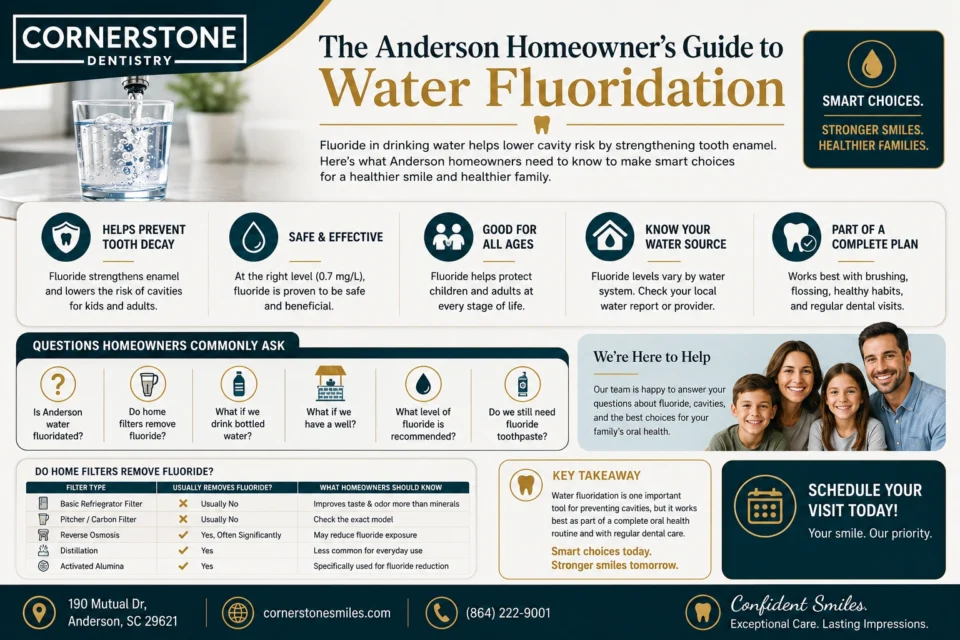
Do home filters remove fluoride?
Some do. Many do not.
Here’s the practical version:
| Filter type | Usually removes fluoride? | What homeowners should know |
| Basic refrigerator filter | Usually no | Often improves taste and odor more than minerals |
| Pitcher filter | Usually no, unless designed for fluoride | Check the exact model |
| Carbon filter | Usually no | Good for some contaminants, not reliable for fluoride |
| Reverse osmosis | Yes, often significantly | May reduce fluoride exposure |
| Distillation | Yes | Less common for everyday home use |
| Activated alumina | Yes | Specifically used for fluoride reduction |
If you use reverse osmosis water for most drinking and cooking, tell your dentist. It may affect fluoride recommendations, especially for children or high-cavity-risk adults.
What if you have a private well?
Private well water is different from public water.
A public water report does not tell you what is in your private well. Well water can vary by location, depth, geology, and household plumbing.
If you use well water in Anderson County, consider testing for:
- fluoride
- bacteria
- nitrates
- lead or other metals, depending on plumbing
- hardness and minerals
From a dental standpoint, fluoride testing matters because well water may have too little, enough, or occasionally too much fluoride. You cannot tell by taste.
Can kids get too much fluoride?
Yes, especially while adult teeth are developing.
The main dental concern from too much fluoride during childhood is dental fluorosis, which can cause white streaks or markings on developing teeth. Most mild fluorosis is cosmetic, but parents still deserve clear guidance.
This is why toothpaste amount matters.
For young children, parents should use the age-appropriate amount of fluoride toothpaste and help with brushing so kids do not swallow too much.
The goal is not “more fluoride is always better.”
The goal is the right amount for the right person.
Should adults care about fluoride?
Yes.
Fluoride is not just for children.
Adults can benefit from fluoride if they have:
- dry mouth from medications
- exposed roots from gum recession
- frequent cavities
- crowns, bridges, implants, or partial dentures
- orthodontic treatment
- a history of radiation treatment
- high-sugar or high-acid habits
- difficulty brushing thoroughly
The CDC states that drinking fluoridated water reduces cavities by about 25% in children and adults.
When extra fluoride may make sense
At Cornerstone Dentistry, this is usually a risk-based conversation.
Extra fluoride may be worth discussing if:
- you or your child gets cavities often
- your child drinks mostly bottled or filtered water
- your home uses reverse osmosis
- you have dry mouth
- you have gum recession and root sensitivity
- you wear braces or clear aligners
- you have a lot of crowns or fillings
- you are undergoing cancer treatment or take medications that reduce saliva
Options may include:
- fluoride varnish
- prescription-strength fluoride toothpaste
- fluoride rinses
- dietary changes
- dry mouth management
- sealants for children or cavity-prone molars
When fluoride is not the whole answer
This is important.
If someone keeps getting cavities, fluoride may help, but it may not solve the real problem by itself.
Repeated cavities are often related to:
- frequent snacking
- sipping sweet tea, soda, sports drinks, or flavored coffee
- dry mouth
- acid reflux
- poor brushing technique
- missed flossing
- deep grooves in teeth
- old dental work breaking down
- inconsistent dental visits
In Anderson and across South Carolina, sweet tea and soda habits are a real-world factor. You can use fluoride toothpaste every day and still get cavities if teeth are exposed to sugar and acid all day long.
Questions Anderson homeowners should ask
If you are trying to make a smart decision for your household, ask:
- Who is my water provider?
- Does my latest water report show fluoride?
- Is fluoride being added currently or only naturally present?
- Do we use reverse osmosis or another fluoride-removing filter?
- Do our kids drink mostly tap water, bottled water, or filtered water?
- Has anyone in the family had frequent cavities?
- Does anyone have dry mouth or gum recession?
- Should my child or I use prescription fluoride?
The bottom line
Water fluoridation is not something homeowners need to panic about, but it is worth understanding.
For Anderson-area families, the key is this:
Check your actual water source before assuming your household is getting cavity-prevention levels of fluoride.
The 2024 Anderson-area water reports show safe water by regulatory standards, but the fluoride details are not as simple as “yes, fully fluoridated all year.” That is why your home’s water source, filtration system, and dental cavity risk all matter.
At Cornerstone Dentistry in Anderson, Dr. Andrew Wilson, Dr. Dale Hardy, and our hygiene team can help you think through fluoride in a practical way: not politics, not scare tactics, just what lowers cavity risk for your family.
Curious About Water Fluoridation in Anderson?
Get trusted dental guidance today. Call now to learn how fluoridation supports healthier smiles.