
Table of Contents
Most people who ask about a smile makeover are not just asking about teeth.
They are asking things like:
- “How much is this realistically going to cost?”
- “Can I spread payments out?”
- “Am I being vain for wanting this?”
- “What if I spend the money and still don’t like my smile?”
- “Do I have to do everything at once?”
At Cornerstone Dentistry in Anderson, SC, those are normal questions. And honestly, they are smart questions.
A smile makeover can be life-changing for the right patient, but it is also a real financial decision. The goal is not to pressure people into cosmetic dentistry. The goal is to help you understand what is possible, what matters most, and what makes sense for your budget and long-term goals.
Ready for a Smile Transformation? Let's Make It Happen
Cornerstone offers financing options that help you achieve the smile you deserve without delaying treatment.
What Is a Smile Makeover?
A smile makeover is not one specific procedure.
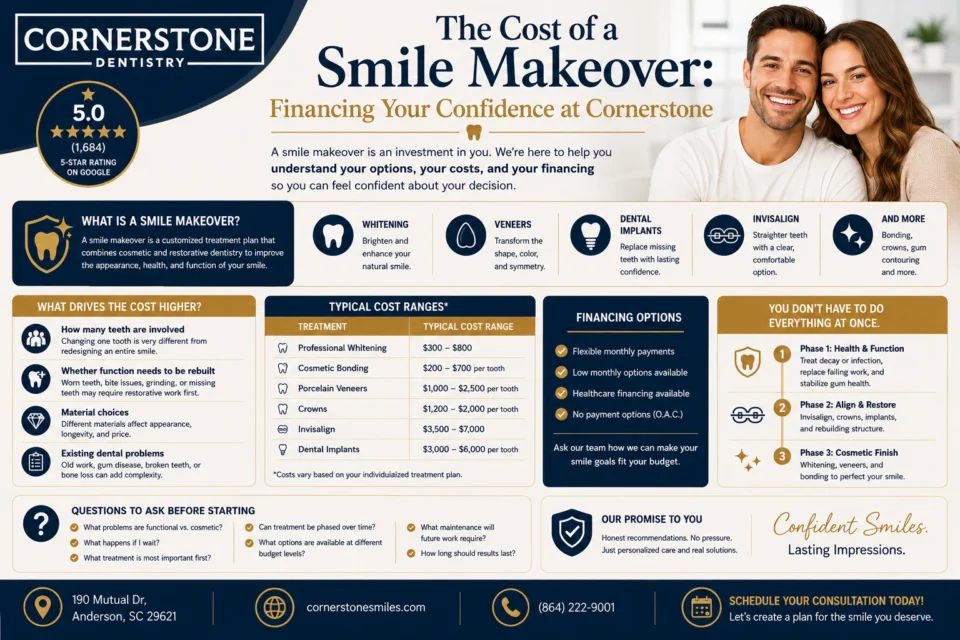
It is a customized treatment plan that combines cosmetic and restorative dentistry to improve the appearance, health, and function of your smile.
That may include:
- Teeth whitening
- Veneers
- Bonding
- Crowns
- Invisalign
- Dental implants
- Gum contouring
- Replacing old dental work
- Fixing chipped, worn, uneven, or missing teeth
Some patients only need one treatment. Others combine several over time.
So… How Much Does a Smile Makeover Cost?
The honest answer is: it varies widely.
A simple cosmetic improvement may cost a few hundred dollars. A full smile transformation involving veneers, implants, Invisalign, or multiple restorations can be several thousand dollars or more.
Here are realistic general ranges patients commonly see:
| Treatment | Typical Cost Range |
| Professional whitening | $300–$800 |
| Cosmetic bonding | $200–$700 per tooth |
| Porcelain veneers | $1,000–$2,500 per tooth |
| Crowns | $1,200–$2,000 per tooth |
| Invisalign | $3,500–$7,000 |
| Dental implants | $3,000–$6,000 per tooth |
The biggest mistake patients make is assuming a smile makeover is always an all-or-nothing treatment plan.
Usually, it is not.
You Do Not Have to Do Everything at Once
This is something we tell patients all the time.
A smile makeover can often be phased over time.
For example:
Phase 1: Address health and function
- Treat decay or infection
- Replace failing dental work
- Stabilize gum health
Phase 2: Improve alignment or structure
- Invisalign
- Crowns
- Implants
Phase 3: Cosmetic finishing
- Whitening
- Veneers
- Bonding
This approach can make treatment more financially manageable while still moving toward the final result.

What Actually Drives the Cost Higher?
There are usually four major factors:
1. How many teeth are involved
Changing one front tooth is very different from redesigning an entire smile.
2. Whether function needs to be rebuilt
Patients with worn teeth, bite problems, grinding, or missing teeth often need restorative work before cosmetic treatment.
3. Material choices
Different materials affect appearance, longevity, and price.
4. Whether previous dental problems exist
Old crowns, gum disease, broken teeth, or bone loss can add complexity.
Does Insurance Cover a Smile Makeover?
Sometimes partially. Sometimes not at all.
Insurance usually covers procedures based on whether they are considered “medically necessary,” not whether they improve appearance.
For example:
- A crown on a cracked tooth may receive partial coverage
- Whitening is usually not covered
- Implants may receive limited benefits depending on the plan
- Invisalign coverage varies significantly
This is where patients get frustrated, because insurance does not always align with what improves long-term confidence or quality of life.
Financing a Smile Makeover
Many patients finance cosmetic or restorative dentistry because it allows them to spread treatment costs over time instead of delaying care for years.
Depending on the situation, financing may help patients:
- Start treatment sooner
- Break larger plans into manageable payments
- Avoid compromising on important long-term solutions
- Combine functional and cosmetic improvements gradually
The important thing is making sure the monthly investment still feels comfortable and realistic for your life.
Is a Smile Makeover Worth It?
For many patients, yes.
But not because of vanity.
What people usually describe afterward is:
- smiling in photos again
- speaking more confidently
- no longer hiding teeth while talking
- feeling healthier and more comfortable
- finally fixing problems they postponed for years
That said, cosmetic dentistry is personal. Not every patient needs veneers. Not every crooked tooth needs Invisalign. And sometimes small changes make a bigger emotional impact than major treatment.
When a Smile Makeover May Not Be the Right Time
Sometimes the best decision is to wait.
That may be true if:
- gum disease is uncontrolled
- major dental anxiety needs to be addressed first
- financial stress would outweigh the benefit
- expectations are unrealistic
- health issues take priority
Good cosmetic dentistry should improve confidence — not create pressure.
Questions to Ask Before Starting
Before agreeing to treatment, ask:
- What problems are functional vs. cosmetic?
- What happens if I wait?
- What treatment is most important first?
- Can treatment be phased over time?
- What options are available at different budget levels?
- What maintenance will future work require?
- How long should results realistically last?
These conversations matter.
The Bottom Line
A smile makeover is not about perfection. It is about helping patients feel more comfortable, healthy, and confident in their everyday lives.
At Cornerstone Dentistry in Anderson, Dr. Andrew Wilson and Dr. Dale Hardy help patients understand their options without pressure or unrealistic promises. Sometimes the best solution is comprehensive treatment. Sometimes it is a few small changes that make a big difference.
If you have been thinking about improving your smile but feel unsure about the cost, financing, or where to begin, a consultation can usually help clarify what is realistic — and what makes sense for you.
Worried About the Cost of a Smile Makeover?
Explore flexible financing options at Cornerstone and take the first step toward a confident, beautiful smile today.