
Table of Contents
If you’ve spent any time on TikTok, Instagram, or YouTube lately, you’ve probably seen dramatic before-and-after videos for:
- purple toothpaste
- charcoal whitening powders
- black toothpaste
- “natural” whitening hacks
- activated charcoal kits
- instant whitening color correctors
The videos usually look impressive.
Someone brushes for 30 seconds.
Their teeth suddenly appear several shades whiter.
The comments fill with:
“OMG I need this.”
But here’s what many patients in Anderson eventually ask us after trying these products:
“Why do my teeth still look yellow?”
“Why are my teeth suddenly sensitive?”
“Did I damage my enamel?”
Here’s the honest answer:
Some of these products are more marketing than dentistry.
And a few can absolutely create long-term problems when overused.
At Cornerstone Dentistry, Dr. Andrew Wilson and Dr. Dale Hardy regularly see patients who have:
- increased tooth sensitivity
- gum irritation
- uneven whitening
- enamel wear
- staining that actually worsened
- unrealistic expectations from social media trends
Patients comparing treatment options may also want to review teeth whitening costs: professional vs. mall kiosks to better understand differences in supervision, treatment quality, and expected results.
That does not mean every whitening product online is dangerous.
But many viral whitening trends oversimplify how teeth actually work.
And some products are designed to create the appearance of whitening rather than true stain removal.
Let’s break down what purple toothpaste and charcoal whitening really do — and why dentists are increasingly concerned about DIY whitening trends.
Want a Brighter Smile?
Professional whitening delivers predictable results without the risks of DIY products. Contact us today.
Why People Are So Drawn to DIY Whitening
Honestly, it makes sense.
Professional whitening can feel:
- expensive
- time-consuming
- intimidating
- “too cosmetic”
- hard to justify financially
Meanwhile, social media promises:
- dramatic whitening in minutes
- cheap alternatives
- “natural” solutions
- no dentist needed
And because teeth are tied closely to confidence, people understandably want fast results.
Especially before:
- weddings
- vacations
- interviews
- photos
- dating
- major events
The problem is that whitening marketing often ignores the difference between:
- temporary visual tricks
and - actual enamel whitening
Those are not the same thing.
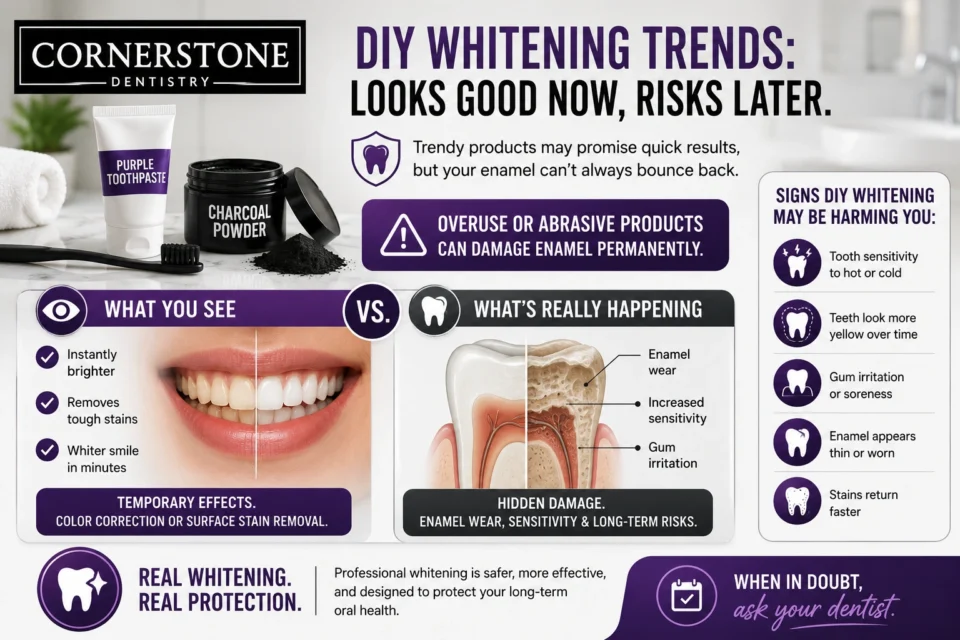
What Purple Toothpaste Actually Does
Purple toothpaste has exploded online recently.
Most of these products are based on a color-correction concept.
The idea comes from color theory:
- purple counteracts yellow tones visually
This is similar to how purple shampoo works for blonde hair.
Here’s the Important Part:
Purple toothpaste usually does not significantly whiten teeth internally.
Instead, it temporarily changes how light reflects off the tooth surface.
For some people, that creates a short-term brighter appearance.
But it does not:
- remove deep stains
- bleach enamel
- permanently whiten teeth
- change the natural tooth color underneath
That distinction matters.
Why Purple Toothpaste Can Be Misleading
The marketing often makes it appear as though:
- years of staining disappear instantly
- enamel becomes permanently whiter
- dramatic whitening occurs after one use
But many online videos rely heavily on:
- lighting
- filters
- editing
- wet enamel reflection
- temporary optical effects
Patients sometimes become disappointed because the results fade quickly.
Others begin brushing aggressively or excessively trying to “maintain” the effect.
That can become harmful over time.
The Bigger Problem: Overbrushing
This is where dentists get concerned.
Many whitening trends encourage:
- frequent brushing
- hard scrubbing
- repeated product use multiple times daily
But aggressive brushing can wear enamel down gradually.
And enamel does not grow back.
Ironically:
Worn enamel can actually make teeth appear more yellow over time.
Why?
Because thinner enamel exposes more of the underlying dentin, which naturally has a warmer yellow tone.
So excessive whitening attempts sometimes create the opposite cosmetic result long term.
Charcoal Toothpaste Is More Concerning
Charcoal whitening products are different from purple toothpaste.
Most charcoal products rely on abrasion.
In simple terms:
- they scrub stains off mechanically
Some people initially notice brighter teeth because surface stains get polished away.
But here’s the concern:
Many charcoal products are significantly more abrasive than standard toothpaste.
And excessive abrasion can slowly damage enamel.
Why Enamel Damage Matters
Enamel is the hard outer layer protecting your teeth.
Once enamel wears away:
- teeth become more sensitive
- staining increases more easily
- translucency changes
- teeth may appear darker or yellower
- decay risk can rise
Unlike skin or bone, enamel does not regenerate naturally.
That makes permanent damage possible if abrasive products are overused.
“Natural” Does Not Automatically Mean Safe
A lot of charcoal marketing leans heavily on the word:
“natural.”
But natural does not necessarily mean gentle.
Sandpaper is natural too.
Dentists care less about whether a product is “natural” and more about:
- abrasiveness
- acidity
- enamel safety
- long-term effects
Some charcoal products are relatively mild.
Others are harsh enough that dentists genuinely worry about repeated daily use.
The problem is that many viral products lack long-term clinical testing.
Charcoal Can Also Create Gum Problems
Many patients focus only on whitening and overlook gum health.
Charcoal particles can sometimes:
- irritate gums
- become trapped near the gumline
- worsen inflammation
- contribute to recession if brushing is aggressive
And gum recession creates another cosmetic problem:
- teeth can appear longer
- roots become exposed
- sensitivity increases
- root surfaces stain faster
Again, this can create the opposite of the intended cosmetic effect.
Some Whitening Damage Happens Slowly
This is important.
Most patients do not suddenly wake up with severely damaged teeth from whitening toothpaste.
The issue is usually cumulative.
Repeated:
- abrasive brushing
- whitening overuse
- acidic products
- aggressive scrubbing
…can gradually thin enamel over years.
That makes damage easy to miss until:
- sensitivity becomes noticeable
- staining worsens
- edges become translucent
- teeth appear uneven
Why Some People See Results — and Others Don’t
Not all discoloration responds the same way.
For frequent tea drinkers, understanding why sweet tea culture in South Carolina stains your teeth can help explain how tannins, sugar, acidity, and repeated sipping contribute to discoloration over time.
Surface Stains
These come from:
- coffee
- tea
- wine
- tobacco
- dark sodas
Surface stains may improve somewhat with whitening toothpaste or professional cleanings.
Internal Staining
This comes from:
- aging
- medications
- trauma
- enamel thinning
- genetics
Internal discoloration usually requires:
- professional whitening
- bonding
- veneers
- restorative treatment
Purple toothpaste and charcoal products cannot meaningfully change deep internal staining.
That is why some people see limited improvement despite repeated use.
Social Media Whitening Expectations Are Unrealistic
This is becoming a major issue in cosmetic dentistry.
Many online whitening videos show teeth that are:
- filtered
- professionally veneered
- edited
- artificially brightened
Natural teeth are not pure paper-white.
In fact, extremely opaque bright-white teeth sometimes look less natural in real life.
A healthy smile is not necessarily the whitest smile possible.
Dentists increasingly spend time helping patients develop realistic cosmetic expectations rather than chasing internet perfection.
Professional Whitening Is Different
Professional whitening works differently than charcoal products.
Most dentist-supervised whitening uses peroxide-based bleaching agents designed to:
- penetrate enamel safely
- break apart stain molecules
- lighten internal discoloration
When properly supervised, professional whitening is generally:
- more predictable
- more effective
- safer long term
- less abrasive
That does not mean zero sensitivity is guaranteed.
But it usually avoids the repeated mechanical abrasion associated with aggressive charcoal use.
Whitening Is Not Right for Everyone
This is another thing social media rarely mentions.
Some people are poor candidates for whitening, including patients with:
- untreated cavities
- gum disease
- exposed roots
- severe sensitivity
- worn enamel
- extensive crowns or veneers
Whitening will not change:
- crowns
- fillings
- bonding
- veneers
So uneven coloration can actually become more noticeable after whitening.
Good cosmetic dentistry involves evaluating the whole smile, not just selling whitening products.
DIY Whitening Can Delay Real Dental Problems
This happens more often than people realize.
Some patients repeatedly try whitening products when the real issue is:
- decay
- enamel erosion
- grinding
- old fillings
- gum recession
- dehydration
- tartar buildup
The cosmetic concern sometimes masks an underlying dental problem that needs treatment.
What Dentists Usually Recommend Instead
For most patients, safer whitening starts with:
- a professional cleaning
- evaluation of enamel health
- realistic shade expectations
- conservative whitening methods
Often, simple improvements help significantly:
- reducing staining beverages
- using less abrasive toothpaste
- stopping tobacco use
- improving hydration
- whitening gradually rather than aggressively
Dentists are usually less concerned about occasional whitening use and more concerned about:
- extreme frequency
- harsh abrasion
- unrealistic expectations
- long-term enamel wear
Red Flags With Viral Whitening Products
Patients should be cautious when products:
- promise “instant permanent whitening”
- claim dramatic changes after one use
- encourage aggressive brushing
- avoid discussing enamel safety
- rely heavily on influencer marketing
- have no clear dental oversight
- make whitening sound completely risk-free
In dentistry, very fast cosmetic changes often come with tradeoffs.
Questions Worth Asking Before Trying Whitening Trends
Before starting any whitening product, it is smart to ask:
- Is this product abrasive?
- Is it ADA-approved?
- Could this worsen sensitivity?
- Is my discoloration even fixable with whitening?
- Am I damaging enamel chasing unrealistic results?
- Would a professional cleaning help more?
Those questions matter more than viral reviews.
The Bottom Line
Purple toothpaste and charcoal whitening products are not always dangerous, but many are oversold online and misunderstood by consumers.
Purple toothpaste mostly creates temporary visual color correction rather than true whitening.
Charcoal products can be more concerning because excessive abrasion may gradually wear down enamel and increase long-term sensitivity and staining.
The biggest risk is not usually one-time use.
It is repeated overuse driven by unrealistic social media expectations.
At Cornerstone Dentistry, Dr. Andrew Wilson and Dr. Dale Hardy often help patients sort through whitening trends realistically:
- what works
- what does not
- what is safe
- and when cosmetic goals may actually be harming long-term oral health
Because healthier enamel almost always matters more than chasing internet-white teeth.
Stop Following Viral Hacks
Get safe, dentist-approved whitening solutions designed to protect your teeth and enhance your smile.