
Table of Contents
If you’re considering straightening your teeth in 2026, one of the first questions you’ll probably ask is:
“How much does SureSmile cost compared to traditional braces?”
Unfortunately, many websites either avoid discussing pricing altogether or provide such broad ranges that the information isn’t useful.
Here’s what we usually tell patients:
In 2026, SureSmile treatment typically costs between $3,500 and $7,500, while traditional braces generally range from $3,000 to $7,000.
At first glance, that may make it seem like the two options cost about the same.
But the total investment depends on several factors, including the complexity of your case, treatment length, insurance benefits, and what kind of experience you want during treatment.
For many patients, the bigger question isn’t whether SureSmile costs more than braces.
It’s whether the differences are worth paying for.
Let’s look at what actually drives the cost, where the two treatments differ, and how to determine which option makes the most sense for your smile and budget.
Ready for a Straighter Smile?
Compare SureSmile® and traditional braces to find the right treatment for your smile and budget.
The Short Answer: Cost Is Often Closer Than People Expect
Many patients assume clear aligners are dramatically more expensive than braces.
That was often true years ago.
Today, the gap has narrowed considerably.
In Anderson and throughout Upstate South Carolina, many patients find that SureSmile and traditional braces fall into surprisingly similar price ranges.
| Treatment | Typical 2026 Cost Range |
| Traditional Metal Braces | $3,000-$7,000 |
| Ceramic Braces | $4,000-$8,000 |
| SureSmile Clear Aligners | $3,500-$7,500 |
The exact cost depends on:
- How crowded your teeth are
- Bite alignment issues
- Treatment complexity
- Number of aligners required
- Length of treatment
- Insurance benefits
- Whether refinements are needed
For some patients, SureSmile may cost only a few hundred dollars more than braces.
For others, there may be virtually no difference at all.
What Are You Actually Paying For?
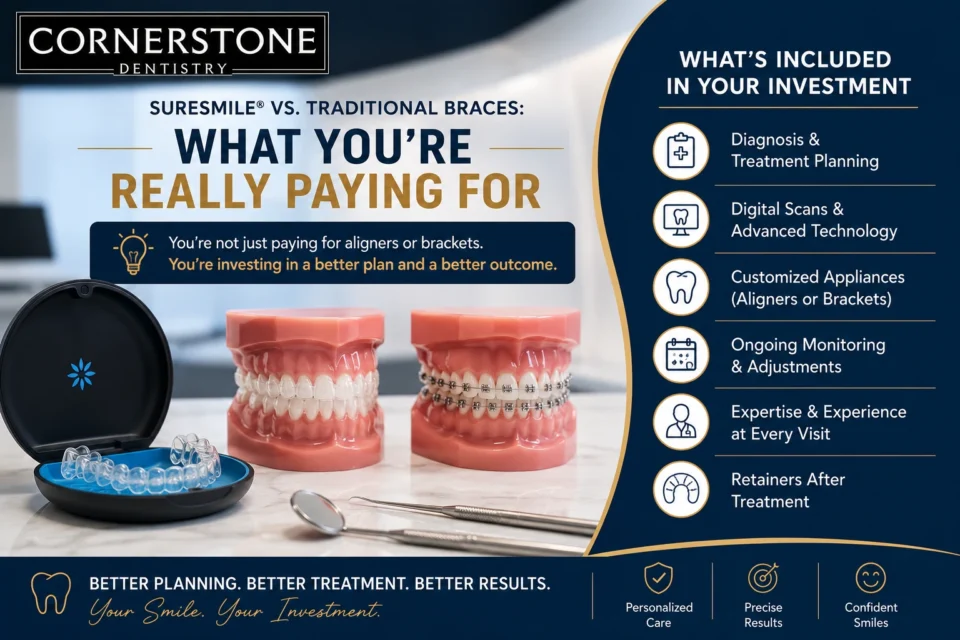
When comparing prices, it’s important to understand that you’re not buying aligners or brackets.
You’re paying for:
- Diagnosis
- Treatment planning
- Digital scans
- Ongoing monitoring
- Tooth movement expertise
- Adjustments throughout treatment
- Retainers after treatment
The appliance itself is only one piece of the total investment.
A great treatment plan with the right provider typically matters far more than whether teeth are moved with aligners or brackets.
Why SureSmile Sometimes Costs More
SureSmile uses advanced digital treatment planning and a series of custom-made clear aligners.
Each aligner is designed to move teeth in specific stages.
Additional costs may come from:
Digital Design Technology
Every case begins with detailed digital scans and treatment mapping.
This allows patients to see a projected outcome before treatment even begins.
Custom Manufacturing
Unlike braces that use standardized brackets and wires, each aligner is individually fabricated.
Refinement Aligners
Some patients require additional aligners near the end of treatment to achieve optimal results.
Depending on the treatment plan, refinements may or may not be included in the original fee.
Why Traditional Braces Can Sometimes Cost More
Many people assume braces are always the cheaper option.
That’s not necessarily true.
More complex orthodontic cases may require:
- Additional appointments
- More adjustments
- Longer treatment times
- Specialized appliances
- Bite correction devices
In these situations, braces can end up costing just as much—or even more—than aligner therapy.
The complexity of the case often matters more than the appliance itself.
What Insurance Typically Covers in 2026
This is where many patients get surprised.
Orthodontic insurance benefits generally do not distinguish heavily between braces and aligners.
Many plans offer:
- Lifetime orthodontic benefits
- Partial coverage
- Fixed orthodontic allowances
Common benefits range from:
- $1,000
- $1,500
- $2,000
- $2,500
Some plans cover neither treatment.
Others contribute similarly toward both.
The important thing to understand is that dental insurance rarely covers the entire cost of orthodontic treatment.
Most patients should expect some out-of-pocket investment regardless of which option they choose.
The Cost of Time: An Overlooked Factor
When patients compare treatment prices, they often forget to consider time.
Time has value.
SureSmile often appeals to adults because it can reduce some of the lifestyle inconveniences associated with braces.
For patients concerned about everyday communication and social situations, learning how clear aligners can change speech and confidence can provide useful insight into what to expect during treatment.
For example:
SureSmile
- Removable for eating
- Easier brushing and flossing
- No dietary restrictions
- Nearly invisible appearance
- Fewer emergency visits
Traditional Braces
- Fixed in place
- Cannot be removed
- Food restrictions apply
- More visible
- Occasional broken brackets or wires
Neither option is universally better.
But many professionals, college students, and adults place a high value on convenience and appearance.
For them, the slightly higher cost of aligners may feel worthwhile.
When Braces May Actually Be the Better Value
There are situations where braces make more sense.
Braces may be the stronger option when:
- Severe crowding exists
- Significant bite correction is needed
- Teeth require complex movement
- Compliance may be difficult
One of the biggest differences between the two treatments is patient responsibility.
SureSmile only works if aligners are worn consistently.
Most patients need to wear them approximately 20-22 hours per day.
Patients who frequently remove aligners may experience:
- Delayed results
- Additional aligners
- Longer treatment times
- Increased costs
Braces eliminate this variable because they’re always working.
For some patients, that’s a significant advantage.
Why Sweet Tea Culture in South Carolina Stains Your Teeth
If you grew up in South Carolina, sweet tea is probably not just a drink. It is: family dinners church…
Learn More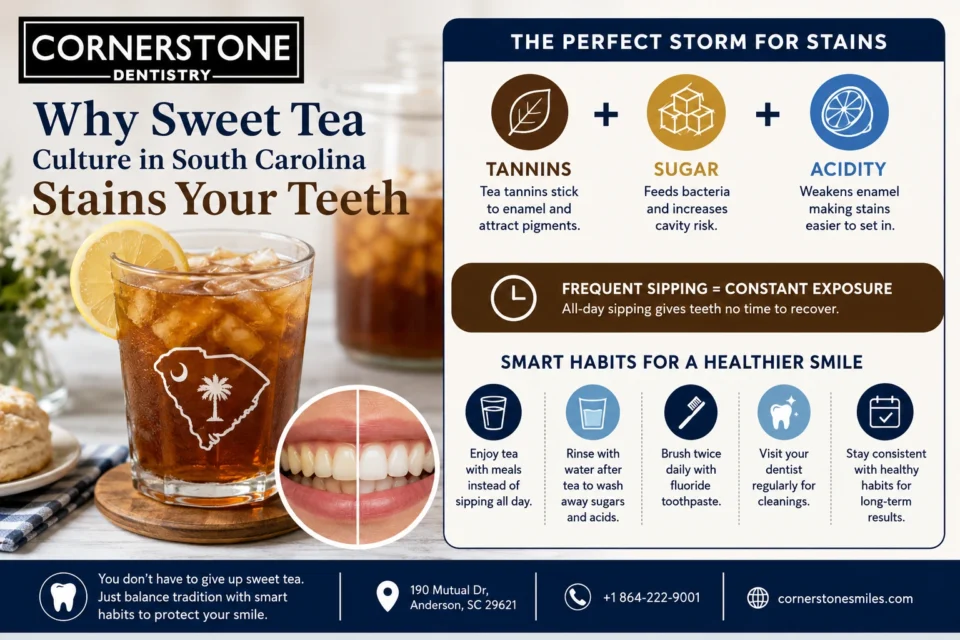
The Hidden Costs Patients Rarely Consider
When researching orthodontics online, most articles focus only on treatment fees.
But there are other costs worth considering.
Lost Aligners
SureSmile aligners can be misplaced or damaged.
Replacement fees may apply.
Broken Brackets
Braces occasionally require repairs.
Additional visits may be necessary.
Oral Hygiene Challenges
Braces can make cleaning more difficult.
Poor hygiene during treatment may lead to:
- Decalcification
- Staining
- Cavities
- Gum inflammation
Retainers After Treatment
Whether you choose SureSmile or braces, retainers are usually necessary after treatment.
Without retainers, teeth often drift over time.
This is one of the most predictable—and preventable—causes of orthodontic relapse.
Which Treatment Is Faster?
Patients often ask whether SureSmile works faster than braces.
The honest answer is:
Sometimes.
Many mild-to-moderate cases can be completed within:
- 6-18 months with SureSmile
- 12-24 months with braces
However, treatment speed depends heavily on:
- Complexity
- Patient compliance
- Biological response
- Treatment goals
There is no appliance that guarantees the fastest outcome for every patient.
Any provider promising that should be viewed cautiously.
Which Option Do Adults Usually Choose?
Adult orthodontic patients increasingly gravitate toward clear aligners.
Beyond straightening teeth, understanding how clear aligners can affect facial structure can help patients see how changes in tooth and bite alignment may subtly influence their smile, profile, and overall facial balance.
The reasons are fairly consistent:
- Professional appearance
- Comfort
- Convenience
- Ability to remove aligners
- Less noticeable treatment
That doesn’t mean braces are outdated.
Many adults still choose braces because:
- Their case is complex
- They prefer a fixed appliance
- They don’t want the responsibility of removable aligners
- Their treatment goals are better suited to braces
The best choice depends on the individual, not the trend.
The Most Expensive Orthodontic Mistake
The biggest mistake isn’t choosing braces.
The biggest mistake isn’t choosing SureSmile.
The most expensive mistake is choosing a treatment option based solely on price.
A treatment that’s a few hundred dollars cheaper but fails to achieve your goals is rarely a bargain.
Likewise, paying more for aligners when braces would produce a better outcome may not be the best investment.
Orthodontic treatment lasts months—or years.
The quality of the final result matters far more than a small difference in monthly payments.
How to Decide Whether SureSmile or Braces Is Worth the Investment
If your primary concern is appearance, flexibility, and convenience, SureSmile often provides advantages that many adults find valuable.
If your case is highly complex—or if you prefer a treatment that doesn’t rely on daily compliance—traditional braces may be the stronger choice.
The good news is that in 2026, the price difference between the two is often smaller than patients expect.
That means the decision can be based more on what fits your lifestyle and treatment goals rather than assuming one option is dramatically more expensive.
The Best Way to Compare Costs Isn’t Online—It’s With Your Own Smile
Online price ranges can help set expectations, but they can’t tell you what your treatment will actually cost.
Two patients may both be interested in SureSmile and receive completely different treatment recommendations based on their bite, crowding, oral health, and goals.
At Cornerstone Dentistry in Anderson, Dr. Andrew Wilson and Dr. Dale Hardy help patients understand both the financial and clinical side of orthodontic treatment. A consultation can often clarify whether SureSmile, traditional braces, or another option makes the most sense—before you commit to months of treatment and thousands of dollars of investment.
SureSmile® or Traditional Braces?
Get personalized answers about pricing and treatment options. Call today to discuss your ideal smile.