
Table of Contents
If you don’t have dental insurance, you’re not alone.
Many patients in Anderson and throughout Upstate South Carolina either don’t receive dental benefits through their employer, are self-employed, retired, between jobs, or simply find traditional dental insurance too expensive for what it provides.
Unfortunately, many people without insurance delay dental care because they’re worried about cost.
They skip cleanings.
They postpone exams.
They ignore a tooth that’s bothering them.
Then what started as a small, manageable problem becomes a much bigger—and more expensive—one.
That’s exactly why many dental practices, including Cornerstone Dentistry, offer membership plans.
But here’s the question most patients are really asking:
Is a dental membership plan actually worth it, or is it just another version of insurance?
The short answer is that a membership plan is not insurance.
In many situations, it’s actually simpler.
For patients without dental coverage, it can provide predictable costs, preventive care benefits, and discounts on treatment without many of the frustrations commonly associated with traditional insurance.
Let’s break down how it works, who it helps most, and when it may or may not be the right fit.
No Dental Insurance? We Can Help
Get affordable dental care with the Cornerstone Dentistry Membership Plan. Call today to learn how you can save.
The Quick Answer: A Membership Plan Is Designed for Patients Without Insurance
A dental membership plan is a program offered directly through the dental office.
Instead of paying monthly premiums to an insurance company, patients pay a yearly membership fee that includes preventive care and provides discounts on many additional treatments.
Unlike traditional insurance, there are typically:
- No deductibles
- No annual maximums
- No claim forms
- No waiting periods
- No insurance approvals
The goal is straightforward:
Help patients receive routine dental care while making treatment costs more manageable.
For many uninsured patients, that’s exactly what they need.
Why So Many People Are Frustrated with Traditional Dental Insurance
Before discussing membership plans, it helps to understand why many patients are looking for alternatives.
Most dental insurance plans have limitations that patients don’t discover until they need treatment.
Common frustrations include:
- Annual maximums
- Coverage restrictions
- Waiting periods
- Denied claims
- Limited provider networks
- Reduced coverage for major treatment
For example, a patient may pay insurance premiums all year only to discover their plan contributes just a portion of the cost of a crown or root canal.
In some cases, the annual maximum benefit is exhausted after only one or two major procedures.
This is why many patients without insurance ask an important question:
“If I’m already paying out of pocket anyway, is there a better option?”
For some people, the answer is yes.
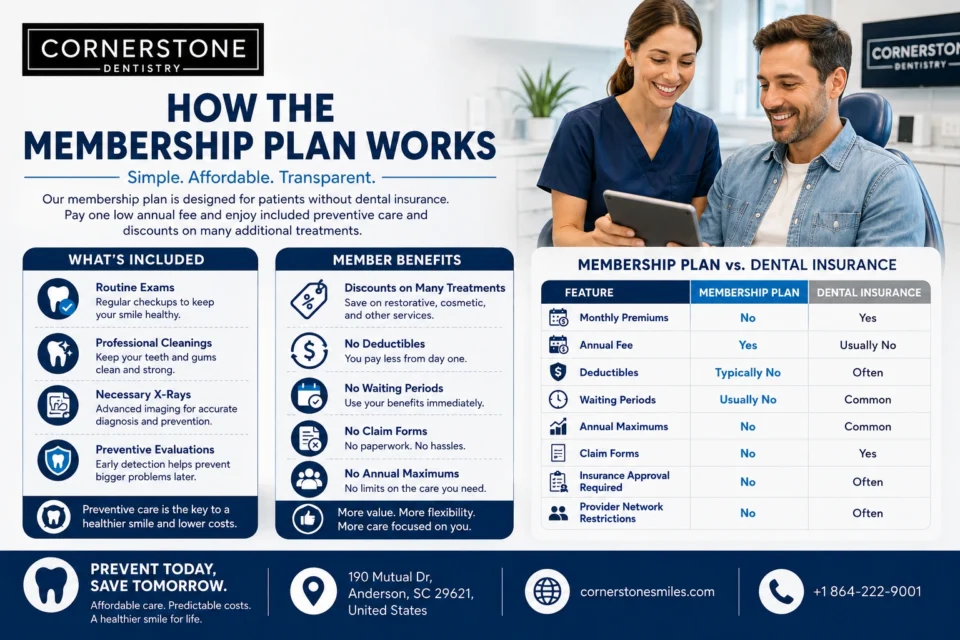
How the Cornerstone Dentistry Membership Plan Works
The purpose of the Cornerstone Dentistry Membership Plan is simple:
Make preventive dental care more affordable while helping patients save money on additional treatment.
While specific plan details can vary, membership plans generally include preventive services such as:
- Routine exams
- Professional cleanings
- Necessary x-rays
- Preventive evaluations
Members also receive discounted fees on many restorative and cosmetic procedures.
That means if treatment is needed, patients pay a reduced rate rather than the full standard fee.
The biggest advantage is predictability.
Patients know they have access to routine preventive care without worrying about insurance approvals or annual benefit limits.
Membership Plans vs. Dental Insurance
Many patients assume these programs are basically the same thing.
They’re not.
Here’s a simple comparison.
| Feature | Traditional Insurance | Membership Plan |
| Monthly Premiums | Yes | No |
| Annual Fee | Usually No | Yes |
| Deductibles | Often | Typically No |
| Waiting Periods | Common | Usually No |
| Annual Maximums | Common | No |
| Claim Forms | Yes | No |
| Insurance Approval Required | Often | No |
| Provider Network Restrictions | Often | No |
The biggest difference is that a membership plan removes the insurance company from the equation.
Your relationship is directly with your dental office.
For many patients, that simplicity is appealing.
Who Benefits Most from a Membership Plan?
Not every patient needs a membership plan.
However, certain groups often benefit significantly.
Self-Employed Individuals
Many business owners and independent contractors don’t receive employer-sponsored dental benefits.
A membership plan can provide preventive care and treatment savings without requiring a traditional insurance policy.
Retirees
Many retirees lose dental benefits when they leave the workforce.
A membership plan can help maintain regular dental care during retirement.
Families Without Dental Benefits
Families often find that paying directly for multiple cleanings, exams, and x-rays each year becomes expensive.
Membership plans can help make those costs more predictable.
Patients Who Avoid the Dentist Due to Cost
This may be the group that benefits most.
When preventive visits become easier to budget for, patients are more likely to stay on top of their oral health.
That often prevents larger expenses later.
What Membership Plans Do Well
One of the biggest strengths of membership plans is encouraging preventive care.
When patients know their exams and cleanings are already included, they’re more likely to schedule appointments consistently.
That matters because preventive dentistry is often the least expensive dentistry.
Finding a cavity early is usually much less expensive than treating a large cavity later.
Treating a crack early is often less costly than waiting until the tooth needs a root canal and crown.
Routine care tends to save both money and stress.
What Membership Plans Don’t Do
Transparency matters.
Membership plans are helpful, but they aren’t perfect.
There are situations where patients misunderstand what these plans provide.
A membership plan is not designed to eliminate treatment costs.
If extensive treatment is needed, there will still be out-of-pocket expenses.
The difference is that members typically receive reduced fees compared to non-members.
It’s important to view a membership plan as a way to make care more affordable—not as unlimited free dentistry.
Is a Membership Plan Worth It If My Teeth Are Healthy?
In many cases, yes.
Some patients assume they only need a membership plan if they have dental problems.
The opposite is often true.
Patients with healthy teeth frequently benefit because preventive services are included and routine care remains affordable.
Regular visits help maintain that healthy condition.
The goal isn’t simply to fix problems.
The goal is to prevent them.
Best Toothpaste for Sensitive Teeth: 6 Dentist-Recommended Picks for 2026
Written and medically reviewed by Dr. Andrew Wilson, DMD, Cornerstone Dentistry, Anderson. Last updated September 2026. Quick answer: The best…
Learn More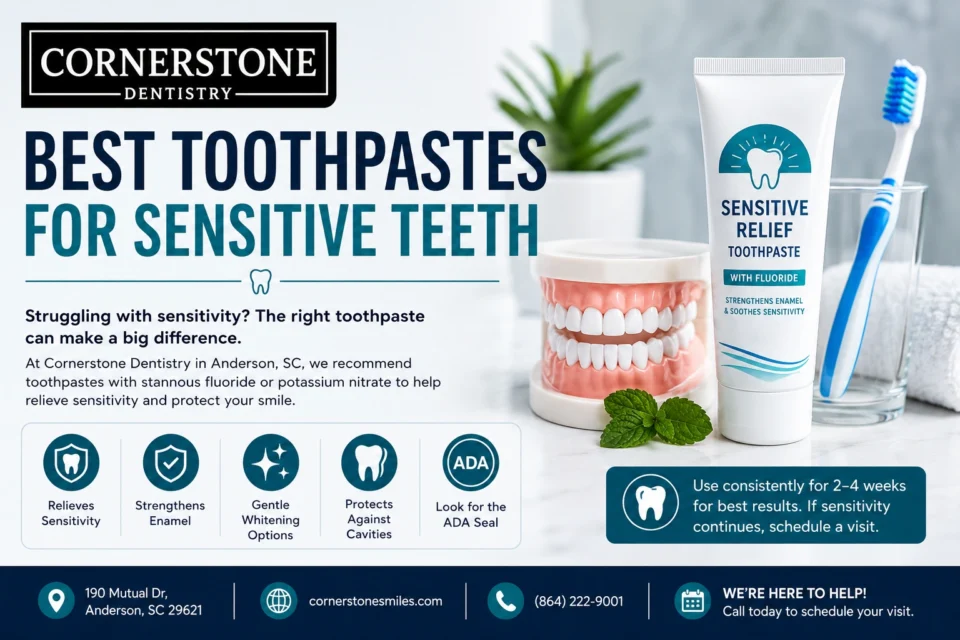
What If I Already Need Dental Work?
This is another common question.
Patients sometimes wait to join because they already know treatment is needed.
In reality, membership plans can still provide value.
The included preventive services and treatment discounts may help reduce overall costs.
The exact savings depend on the treatment required.
This is why reviewing your treatment plan with the dental office is important.
You’ll be able to see how membership pricing compares to standard fees.
The Real Financial Benefit Most Patients Overlook
Most people focus on discounts.
But the biggest financial benefit may actually be consistency.
Patients who visit regularly tend to experience:
- Fewer emergencies
- Smaller treatment needs
- Earlier diagnosis
- Less extensive restorative work
In other words, the value isn’t just what you save today.
It’s what you potentially avoid spending tomorrow.
That’s difficult to measure, but it matters.
Questions to Ask Before Joining Any Dental Membership Plan
Before enrolling in any membership program, we encourage patients to ask:
- What preventive services are included?
- How often are cleanings covered?
- What discounts apply to treatment?
- Are there exclusions?
- Is cosmetic dentistry included?
- Is there a family option?
- How is payment handled?
A good membership plan should be easy to understand.
If the details feel confusing, ask questions.
You deserve clear answers before making a decision.
Is a Membership Plan Better Than Insurance?
Sometimes.
Sometimes not.
If your employer offers strong dental benefits at a reasonable cost, insurance may still make sense.
However, many uninsured patients discover that a membership plan provides:
- Simpler pricing
- Fewer restrictions
- No waiting periods
- No annual maximums
- Easier access to care
The right choice depends on your specific situation.
The important thing is understanding your options instead of assuming dental care is unaffordable without insurance.
Frequently Asked Questions
Is a membership plan dental insurance?
No.
Membership plans are offered directly through the dental office and are not insurance products.
Can I use a membership plan anywhere?
Typically, membership benefits apply only at the participating dental office.
Are there waiting periods?
Most membership plans do not have waiting periods.
Is there an annual maximum?
Unlike traditional insurance, membership plans generally do not have annual maximums.
Can families join together?
Many offices offer family membership options. Ask your dental office about available plans.
Dental Care Shouldn’t Feel Out of Reach
One of the biggest misconceptions in dentistry is that patients must have insurance to receive quality care.
That’s simply not true.
Many patients without insurance successfully maintain healthy smiles through membership plans that make preventive care more affordable and treatment costs more predictable.
At Cornerstone Dentistry, Dr. Andrew Wilson and Dr. Dale Hardy understand that cost concerns are real. That’s why conversations about treatment should include honest discussions about fees, options, and ways to make care fit comfortably within your budget.
Want to Know Whether Our Membership Plan Would Actually Save You Money?
The best way to evaluate a membership plan is to compare it to your real dental needs—not someone else’s.
If you’re uninsured and wondering whether the Cornerstone Dentistry Membership Plan makes sense for you or your family, we’re happy to walk through the details, explain what’s included, and help you determine whether it would provide meaningful value based on your current oral health and future goals.
A short conversation today can often eliminate a lot of uncertainty about dental costs tomorrow.
Save on Dental Care Without Insurance
Take control of your dental expenses with a convenient membership plan. Call now to find out how to get started.