
Table of Contents
If you’ve seen recent headlines about fluoride bans, you’re probably wondering two things:
- Is fluoride actually safe?
- What happens to kids’ teeth if fluoride is removed from public water?
Those are fair questions.
And right now, they’re especially relevant in South Carolina because of proposed Senate Bill S. 743, which would prohibit fluoride from being added to public water systems statewide.
For many parents in Anderson, this debate feels confusing because the messaging online is all over the place.
Some people describe fluoride as one of the biggest public health successes in dentistry.
Others argue it should not be added to community water at all.
Here’s what we usually tell patients at Cornerstone Dentistry:
The fluoride conversation has become highly political online, but most parents are really asking something much simpler:
“Will removing fluoride increase my child’s risk for cavities?”
And the honest answer is:
For many children — especially higher-risk kids — it probably would.
That does not mean fluoride is magic.
It does not mean every child would suddenly develop severe decay.
And it does not mean parents would be powerless without fluoridated water.
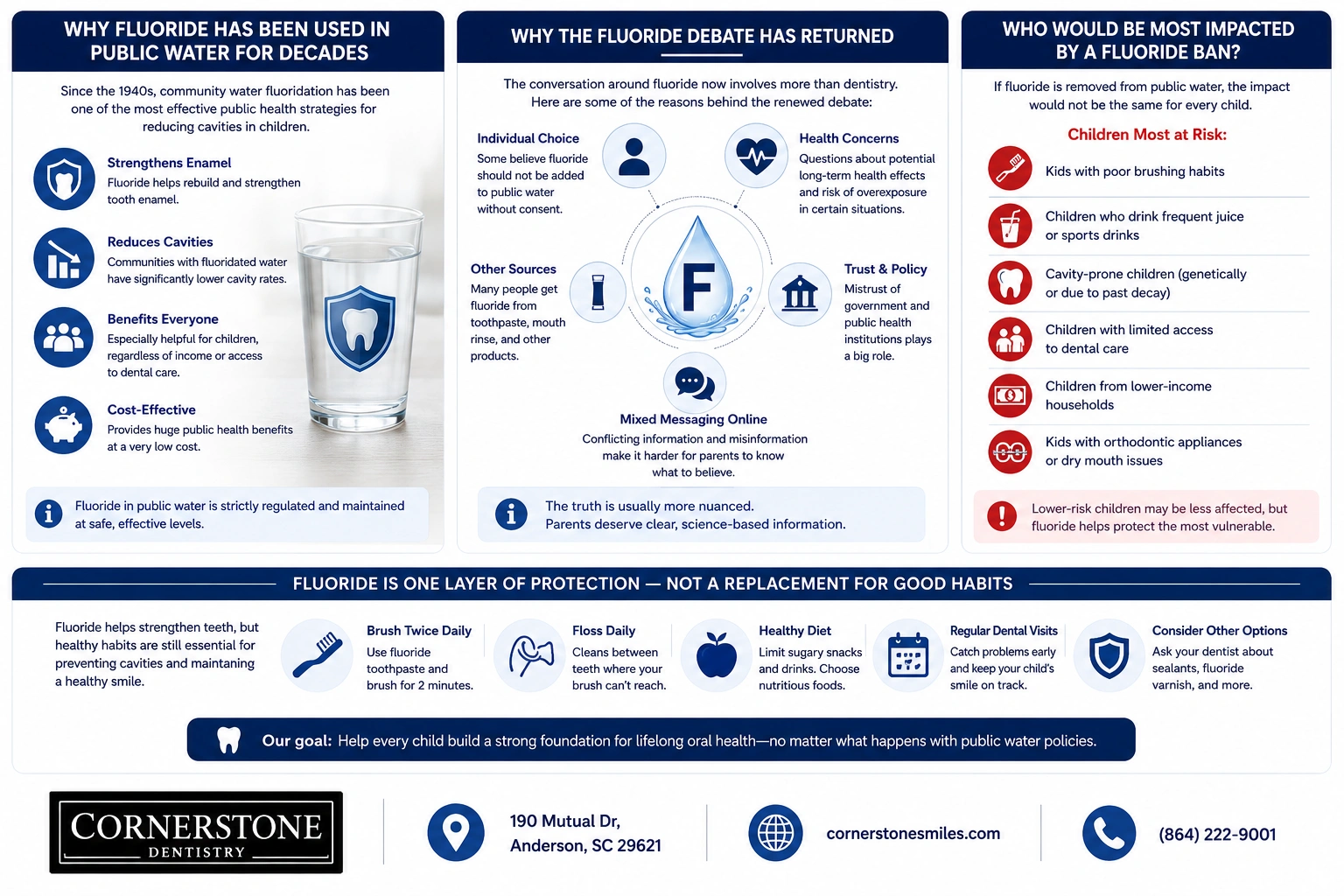
But it likely would change cavity rates over time, particularly in children who:
- already struggle with brushing
- consume sugary drinks frequently
- snack often
- have limited dental access
- are cavity-prone genetically
- come from lower-income households
Let’s walk through what South Carolina Bill S. 743 actually says, why fluoride became controversial again, and what the real-world dental implications could look like for families in Anderson and across Upstate South Carolina.
Protect your child's smile today.
Don't wait for cavities to develop. Schedule a dental checkup with our experienced team and get the answers you need.
What Is South Carolina Bill S. 743?
South Carolina Senate Bill S. 743 was introduced during the 2025–2026 legislative session.
The bill would prohibit adding fluoride to public water systems in South Carolina.
The proposed language states that:
- fluoride may not be added to public water systems
- local governments could not require fluoridation
- certain bottled water operators also could not add fluoride intentionally
At the time of writing, the bill has been introduced and referred to committee, but it has not become law.
Still, the proposal reflects a growing national debate.
Utah and Florida have already moved toward statewide fluoride restrictions, and other states are actively discussing similar legislation.
Why Was Fluoride Added to Water in the First Place?
Fluoride has been added to public water systems in the United States since the 1940s.
The original reason was straightforward:
Communities with naturally occurring low levels of fluoride tended to have fewer cavities.
Researchers eventually found that controlled fluoride exposure helped strengthen enamel and reduce tooth decay rates, particularly in children.
That led to community water fluoridation programs across the country.
For decades, many major public health organizations supported fluoridation because it:
- reached large populations cheaply
- did not depend on perfect brushing habits
- benefited children regardless of income level
- reduced cavity rates broadly
Dentists have seen those effects firsthand.
Why Has Fluoride Become Controversial Again?
This is where things get complicated.
The fluoride debate today is not just about dentistry.
It also involves:
- public health policy
- individual choice
- government intervention
- toxicology concerns
- mistrust of institutions
- internet misinformation
- emerging research debates
Some opponents argue:
- fluoride should not be added to public water without individual consent
- long-term exposure may carry health concerns
- people already receive fluoride from toothpaste and dental products
- overexposure is possible in certain situations
Supporters argue:
- fluoride levels in public water are carefully regulated
- decades of research support cavity reduction benefits
- removing fluoride would disproportionately hurt children
- fluoridation especially benefits underserved communities
The online conversation often becomes extreme on both sides.
That makes it harder for parents to sort through what is actually relevant to their child.
What Dentists Actually See in Real Life
This part matters.
Most general dentists are not approaching fluoride as a political issue.
They are looking at:
- cavity rates
- enamel strength
- childhood decay patterns
- long-term oral health outcomes
And clinically, dentists tend to notice a difference when fluoride exposure decreases — especially in higher-risk children.
Not every child develops cavities at the same rate.
Some kids seem naturally resistant to decay.
Others develop cavities despite parents doing many things right.
Fluoride is not the only factor, but it is often one helpful layer of protection.
Which Children Would Be Most Affected by a Fluoride Ban?
This is probably the most important question.
If fluoride disappeared from public water tomorrow, the impact would likely be uneven.
Children Potentially Most at Risk Include:
- kids with poor brushing habits
- children drinking frequent juice or sports drinks
- cavity-prone children
- children with limited access to dental care
- children with orthodontic appliances
- kids with dry mouth issues
- lower-income households
- children consuming high-sugar diets
These are often the children dentists already monitor closely.
For lower-risk children with:
- excellent oral hygiene
- low sugar intake
- regular dental care
- fluoride toothpaste use
- sealants
…the overall impact may be smaller.
But public health policies are usually designed around population-wide outcomes, not ideal-case households.
Fluoride Is Not a Substitute for Good Habits
This is important.
Some people discuss fluoride as though it alone prevents cavities.
That is not true.
A child with:
- poor brushing
- constant snacking
- heavy soda intake
- inconsistent dental visits
…can absolutely develop cavities even with fluoridated water.
Likewise, some children maintain excellent oral health without significant fluoride exposure because:
- their diet is strong
- hygiene is excellent
- genetics are favorable
Fluoride is one piece of the puzzle.
Not the entire puzzle.
Preventive dental care also includes monitoring existing restorations, since a cavity under a crown: what happens and how it’s treated can become an issue even when the crown itself still looks intact.
What Happens in Communities Without Fluoridated Water?
Research on this gets debated online constantly.
But many dentists practicing in non-fluoridated areas report seeing:
- higher decay rates
- more childhood cavities
- more severe decay in underserved populations
Again, that does not mean fluoridation eliminates cavities entirely.
It means it may reduce cavity risk across large groups over time.
The children most affected are often the ones least able to compensate with:
- private preventive care
- expensive dental products
- highly consistent home care
Could Parents Just Use Fluoride Toothpaste Instead?
Possibly — and many already do.
Fluoride toothpaste remains one of the most important tools for preventing decay.
If fluoridated water became unavailable, dentists would likely place even greater emphasis on:
- twice-daily brushing
- prescription-strength fluoride when appropriate
- regular cleanings
- sealants
- diet counseling
- fluoride varnish applications
But here’s the challenge:
Public water fluoridation works partly because it reaches people consistently, even when habits are imperfect.
Not every child brushes properly twice a day.
Not every family has easy access to preventive care.
That is part of why the issue remains controversial from a public health perspective.
Some Parents Are Concerned About Fluoride Overexposure
That concern is not irrational.
Like many substances, fluoride can become problematic at excessive levels.
For example, too much fluoride exposure during childhood can contribute to:
- dental fluorosis
- white spotting on teeth
- enamel appearance changes
Severe overexposure is uncommon in regulated U.S. water systems, but dosage still matters.
This is one reason pediatric dentists usually recommend:
- supervising toothpaste use in young children
- using only pea-sized amounts
- avoiding swallowing toothpaste
The conversation becomes less productive when people frame fluoride as either:
- completely harmless in unlimited amounts
or - universally dangerous at any level
Older restorations can also create separate dental concerns, so recognizing 3 signs your old silver fillings are cracking your teeth can help patients know when an evaluation may be needed.
Most healthcare discussions are more nuanced than that.
What Would Parents Need to Do If Fluoride Were Removed?
If South Carolina eventually banned water fluoridation, many families would likely need to become more intentional about preventive dental care.
That may include:
- improving brushing supervision
- reducing sugary snacks and drinks
- maintaining regular cleanings
- using fluoride toothpaste consistently
- discussing fluoride supplements when appropriate
- considering sealants earlier
For some families, the adjustment would be minor.
For others, especially cavity-prone children, it could matter more significantly.
Best Toothpaste for Sensitive Teeth: 6 Dentist-Recommended Picks for 2026
Written and medically reviewed by Dr. Andrew Wilson, DMD, Cornerstone Dentistry, Anderson. Last updated September 2026. Quick answer: The best…
Learn More
Would Cavities Immediately Skyrocket?
Probably not overnight.
Dental trends usually change gradually.
But over several years, many dentists would expect cavity rates to increase to some degree — particularly in vulnerable populations.
That may mean:
- more fillings
- more childhood dental pain
- more school absences
- more emergency dental visits
- higher long-term dental costs
Again, not for every child equally.
But likely across populations overall.
Why This Debate Feels So Emotional
Part of the tension comes from the fact that both sides believe they are protecting children.
One side prioritizes:
- population-wide cavity prevention
- public health outcomes
- access equity
The other prioritizes:
- individual choice
- minimizing chemical exposure
- skepticism toward government mandates
Those values collide emotionally.
And unfortunately, internet discussions often oversimplify the issue into:
- “fluoride is poison”
or - “only irresponsible people oppose fluoride”
Neither framing is especially helpful for parents trying to make informed decisions.
What Parents in Anderson Should Focus on Right Now
At this point, S. 743 remains proposed legislation and has not become law.
So the most practical thing parents can do right now is focus on the factors that consistently matter most for children’s oral health:
- supervised brushing
- limiting sugary drinks
- regular dental visits
- preventive care
- early cavity detection
- healthy dietary habits
Those habits influence cavity risk far more than political headlines alone.
The Bottom Line
South Carolina Bill S. 743 would prohibit adding fluoride to public water systems statewide if passed.
The debate around fluoride is likely to continue because it touches on both public health and personal choice.
From a dental perspective, many dentists believe removing fluoride from community water would likely increase cavity rates over time — especially among children already at higher risk for decay.
That does not mean fluoride is the only thing protecting children’s teeth.
And it does not mean parents would lose control over prevention.
But it probably would place more responsibility on individual families to compensate through:
- home hygiene
- preventive products
- nutrition
- regular dental care
At Cornerstone Dentistry, Dr. Andrew Wilson and Dr. Dale Hardy spend far more time helping parents prevent cavities than debating politics.
Because regardless of legislation, most children’s oral health still comes down to the same core things:
- consistent habits
- early prevention
- realistic guidance
- and catching problems before they become painful or expensive.
Worried about your child's cavity risk?
Get trusted, personalized dental guidance for your family. Call today to schedule a preventive exam and protect healthy smiles.