
Table of Contents
Most cavities don’t start as emergencies.
In fact, many patients in Anderson come into our office surprised to learn they even have one. There’s no severe pain. No swelling. No obvious hole in the tooth.
Does your crown feel off? Learn why a crown can feel weird when you bite down and how it’s fixed.
That’s part of what makes cavities so deceptive.
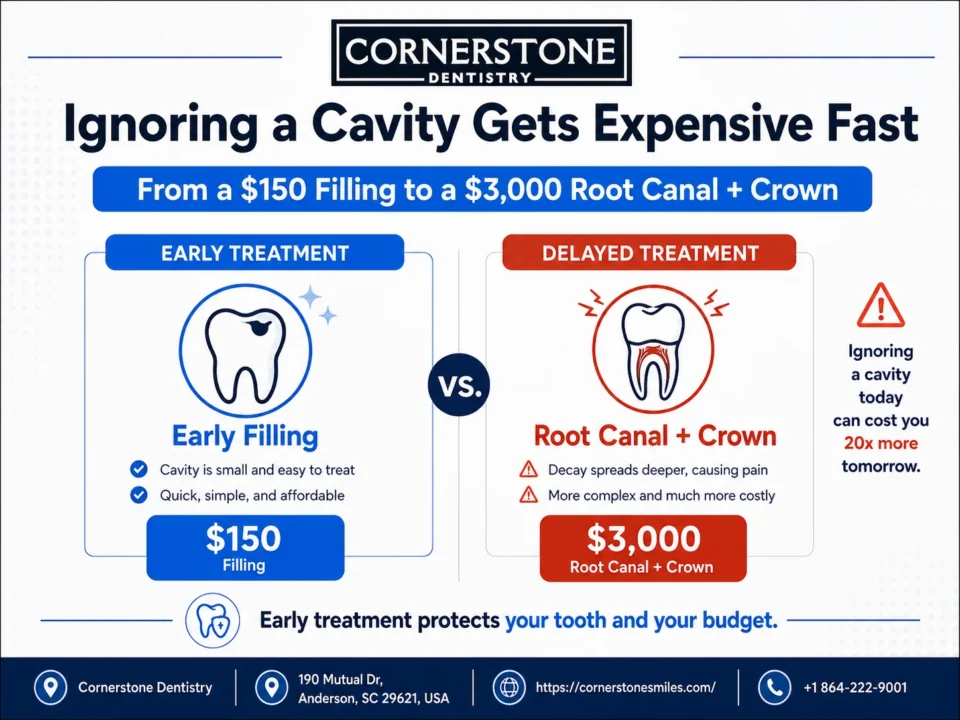
A small cavity that could have been treated with a relatively simple filling may not seem urgent today. But if decay continues to spread deeper into the tooth, the treatment needed—and the cost—can change dramatically.
What starts as a $150–$300 filling can eventually become a $2,000–$3,000+ root canal and crown, and in some cases, even lead to tooth extraction and replacement.
Here’s what we usually tell patients: cavities rarely get better on their own, but they almost always get more expensive if they’re ignored.
Fix Your Cavity Before It Gets Worse
Early treatment can save your tooth, your time, and thousands in dental costs.
The Short Answer
A cavity is essentially a bacterial infection in your tooth.
When caught early, treatment is often straightforward and affordable. But as the decay progresses deeper into the tooth, it damages more structure, threatens the nerve, and requires increasingly complex treatment.
The progression often looks something like this:
| Stage | Typical Treatment | Estimated Cost |
| Early cavity | Filling | $150–$300 |
| Moderate decay | Larger filling or onlay | $300–$1,000 |
| Deep decay reaching nerve | Root canal | $800–$1,500+ |
| Root canal + crown | Complete restoration | $2,000–$3,000+ |
| Tooth loss | Implant and crown | $4,000–$6,000+ |
The exact costs vary based on the tooth involved, insurance coverage, and treatment complexity, but the pattern remains consistent:
The longer decay progresses, the more treatment is usually required.
Why Cavities Get More Expensive Over Time
Many people assume a cavity is simply a hole in a tooth.
In reality, tooth decay is a process.
Bacteria feed on sugars and carbohydrates in the mouth and produce acids that gradually weaken enamel. Once the protective enamel layer is breached, decay can spread more rapidly through the softer dentin underneath.
Think of it like a small leak in a roof.
Repairing a single damaged shingle is relatively simple. Ignoring it until water damages insulation, drywall, and framing creates a much larger project.
The same principle applies to your teeth.
The decay doesn’t stop because you aren’t feeling it.
Understanding tooth decay: maintaining good oral hygiene can also help patients reduce plaque buildup, protect enamel, and lower the risk of new cavities developing.
Stage 1: The Small Cavity
At the earliest stage, decay affects a limited area of enamel or dentin.
This is the ideal time for treatment.
A dental filling removes the damaged portion of the tooth and replaces it with a durable restorative material.
Why Fillings Are Usually the Best Value
When patients ask whether a filling is really necessary, we often explain that fillings are typically the most conservative treatment available once decay has formed.
Benefits include:
- Preserving healthy tooth structure
- Preventing deeper infection
- Completing treatment in a single visit
- Lower overall cost
- Minimal recovery time
This is often the point where treatment is least invasive and least expensive.
Stage 2: The Cavity Gets Larger
When a cavity remains untreated, bacteria continue moving deeper into the tooth.
Over time, the decay can weaken larger portions of the tooth structure.
At this stage, patients may begin noticing:
- Sensitivity to cold
- Sensitivity to sweets
- Food getting stuck between teeth
- Occasional discomfort when chewing
However, many people still have no symptoms at all.
That’s one reason routine exams and X-rays remain important. Some cavities grow significantly before becoming painful.
Bigger Problem, Bigger Repair
As more tooth structure is lost, a simple filling may no longer provide enough strength.
Treatment may involve:
- Larger fillings
- Indirect restorations
- Onlays
- Partial crowns
These procedures generally cost more because they require more materials, more planning, and more reconstruction of the tooth.
Stage 3: The Decay Reaches the Nerve
This is where treatment often changes dramatically.
Inside every tooth is a soft tissue center called the pulp.
The pulp contains:
- Blood vessels
- Nerves
- Connective tissue
Once decay reaches this area, bacteria can trigger inflammation and infection.
Patients frequently experience:
- Persistent toothaches
- Sharp pain when chewing
- Sensitivity that lingers after eating or drinking
- Pain that wakes them up at night
- Sudden severe discomfort
Sometimes patients are surprised because the tooth was only mildly sensitive weeks earlier.
Unfortunately, once the nerve becomes infected, a filling is usually no longer enough.
Why a Root Canal Becomes Necessary
A root canal removes infected tissue from inside the tooth and seals the canals to prevent further infection.
Despite the reputation root canals have developed online, modern root canal treatment is typically focused on relieving pain, not causing it.
The goal is to save the natural tooth whenever possible.
What Happens During a Root Canal?
The procedure generally involves:
- Removing infected pulp tissue
- Cleaning and disinfecting the canals
- Sealing the root system
- Restoring the tooth afterward
For many patients, this is the point where they realize how expensive waiting can become.
A filling that may have cost a few hundred dollars is now a procedure involving significantly more time, technology, and expertise.
Why Most Root Canal Teeth Need Crowns
Many patients assume the root canal is the entire treatment.
Usually, it isn’t.
After a root canal, the tooth often becomes more brittle because:
- Significant decay has already weakened it
- Tooth structure was removed during treatment
- The tooth no longer has a living nerve supply
Without additional protection, the tooth becomes more vulnerable to cracking.
That’s why dentists frequently recommend a dental crown after root canal therapy.
A crown acts like a protective helmet around the tooth.
It helps:
- Prevent fractures
- Restore chewing strength
- Protect the remaining structure
- Extend the life of the tooth
When patients look at the combined cost of a root canal and crown, they’re often seeing the financial consequences of years of untreated decay—not just the price of one procedure.
What Happens If You Keep Waiting?
Some patients attempt to manage symptoms with:
- Pain medication
- Sensitive toothpaste
- Avoiding one side of the mouth
- Home remedies found online
While these may temporarily reduce discomfort, they do not eliminate the infection.
As decay progresses, several complications can occur.
Tooth Fracture
A weakened tooth can crack unexpectedly.
Once a crack extends below the gumline, saving the tooth may become impossible.
Dental Abscess
An infection can spread beyond the tooth into surrounding tissues.
Signs may include:
- Swelling
- Severe pain
- Bad taste in the mouth
- Facial tenderness
- Fever
An abscess can become a true dental emergency.
Tooth Loss
Eventually, some teeth become too damaged to restore.
At that point, extraction may be the only realistic option.
Dental Onlays vs. Crowns: Which One Do You Actually Need?
When a tooth is too damaged for a simple filling, many patients assume a crown is automatically the next step.…
Learn More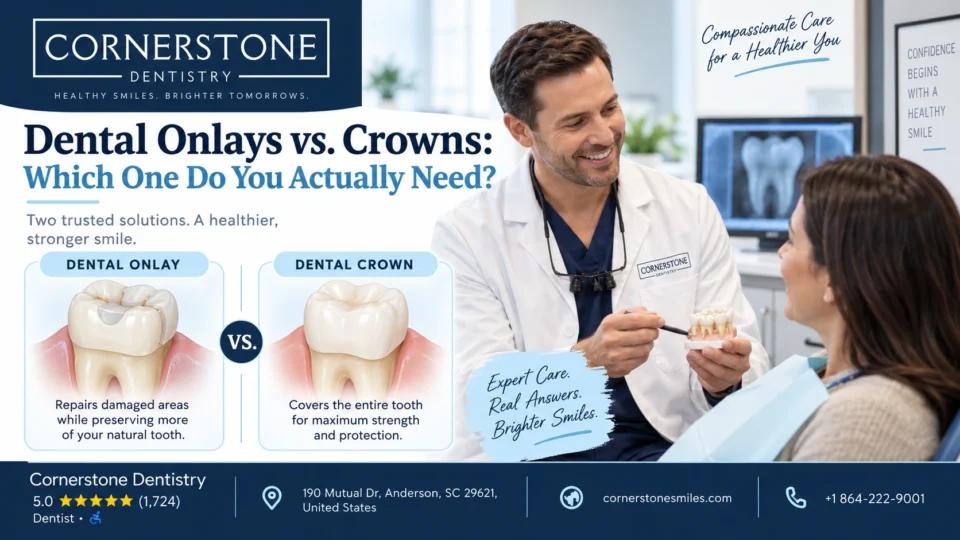
The Cost Gets Even Higher After Tooth Loss
Many patients assume extraction solves the problem.
It removes the painful tooth, but it also creates a new challenge: replacing it.
Without replacement, missing teeth can lead to:
- Shifting teeth
- Bite problems
- Difficulty chewing
- Bone loss in the jaw
For patients considering what comes next after tooth loss, filling in the gaps: restoring your smile & quality of life can help explain how replacing missing teeth supports function, appearance, and long-term oral health.
Common replacement options include:
| Treatment | Typical Cost Range |
| Partial denture | $1,000–$3,000 |
| Bridge | $2,000–$5,000 |
| Dental implant and crown | $4,000–$6,000+ |
This is why many dentists view fillings as preventive investments rather than expenses.
The goal isn’t simply fixing a cavity.
The goal is preventing the chain reaction that follows.
Does Dental Insurance Change the Equation?
Sometimes.
Most dental insurance plans provide some coverage for fillings.
However, many plans have:
- Annual maximums
- Waiting periods
- Percentage-based coverage
Ironically, insurance may cover a larger percentage of a filling than a crown, but because crowns and root canals are significantly more expensive, patients still end up paying far more out of pocket.
We often tell patients that insurance can help reduce costs, but it rarely eliminates the financial advantage of treating decay early.
Are There Times When a Cavity Can Wait?
This is a fair question.
Not every cavity requires immediate treatment within days.
Some very small areas of early decay can sometimes be monitored based on:
- Location
- Size
- Risk factors
- Oral hygiene habits
- X-ray findings
However, once a cavity has clearly penetrated the tooth structure, delaying treatment usually increases risk.
The challenge is that patients often cannot determine that progression themselves.
The cavity may feel exactly the same while becoming significantly larger.
That’s why clinical exams and diagnostic X-rays matter.
How to Decide Whether to Fix a Cavity Now
When patients are uncertain, we encourage them to ask a few simple questions:
- How large is the cavity today?
- Is it getting close to the nerve?
- What happens if I wait six months?
- What are the chances this becomes a root canal?
- What are my treatment options right now?
Those conversations often provide clarity.
The decision is rarely about whether a filling costs money.
It’s about comparing today’s smaller investment against the possibility of a much larger one later.
When a Small Problem Is Still a Small Problem
One of the most frustrating things we hear from patients is:
“I wish I had taken care of it when it was just a filling.”
Most people don’t ignore cavities because they’re careless. Life gets busy. Symptoms come and go. Insurance renewals are around the corner. The tooth doesn’t hurt yet.
But decay doesn’t usually pause while we decide.
Concerned About a Cavity? Get Answers Before It Becomes Something Bigger
If you’re wondering whether a cavity is minor or already moving toward a root canal, the best next step is a professional evaluation. In many cases, a simple exam and X-rays can show exactly how far the decay has progressed and what your options look like today.
At Cornerstone Dentistry in Anderson, Dr. Andrew Wilson and Dr. Dale Hardy help patients understand what’s happening, what treatment is truly necessary, and what may happen if they choose to wait. The goal isn’t pressure—it’s clarity.
Because when it comes to cavities, the most affordable treatment is often the one you catch early.
Don’t Let a Small Cavity Get Expensive
Treat decay early before a simple filling turns into a root canal and crown.