
Table of Contents
If you’ve been thinking about whitening your teeth, there’s a good chance you’ve wondered about one thing more than anything else:
“Will it make my teeth sensitive?”
It’s one of the most common questions we hear from patients considering cosmetic whitening.
And for good reason.
Many people have tried Crest White Strips or another over-the-counter whitening product and experienced sharp sensitivity afterward. Others have heard stories from friends who couldn’t drink cold water for days after whitening their teeth.
So when they’re considering professional whitening, they naturally want to know:
Will professional whitening hurt more, or less?
Here’s what we usually tell patients:
Both professional whitening and Crest White Strips can cause tooth sensitivity. The real difference is how predictable, manageable, and temporary that sensitivity tends to be.
The surprising part is that the stronger whitening treatment isn’t always the one that creates the most discomfort.
Let’s look at why whitening causes sensitivity in the first place, how Crest White Strips compare to professional whitening systems, and which option may be the better choice if sensitive teeth are one of your biggest concerns.
Upgrade Your Whitening Experience
Skip the guesswork of whitening strips and discover professional care customized for your teeth. Call today to get started.
The Short Answer: Both Can Cause Sensitivity
Many people assume sensitivity only happens with professional whitening because the whitening agents are stronger.
That’s not true.
Sensitivity can occur with:
- Crest White Strips
- Store-bought whitening kits
- Professional take-home whitening trays
- In-office whitening treatments
The whitening ingredient itself is usually responsible.
Whether the product contains hydrogen peroxide or carbamide peroxide, the whitening process works by penetrating the tooth and breaking apart stain molecules.
That process can temporarily irritate the nerve inside the tooth.
For some people, this causes little to no discomfort.
For others, it creates noticeable sensitivity to:
- Cold drinks
- Ice cream
- Cold air
- Sweet foods
- Brushing
The key question isn’t whether sensitivity is possible.
It’s how likely it is and how well it can be managed.
Why Whitening Causes Sensitivity
To understand the comparison, it helps to understand what’s happening inside the tooth.
Your teeth are not solid blocks of enamel.
Underneath the enamel is a layer called dentin.
Dentin contains microscopic channels that connect to the nerve inside the tooth.
When whitening agents penetrate the tooth, they can temporarily increase nerve responsiveness.
Think of it like turning up the volume on a speaker.
The tooth isn’t necessarily damaged.
It’s simply more reactive for a period of time.
That’s why many whitening-related sensitivity symptoms disappear after treatment is completed.
For most patients, the sensitivity is temporary.
Patients considering treatment often also ask is teeth whitening safe and how long do results last, especially when balancing sensitivity concerns with the desire for longer-lasting cosmetic improvement.
How Crest White Strips Work
Crest White Strips remain one of the most popular whitening products available.
The appeal is obvious:
- Widely available
- Relatively inexpensive
- Easy to use
- No dental appointment required
Most kits cost between $25 and $70.
The strips contain peroxide-based whitening gel that adheres directly to the front surfaces of the teeth.
Patients typically wear them daily for a specified period.
The results can be impressive for many people.
But there are limitations that affect both whitening effectiveness and sensitivity.
The Biggest Sensitivity Problem With White Strips
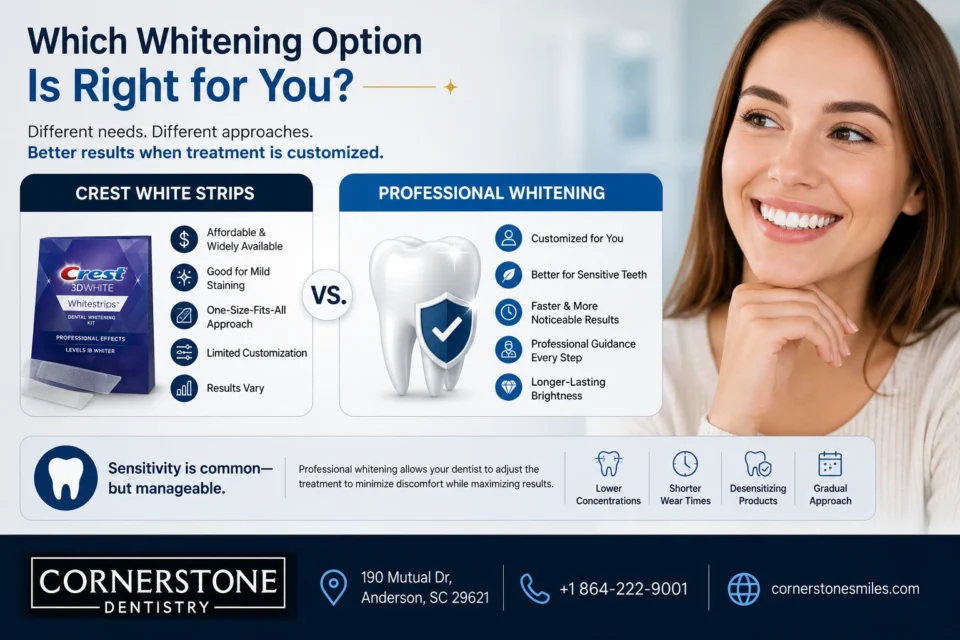
One of the biggest challenges with whitening strips is that they’re designed for the average person.
Your teeth, however, are not average.
Neither are your gums.
Neither is your sensitivity level.
The strips come in standardized sizes and shapes.
This creates several potential issues:
Uneven Coverage
Teeth vary significantly from person to person.
Strips may not fit perfectly.
Some areas receive more whitening gel than others.
Gum Contact
The strips often overlap onto gum tissue.
This can cause temporary gum irritation.
No Customization
If sensitivity develops, there is little ability to modify the treatment other than stopping completely.
The product isn’t tailored to your specific needs.
This lack of customization is one reason some patients struggle with discomfort.
Why Professional Whitening Can Sometimes Feel More Comfortable
This surprises many patients.
Professional whitening often uses stronger whitening agents.
Yet many patients report a more comfortable experience.
Why?
Because professional whitening is typically customized.
Instead of a one-size-fits-all approach, treatment can be adjusted based on:
- Existing sensitivity
- Gum health
- Tooth condition
- Whitening goals
- Previous whitening experiences
For example, if a patient has sensitive teeth, a dentist may recommend:
- Lower concentrations
- Shorter wear times
- Desensitizing products
- Gradual whitening schedules
The whitening agent may be stronger, but the treatment plan is often smarter.
Not All Sensitivity Is Created Equal
Many patients assume sensitivity is simply a matter of intensity.
But duration matters too.
Consider these two scenarios:
Scenario One
A patient uses whitening strips for two weeks.
They experience mild sensitivity every day during treatment.
Scenario Two
A patient completes professional whitening.
They experience moderate sensitivity for one or two days.
Which experience is better?
That depends on the individual.
The important point is that sensitivity isn’t just about how much discomfort occurs.
It’s also about how long it lasts and how manageable it feels.
Who Is Most Likely to Experience Whitening Sensitivity?
Certain patients are naturally more prone to sensitivity regardless of which whitening method they choose.
Common risk factors include:
Receding Gums
When gums recede, root surfaces may become exposed.
These areas are often more sensitive than enamel-covered portions of the tooth.
Existing Tooth Sensitivity
If cold drinks already bother your teeth, whitening may temporarily increase that sensitivity.
Enamel Wear
Teeth that have experienced significant wear may be more reactive during whitening.
Cracked Teeth
Small cracks can create pathways that increase sensitivity.
Untreated Cavities
Whitening should generally be postponed until cavities are treated.
Otherwise discomfort may become significantly worse.
This is one reason professional evaluation can be helpful before whitening begins.
HPV & Oral Cancer: What You Need to Know
We love to talk about the fun and interesting sides of oral health, but today, there is something much more…
Learn More
Which Option Produces Better Whitening Results?
Sensitivity is important.
But so are results.
Patients often tolerate temporary discomfort if the outcome is worth it.
Generally speaking:
Crest White Strips
Often work well for:
- Mild staining
- Surface discoloration
- Younger patients
- Maintenance whitening
Professional Whitening
Often works better for:
- Deeper staining
- More dramatic whitening goals
- Faster results
- Customized treatment
That doesn’t mean strips don’t work.
Many people achieve noticeable improvements.
Professional systems simply offer greater control and often greater whitening potential.
The Hidden Cost of Chasing Whitening Results
One factor many consumers overlook is repetition.
Let’s say someone uses whitening strips multiple times per year because they aren’t achieving the desired shade.
The costs may look something like this:
- Four whitening strip kits annually
- $50 per kit
Annual cost: $200
After several years, the total investment can become significant.
Professional whitening may involve a higher initial cost but can sometimes provide longer-lasting results and easier maintenance.
That’s why comparing whitening options based solely on upfront cost can be misleading.
What About Whitening Toothpaste?
Many patients try whitening toothpaste before considering strips or professional whitening.
Whitening toothpaste can help remove surface stains.
However, most whitening toothpastes do not significantly change the intrinsic color of the tooth.
In other words:
They polish.
They don’t dramatically bleach.
For patients seeking a noticeably whiter smile, toothpaste alone often falls short of expectations.
When Crest White Strips Make Sense
White strips may be a reasonable option if:
- Your teeth are generally healthy
- You have minimal sensitivity
- You want modest whitening
- You’re working with a limited budget
- You understand the limitations
For many patients, they provide a cost-effective way to brighten their smile.
Before choosing them, it can also help to understand how effective are whitening strips and what kinds of stains they are most likely to improve.
Not everyone needs professional treatment.
When Professional Whitening May Be Worth the Investment
Professional whitening is often worth considering when:
- You have sensitive teeth
- You want maximum whitening
- You have existing dental work
- You’ve experienced whitening disappointment before
- You want guidance throughout the process
- You’re preparing for a major event
The ability to customize treatment can make a meaningful difference in both comfort and results.
The Biggest Whitening Myth About Sensitivity
One of the most persistent myths is:
“If whitening causes sensitivity, it’s damaging your teeth.”
For most patients, that’s not what’s happening.
Temporary sensitivity is a common side effect of the whitening process.
It does not automatically mean the teeth are being harmed.
That said, severe or persistent sensitivity should always be evaluated.
A whitening product may be revealing an underlying issue such as:
- Tooth decay
- Gum recession
- Cracks
- Existing dental problems
This is another reason professional guidance can be valuable.
The Real Winner in the Sensitivity Battle
If we’re looking strictly at affordability, Crest White Strips are difficult to beat.
If we’re looking strictly at customization and sensitivity management, professional whitening usually has the advantage.
The best option depends on your goals, budget, and oral health.
For some patients, whitening strips provide exactly what they need.
For others, the ability to customize treatment and manage sensitivity makes professional whitening well worth the additional investment.
The right choice isn’t necessarily the cheapest one.
It’s the one that helps you achieve the result you want without creating discomfort that makes you regret the process.
Before You Whiten, Make Sure Sensitivity Isn’t Warning You About Something Else
Many people assume tooth sensitivity is simply part of whitening. Sometimes it is. Other times, sensitivity can be a sign of gum recession, enamel wear, a cracked tooth, or an untreated cavity that should be addressed before any whitening begins.
If you’ve been hesitant to whiten because of sensitivity—or if you’ve tried whitening products before and had a painful experience—an evaluation can often identify what’s causing the discomfort and whether a different whitening approach would be safer and more effective.
At Cornerstone Dentistry in Anderson, Dr. Andrew Wilson and Dr. Dale Hardy help patients understand their whitening options, set realistic expectations, and create treatment plans that balance cosmetic goals with long-term oral health. A brighter smile is great, but it shouldn’t come at the expense of your comfort.
Sensitive Teeth? Choose Professional Care
Enjoy a whiter smile without relying on one-size-fits-all strips. Call today to explore professional whitening options.