
Table of Contents
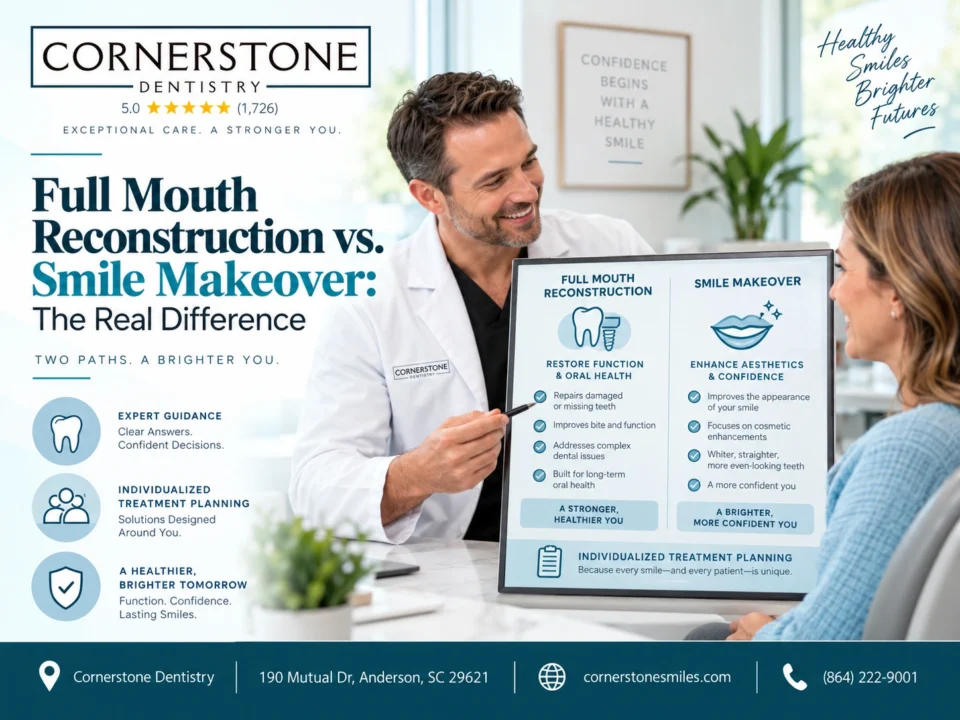
“Full mouth reconstruction” and “smile makeover” are sometimes used as though they’re interchangeable, but they usually describe different treatment priorities. A full mouth reconstruction is primarily designed for people with widespread dental damage, missing teeth, severe wear, or other problems affecting oral health and function. A smile makeover is generally driven more by esthetic goals, although cosmetic treatment still has to respect the health, strength, and function of the teeth underneath. The two can overlap, and the procedures themselves aren’t exclusive to one category.
Key Takeaways
- Full mouth reconstruction is comprehensive restorative treatment intended to rebuild extensively damaged, worn, or missing teeth while improving health, chewing function, and appearance.
- A smile makeover is generally an esthetically focused treatment plan designed around concerns such as tooth color, shape, proportion, spacing, or alignment.
- The same procedure, such as a crown, implant, orthodontic treatment, or veneer, can sometimes appear in either type of plan depending on why it is being performed.
- Dental insurance does not cover a “full mouth reconstruction” or “smile makeover” as a single package. Coverage is determined procedure by procedure under the patient’s specific dental plan.
- When functional and cosmetic concerns overlap, treatment is generally planned so active disease and structural problems are addressed before or alongside elective esthetic work.
Full mouth reconstruction: rebuilding extensively compromised teeth. The American College of Prosthodontists describes full mouth reconstruction as rebuilding and/or replacing the teeth throughout the mouth. Rather than treating one isolated cavity or replacing one missing tooth, it is a comprehensive treatment strategy for people whose dental problems affect many teeth.
The goal isn’t function at the expense of appearance. The ACP specifically describes full mouth reconstruction as combining esthetics with restorative dentistry to improve the health, function, and beauty of the mouth.
At Cornerstone Dentistry, a reconstruction plan can involve multiple restorative treatments depending on what the examination shows. Options may include dental implants, crowns, bridges, onlays, bonding, veneers, full-arch restorations, or other treatment needed to rebuild damaged or missing teeth.
The ACP identifies patients with multiple missing teeth, numerous failing or decayed restorations, cracked or broken teeth, and severely worn teeth as examples of people who may require comprehensive reconstruction. Some inherited developmental conditions can also create a need for extensive restorative treatment.
Other dental care may need to happen before or during reconstruction as well. For example, active gum disease, decay, infection, or teeth that cannot be restored need to be addressed before the final restorative work is completed.
Smile makeover: changing the appearance of the smile. A smile makeover is generally an esthetically focused treatment plan built around what a patient wants to change about the appearance of their smile.
Depending on the concern, cosmetic dentistry may involve teeth whitening, dental bonding, veneers, gum contouring, crowns, or orthodontic treatment such as clear aligners. Some smile makeover plans are relatively simple. Others combine several treatments and can be much more involved.
The important distinction is that “cosmetic” does not mean oral health and function stop mattering. The American Academy of Cosmetic Dentistry states that responsible esthetic dentistry should complement the patient’s overall oral health and function and should use minimally invasive treatment where appropriate.
That means someone asking for whiter or straighter-looking teeth still needs underlying decay, gum disease, unstable restorations, significant wear, or other oral-health problems evaluated before elective cosmetic treatment is finalized.
It’s also too restrictive to say that a smile makeover is only for teeth that already “work perfectly.” Cosmetic plans can include restorations on chipped, worn, previously restored, or otherwise imperfect teeth. The main difference is that the patient’s treatment goal is primarily esthetic rather than the comprehensive rebuilding of a heavily compromised dentition.
The differences that actually matter.
| Factor | Full Mouth Reconstruction | Smile Makeover |
| Primary emphasis | Rebuilding widespread dental health, structure and function while also considering appearance | Improving smile appearance while preserving oral health and function |
| Typical starting point | Multiple damaged, worn, failing or missing teeth | Concerns about color, shape, proportion, spacing, alignment or overall smile appearance |
| Possible procedures | Crowns, bridges, implants, onlays, full-arch restorations, orthodontics and other restorative care | Whitening, bonding, veneers, crowns, gum contouring, clear aligners and other esthetic treatments |
| Number of teeth involved | Usually extensive and comprehensive | Can involve one tooth, several teeth or much of the visible smile |
| Surgery | May be involved if implants, extractions or grafting are needed | Not necessarily; many cosmetic treatments are nonsurgical |
| Treatment time | Depends greatly on the procedures involved and may be phased over months when surgery or implants are required | Can range from one or several visits to many months if orthodontics or extensive restorative treatment is included |
| Insurance | Individual restorative procedures may have benefits depending on the plan and its limitations | Purely cosmetic procedures may be excluded; restorative or orthodontic components depend on the specific plan |
The procedure list itself doesn’t determine which category a patient belongs in. A crown, for example, might be placed because a tooth is badly fractured and needs structural protection, because an old restoration is failing, or partly to improve appearance. An implant may restore chewing function while also improving the appearance of a missing-tooth space.
The reason for treatment and condition of the mouth matter more than the name attached to the overall plan.
Signs full mouth reconstruction may be worth discussing. Full mouth reconstruction is generally considered when dental problems are widespread enough that treating one tooth at a time without an overall plan may not produce the best result.
Examples include:
- Multiple missing teeth
- Several cracked, fractured, or severely damaged teeth
- Numerous large or failing restorations
- Significant generalized tooth wear
- Extensive loss of tooth structure from grinding or other causes
- Multiple teeth requiring crowns, replacement, or other major restorative work
- A combination of missing, worn, and damaged teeth that affects chewing or oral function
The American College of Prosthodontists specifically lists multiple missing teeth, failing large fillings, decay, cracked or broken teeth, and badly worn teeth among circumstances in which full mouth reconstruction may be appropriate.
One important caution involves jaw pain and TMJ symptoms. Jaw discomfort should not automatically be interpreted as evidence that a patient needs full mouth reconstruction or bite-changing dental work.
The National Institute of Dental and Craniofacial Research states that current evidence does not support a strong relationship between malocclusion and temporomandibular disorders. It also cautions that irreversible occlusal treatments, including crowns, grinding down teeth, or orthodontic treatment intended specifically to change the bite as a TMD treatment, lack sufficient evidence and can sometimes make TMD symptoms worse. Jaw pain therefore deserves its own careful diagnosis rather than being used by itself as justification for reconstruction.
If comprehensive reconstruction is recommended for other established dental reasons, our full mouth reconstruction post-op instructions explain general aftercare considerations following treatment.
Signs a smile makeover may fit your goals. A smile makeover may be worth discussing when the primary concerns involve what you see when you smile rather than widespread failure of the teeth.
Those concerns might include:
- Tooth discoloration
- Chipped or irregular tooth edges
- Small spaces between teeth
- Tooth size or proportion
- Uneven-looking teeth
- Mild alignment concerns
- Older visible restorations that no longer blend naturally
- The overall color, shape, or symmetry of the visible smile
That doesn’t mean the dentist skips the health examination and goes straight to veneers or whitening. Cosmetic treatment should still be planned around healthy teeth, gums, and a functional bite. The AACD specifically emphasizes that esthetic dentistry should complement oral health and avoid unnecessary loss of healthy tooth structure.
Our guide to smile makeover costs and financing also explains why one patient’s makeover might consist of a relatively simple cosmetic treatment while another person’s plan involves several stages.
How we plan a case that has both functional and cosmetic goals. There doesn’t always have to be a choice between reconstruction and appearance. Full mouth reconstruction itself can include an esthetic goal, and a cosmetic treatment plan sometimes identifies restorative problems that need to be corrected along the way.
The general planning principle is to establish oral health and structural stability before completing elective esthetic treatment that depends on that foundation.
For example, a comprehensive plan might involve:
- Treating active decay, infection, or gum disease.
- Determining which damaged teeth can be restored and which need replacement.
- Replacing missing teeth or rebuilding severely compromised teeth when indicated.
- Establishing stable restorative relationships between the teeth.
- Coordinating orthodontic treatment when tooth movement is part of the plan.
- Completing esthetic treatments such as whitening, bonding, or veneers at the appropriate point in the sequence.
That order isn’t identical for every patient. Whitening, for example, is often planned before matching the final shade of visible crowns, bonding, or veneers. Orthodontic treatment can also substantially change the sequence because tooth movement may take months.
The goal is to plan the final result from the beginning so one phase of treatment doesn’t unnecessarily compromise another.
Frequently asked questions.
Is full mouth reconstruction an official dental procedure? The American College of Prosthodontists uses and defines the term “full mouth reconstruction” and describes it as rebuilding and/or replacing the teeth throughout the mouth. It is not one single procedure with one universal technique. Instead, it is a comprehensive treatment plan that may combine multiple established dental procedures.
Is a smile makeover one specific procedure? No. “Smile makeover” generally describes an individualized esthetic treatment plan rather than one procedure. It can involve a single treatment or a combination of whitening, bonding, veneers, crowns, orthodontics, gum treatment, or other dental care depending on the patient’s goals and oral health.
Can insurance help pay for a full mouth reconstruction? Possibly, but insurance doesn’t typically evaluate “full mouth reconstruction” as one all-inclusive treatment category. Each procedure is subject to the patient’s particular dental benefits, exclusions, annual maximums, waiting periods, frequency limitations, alternate-benefit provisions, and other plan rules. The ADA emphasizes that dental plan benefits vary widely and that even clinically necessary procedures aren’t automatically reimbursed by every plan.
Does insurance cover a smile makeover? It depends on what the makeover includes. Procedures performed solely for cosmetic purposes, such as tooth whitening or cosmetic veneers under plans that exclude cosmetic care, commonly receive no benefit. A crown, implant, orthodontic procedure, or other treatment that has a restorative purpose may have benefits under some plans, but coverage still depends on that specific contract. The ADA notes that procedures considered cosmetic can vary in coverage and advises verifying benefits rather than assuming a procedure will be paid for.
How long does full mouth reconstruction take? There isn’t one standard timeline. A plan involving primarily crowns or other tooth-supported restorations may progress differently from one involving extractions, bone grafting, or dental implants. Cornerstone Dentistry’s current reconstruction process notes that implant or graft healing can take weeks to months and that treatment can be completed in multiple phases.
How long does a smile makeover take? That depends entirely on the treatments selected. Whitening or bonding may require relatively little treatment time. Veneers and crowns generally involve additional planning and appointments. Clear aligner treatment can take months. Because a smile makeover can include any combination of those treatments, saying every makeover is completed “within a few weeks” would be misleading.
Is full mouth reconstruction more painful than a smile makeover? Not necessarily. Comfort and recovery depend on the actual procedures, not the label attached to the treatment plan. Implant placement, bone grafting, or extraction involves a different recovery than whitening, but crowns, veneers, orthodontics, bonding, and other procedures each have their own experience and aftercare requirements.
Can I start with cosmetic dentistry and deal with damaged teeth later? That depends on what the examination shows. Active infection, decay, uncontrolled gum disease, severe structural problems, and other oral-health conditions may need to be addressed before elective cosmetic treatment. The AACD supports esthetic treatment that complements overall oral health rather than compromising it.
That doesn’t mean every small imperfection requires extensive restorative treatment before a cosmetic procedure. The point of the examination is to distinguish problems that genuinely need treatment from healthy teeth that can be managed conservatively.
What does the first appointment involve? For full mouth reconstruction at Cornerstone Dentistry, the practice’s current treatment information describes a comprehensive oral examination along with digital imaging and bite analysis to evaluate the teeth, existing restorations, wear patterns, gums, bone, and other relevant factors. A customized treatment roadmap is then developed based on those findings.
For cosmetic treatment, the evaluation is guided by the patient’s goals and oral health. Cornerstone’s cosmetic dentistry consultation includes a review of those goals and oral condition, with digital previews used when appropriate.
You should know the proposed treatment, alternatives, approximate sequence, fees, and expected timeline before committing to a complex plan.
Why getting the diagnosis right matters more than the label. The most useful question usually isn’t “Do I need a reconstruction or a makeover?” It’s “What problems actually need to be treated, and what changes are optional?”
A patient with widespread tooth damage shouldn’t receive an esthetic-only treatment plan that ignores disease or structural problems. At the same time, someone with healthy teeth and a straightforward cosmetic concern shouldn’t automatically be pushed toward extensive restorative dentistry when a more conservative option can achieve the goal.
Responsible treatment planning aims to preserve healthy tooth structure whenever possible, restore what genuinely needs to be restored, and incorporate appearance into the plan in a way that supports long-term oral health.
Not sure which category your situation falls into? An examination can separate functional needs from cosmetic goals and show where the two overlap. Call Cornerstone Dentistry at (864) 222-9001 or schedule online to discuss the options that make sense for your teeth.