
Table of Contents
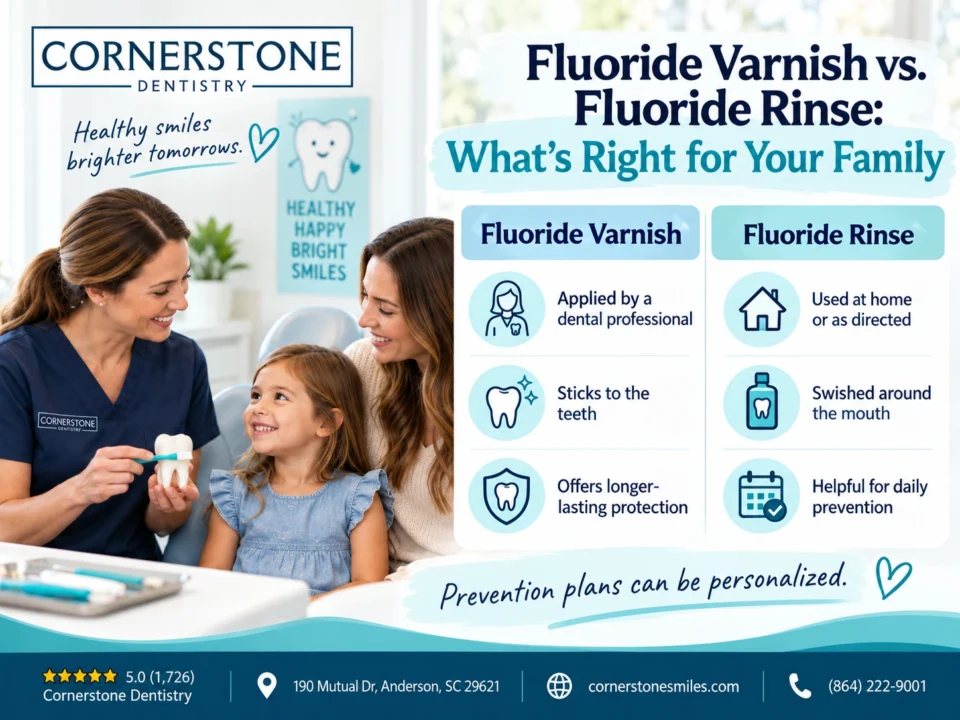
Fluoride comes up in almost every dental conversation, but “varnish” and “rinse” aren’t the same product used the same way. Professional varnish delivers a much more concentrated amount of fluoride directly to the teeth in a small, controlled application, while mouthrinses use lower concentrations at home. Here’s how each actually works, based on ADA, AAPD, and USPSTF guidance.
Key Takeaways
- The commonly used 5% sodium fluoride varnish contains 22,600 ppm fluoride, about 98 times the fluoride concentration of a typical 0.05% sodium fluoride daily rinse.
- The USPSTF recommends fluoride varnish for children younger than age 5 beginning when the first primary tooth erupts, but it does not prescribe one universal application interval.
- Fluoride mouthrinses are not recommended for children younger than age 6 because young children are more likely to swallow the rinse instead of reliably spitting it out.
- Fluoride varnish and mouthrinse serve different purposes, and not everyone needs both. Recommendations should be based on age and individual cavity risk.
- Community water fluoridation is a separate fluoride exposure. Current U.S. guidance recommends 0.7 mg/L, while federal agencies continue to evaluate newer research on fluoride exposure and neurodevelopment.
Stronger Teeth Start Here
Help protect your family’s teeth with professional fluoride care. Call today to schedule an appointment.
The concentration difference matters, but it isn’t the whole story. Professional varnish is substantially more concentrated than at-home mouthrinse, according to the ADA. The most commonly used varnish is 5% sodium fluoride, which contains 2.26% fluoride ion, or 22,600 parts per million (ppm). A common over-the-counter daily sodium fluoride rinse contains 230 ppm fluoride. That makes the varnish concentration about 98 times higher.
That doesn’t mean someone using varnish receives 98 times as much fluoride overall. Varnish is applied in a very small amount by a health professional and only periodically, while a mouthrinse is a lower-concentration product designed to be swished and spit out on a regular schedule.
| Factor | Professional Varnish | OTC Rinse | Prescription/High-Strength Rinse |
| Common concentration | 5% sodium fluoride, providing 2.26% fluoride or 22,600 ppm | 0.05% sodium fluoride, about 230 ppm fluoride | 0.2% sodium fluoride, about 920 ppm fluoride |
| How it’s used | Painted directly onto teeth by a dental or health professional | Swished and spit out at home | Swished and spit out at home as prescribed |
| Typical frequency | Periodic professional application based on age and cavity risk | Commonly daily | Commonly weekly for 0.2% sodium fluoride |
| Age consideration | 2.26% fluoride varnish is the professionally applied topical fluoride recommended for children under 6 | Not recommended under age 6 | Generally used in patients age 6 or older when indicated |
The ADA also lists a 0.1% fluoride difluorsilane varnish formulation containing approximately 1,000 ppm fluoride, so not every product marketed as a fluoride varnish has exactly the same concentration. The 22,600 ppm figure refers specifically to the widely used 5% sodium fluoride varnish.
Fluoride varnish: what actually happens at your appointment. Fluoride varnish is painted directly onto the teeth in a small amount. It sets when it contacts saliva and temporarily keeps concentrated fluoride against the tooth surfaces. It isn’t intended to stay attached permanently and gradually wears away.
The ADA says at least two applications per year are needed for sustained benefit when varnish is being used for cavity prevention. Its evidence-based clinical guidance recommends 2.26% fluoride varnish every 3 to 6 months for patients at elevated cavity risk, depending on age and individual circumstances. The AAPD recommends that children at risk for cavities receive professional fluoride treatment at least every six months.
Post-treatment instructions aren’t identical for every varnish product. Recommendations about when to eat, drink, brush, or floss depend partly on the manufacturer’s instructions and the product your dental office uses. Rather than following a universal “six-hour rule,” follow the specific instructions you’re given after your application. The ADA generally advises delaying eating, drinking, and brushing as directed by the varnish manufacturer so the product has sufficient contact time.
Fluoride rinse: what you do at home. Fluoride mouthrinse is much less concentrated and is designed to be swished around the teeth and then spit out rather than swallowed.
A commonly available over-the-counter formulation contains 0.05% sodium fluoride, or approximately 230 ppm fluoride, and is intended for daily use. Higher-strength 0.2% sodium fluoride rinse, containing approximately 920 ppm fluoride, may be prescribed for once-weekly use in people at higher risk for tooth decay and is also used in some supervised school programs.
For sodium fluoride dental rinse, Cleveland Clinic describes a common regimen of 10 milliliters, or about two teaspoons, swished for one minute and then spit out, followed by no eating, drinking, or additional rinsing for at least 30 minutes. But products differ, so the directions on your specific rinse or the instructions from your dentist take priority.
Don’t swallow fluoride rinse, and don’t use more than directed. More fluoride isn’t automatically better.
Who typically needs which, by age. The USPSTF gives fluoride varnish a Grade B recommendation for all children younger than age 5, beginning as soon as the first primary tooth erupts. Its recommendation is directed to primary care clinicians and is based on evidence that varnish can help prevent cavities in young children.
One point that’s easy to misstate: the USPSTF does not mandate varnish “every six months” as part of the recommendation itself. The studies it reviewed most commonly used 5% sodium fluoride varnish every six months, but the appropriate schedule should still reflect the child’s dental care, cavity risk, and professional guidance.
For children younger than age 6, fluoride varnish has a particular safety advantage. The ADA and AAPD identify 2.26% fluoride varnish as the professionally applied topical fluoride option recommended for this age group. Only a small amount is applied, and the varnish hardens quickly on the teeth, limiting how much can be swallowed.
Mouthrinse is different. The ADA advises against fluoride mouthrinse for children under age 6 because repeated swallowing while permanent teeth are developing could contribute to dental fluorosis. Once a child is old enough to reliably swish and spit, a rinse may be considered when their cavity risk and overall fluoride exposure make it appropriate.
The USPSTF separately recommends oral fluoride supplements beginning at age 6 months for children younger than 5 whose water supply is deficient in fluoride, defined as less than 0.6 ppm. That does not mean parents should start supplements automatically when they use well water. Well water needs to be tested, and a dentist or pediatrician should consider the child’s other fluoride sources before prescribing a supplement.
On fluoride safety, in plain terms. This part deserves more nuance than either “fluoride is completely harmless at any dose” or “fluoride is unsafe.”
For community water fluoridation, the U.S. Public Health Service recommends a fluoride concentration of 0.7 mg/L, a level intended to balance cavity prevention with minimizing the risk of dental fluorosis. The CDC continues to support community water fluoridation and states that fluoridated water at recommended levels reduces cavities by about 25% in children and adults.
The CDC’s scientific statement says expert reviews have not found convincing evidence linking community water fluoridation at recommended levels with systemic conditions such as cancer, heart disease, osteoporosis, kidney disease, Alzheimer’s disease, or allergic reactions. Dental fluorosis is the well-established effect associated with excess fluoride intake while teeth are developing, and most fluorosis seen in the United States is mild.
How to Handle a Knocked-Out Tooth at a T.L. Hanna or Westside Football Game
Friday night football is a big part of life in Anderson. Whether you’re cheering under the lights at T.L. Hanna…
Learn More
The discussion around intelligence and neurodevelopment needs more precise language. The National Toxicology Program concluded with moderate confidence that higher fluoride exposures, such as drinking-water concentrations above 1.5 mg/L, are associated with lower IQ in children. It also states that the evidence is insufficient to determine whether the U.S. community-water target of 0.7 mg/L affects children’s IQ. An association at higher exposure levels does not by itself establish that optimally fluoridated U.S. drinking water causes lower IQ.
The federal government is still reviewing this issue. In August 2026, the EPA advanced a new human-health toxicity assessment of fluoride in drinking water. That assessment is ongoing, while the current U.S. Public Health Service recommendation remains 0.7 mg/L.
There’s also an important date correction in the legal history. The widely reported federal district-court ruling involving fluoride occurred in September 2024, after which the AAP and ADA reaffirmed their existing recommendations. In May 2026, the Ninth Circuit Court of Appeals overturned that lower-court order and returned the case for further proceedings under a narrower evidentiary record.
So the most accurate takeaway today is that U.S. dental and public-health organizations continue to recommend fluoride at established preventive levels, while research and federal review of possible effects at different exposure levels continue.
Frequently asked questions.
Is it safe if my child swallows a little varnish during application? Fluoride varnish is deliberately applied in a very small amount. The ADA notes that proper application limits how much varnish can be swallowed during treatment or as it gradually wears away. It also reports no published evidence showing professionally applied fluoride varnish to be a risk factor for dental fluorosis, including in children younger than 6. The goal is still to minimize unnecessary ingestion, which is why varnish is professionally applied rather than used as a swish-and-spit treatment in very young children.
What if my community’s water isn’t fluoridated? First find out how much fluoride is actually in your primary drinking water. If you use a public water system, your utility can provide that information. If you use a private well, laboratory testing is needed. The USPSTF recommends oral fluoride supplementation beginning at 6 months for young children whose primary water supply contains less than 0.6 ppm fluoride, but supplementation should be discussed with a dentist or pediatrician rather than started without evaluating all fluoride sources.
Does my child need both varnish and a rinse? Not necessarily. Fluoride varnish and mouthrinse aren’t automatically a package deal. Young children may receive varnish but shouldn’t use fluoride rinse before they’re capable of reliably spitting it out. For older children, adolescents, and adults, a rinse may be recommended when cavity risk warrants additional fluoride exposure. The right combination depends on age, cavity history, fluoride exposure, dry mouth, orthodontic appliances, diet, and other risk factors.
Can adults benefit from fluoride varnish too, or is it just for kids? Yes. Fluoride varnish isn’t limited to children. ADA guidance supports professionally applied fluoride for adults at elevated risk for cavities, including people with exposed root surfaces, recurrent decay, or dry mouth. In fact, the ADA’s 2026 adult quality measure specifically addresses topical fluoride for adults at moderate or high cavity risk. How frequently it is recommended depends on individual risk rather than age alone.
Is my regular fluoride toothpaste doing anything, or do I need varnish and rinse instead? Fluoride toothpaste is a major baseline preventive measure. The ADA recommends brushing twice daily with fluoride toothpaste for most children and adults, using age-appropriate amounts for young children. Varnish and mouthrinse are not automatically necessary on top of toothpaste for everyone. They’re additional preventive options that may be recommended based on age and cavity risk.
For children younger than 3, the ADA recommends no more than a smear or rice-grain-sized amount of fluoride toothpaste. For ages 3 through 6, no more than a pea-sized amount is recommended, with an adult supervising brushing.
If you’ve been following the news about proposed fluoride restrictions in South Carolina, our post on the fluoride ban debate explains what’s actually on the table, and Fluoride: Good or Bad? addresses the broader safety question in more depth. Our fluoride treatments buyer’s guide has more on what we offer in-office.
As of September 2026, South Carolina S. 743 remains proposed legislation rather than enacted law. The bill would prohibit adding fluoride to public water systems if enacted, but its current legislative record shows it remains in the Senate after referral to the Committee on Medical Affairs.
If it’s been a while since your last cleaning or you’re wondering whether professional fluoride makes sense for you or your child, call Cornerstone Dentistry at (864) 222-9001 or schedule online. We’ll base the recommendation on age, cavity history, fluoride exposure, and your actual risk rather than assuming everyone needs the same fluoride routine.
Choose the Right Fluoride Care
Give your family extra cavity protection. Call now to find the fluoride option that fits their needs.